What Separates a Voice Journaling App From a Glorified Memo Recorder When Anxiety Is the Point
Voice journaling only helps anxiety if it prompts naming, ordering, and distance.
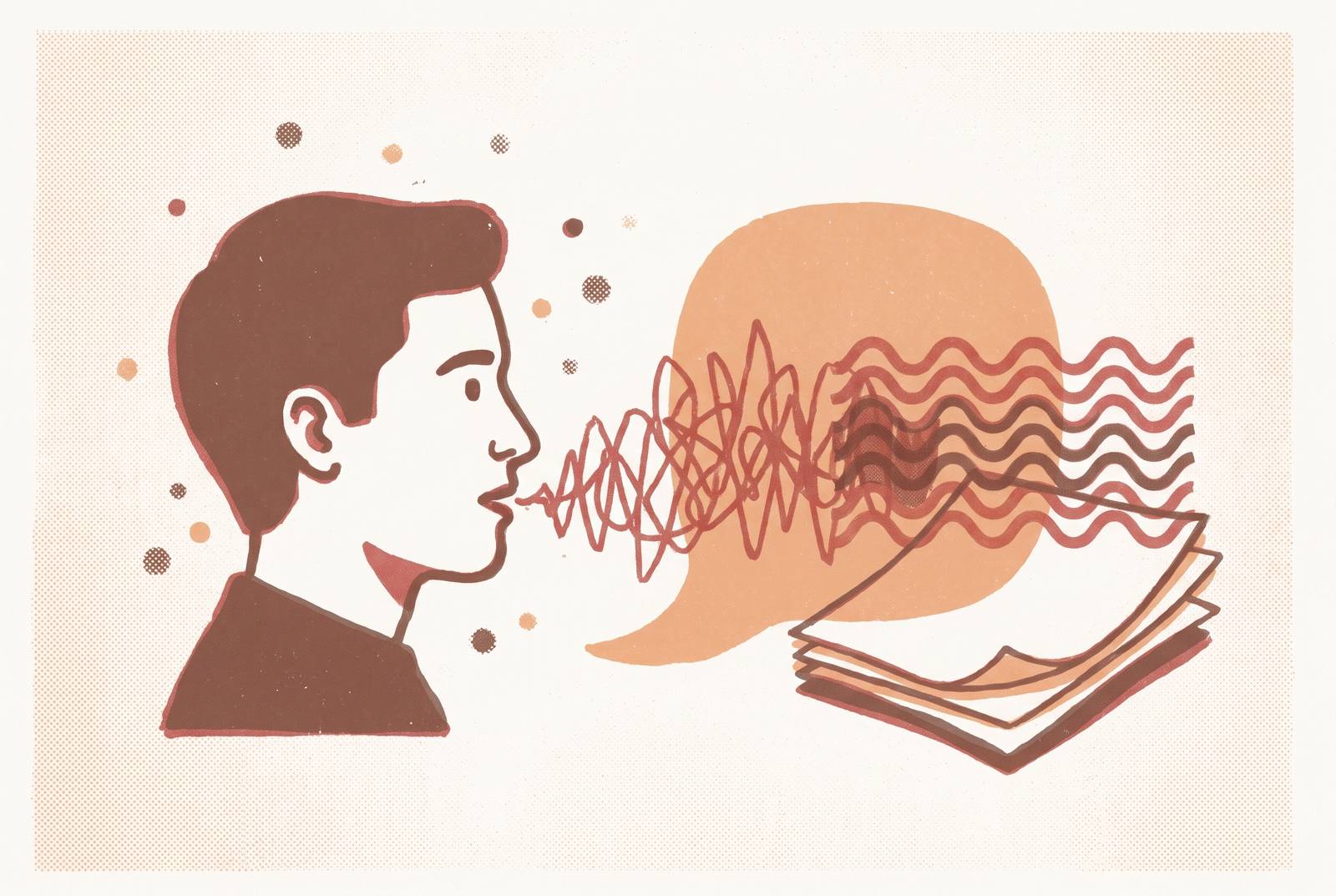
A voice journaling app for anxiety and overthinking without typing should do more than save speech. It should help name emotions, organize an experience into a story, and create distance from anxious thoughts.
Why a memo recorder is the wrong mental model for anxiety journaling
Someone has recorded anxious thoughts for weeks, kept the habit, and still feels caught in the same worry. Why has nothing shifted? The microphone made it easier to speak, but the app never helped change the relationship to what was said. A transcript and playback can preserve an experience without helping process it, even though those features make a recorder look like a journaling tool. The blank page has a voice equivalent, and speaking into a void can leave the same cognitive stall intact. Friction moved from the keyboard to the conversation that never happened.
The three cognitive mechanisms that separate processing from recording
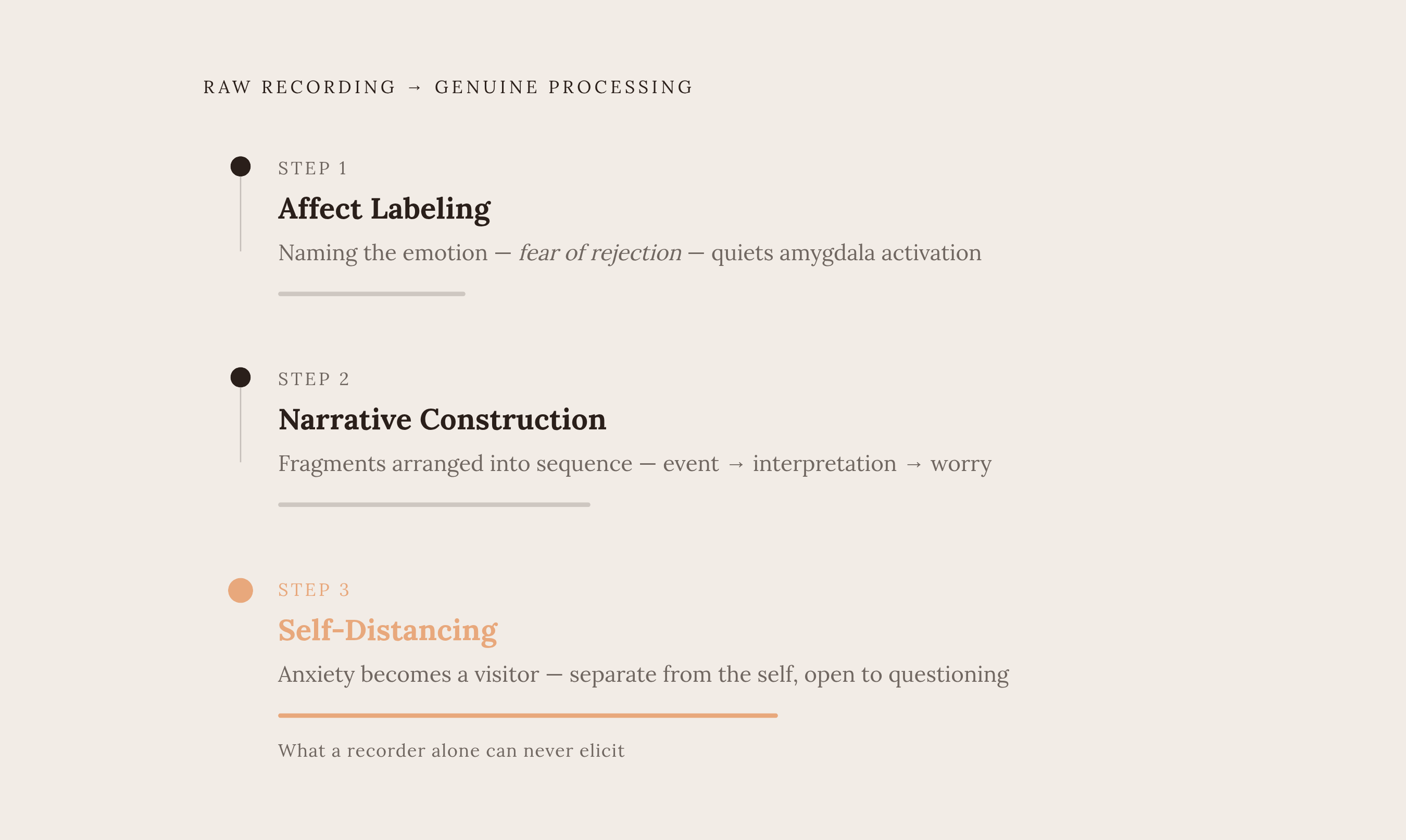
Affect labeling means naming the emotion. In practice, that can mean identifying fear of rejection instead of simply recounting an uncomfortable conversation. The distinction is small but consequential. An account of what someone said describes the event, while naming embarrassment or fear identifies the emotional response that needs attention. A useful prompt helps make that move.
Narrative construction means putting the pieces into an order that makes sense. An entry might move from a tense exchange, to the interpretation that followed, to the worry it created about tomorrow. Sequence gives the experience a shape. Instead of treating every thought as another alarm, the speaker can begin to distinguish what happened from what followed in their own thinking.
Self-distancing means watching anxiety as separate from who someone is. Describing anxiety as a visitor that tried to talk someone into staying home separates the symptom from who that person is. That change gives them room to question what anxiety tells them. An external prompt can help produce this shift reliably, whereas a recorder supplies no responding element. A person may make all three moves while recording alone, but the recorder itself does nothing to elicit them.
What the brain is actually doing when speech becomes journaling
Naming an emotion engages the right ventrolateral prefrontal cortex, a region associated with symbolic processing of emotional information and inhibitory control, and reduces amygdala activation. Naming is not merely describing the alarm. It changes how the emotional information is processed, which explains why an app’s question about a feeling can be more useful than a flawless transcript of its circumstances.
Pennebaker’s expressive writing work places narrative construction at the center of processing difficult experiences. Converting fragmented emotional memories into a coherent account shifts the task from reacting to reflecting, with the work replicated across more than two hundred trials since the 1980s. Rumination and journaling can look the same from the outside, because both may involve talking about the same worry again and again. The relevant distinction is whether the process helps organize and reconsider it.
But does the evidence from controlled studies give reason to expect relief from anxiety? O’Meara et al.’s 2026 meta-analysis in Anxiety Stress Coping found that single-session expressive writing had a negligible, nonsignificant effect on test anxiety. A 2026 study in Acta Psychologica likewise found no detectable incremental advantage from brief expressive writing over active neutral writing in the conditions examined. These findings limit the promise of expression alone. They support judging a tool by the work it invites.
Voice adds another possible source of information. Affective computing research shows that tone, pacing, hesitation, and small linguistic shifts contain mood information that pure text loses. But an app that accepts audio may or may not use those signals. The evidence supports a calibrated position, with modest and variable benefits from expressive work and journaling best treated as an adjunct to professional care.
How the two clinical frameworks map onto different anxiety problems
First, distinguish anxiety about something that happened from anxiety about something that might happen. The Pennebaker protocol suits work on past events, with the person writing over several days about deep emotional thoughts tied to an important experience. Effects have been reported to persist for weeks to months. Its purpose is to give an existing experience a coherent account, rather than repeatedly rehearse its most upsetting fragments.
Future-focused worry calls for a different kind of structure. CBT-style thought records, worry audits, and cognitive distortion spotting aim to catch and reframe distorted thinking before the loop deepens. Someone anticipating a feared event may therefore need help examining a prediction. Starting difficulty introduces a separate choice. Guidance helps when a person freezes at the outset, while an open-ended space can suit someone who needs to get a crowded stream of thoughts out before thinking them through becomes possible.
The voice-built versus voice-added distinction in practice
A voice-built app opens to recording and expects someone to speak, rather than giving them a microphone beside a text editor. A voice-added app still presents the blank page first. That difference changes the starting task. For someone who freezes when asked to write about anxiety, the option to use a microphone may make the task easier while leaving them stuck at the start. Voice-built design removes the text-first demand, although it still needs a useful response after the entry.
The second dividing line is response specificity. Generic sympathy followed by an invitation to continue may prolong the same account, whereas a question grounded in what was just said can redirect attention. AI presence alone is not the mechanism. MIT Media Lab’s 2025 study of Resonance had 55 participants and reported lower PHQ-8 depression scores in the group given suggestions that drew on memories and focused on things to do in the future, while the no-intervention control showed no improvement. The study concerned depression and did not compare specific suggestions with generic AI replies, so it supports interest in that design without establishing whether it relieves anxiety.
What apps let you talk out anxious thoughts instead of typing?
Trovera offers voice input, responding AI, and structured session modes on iOS and Android. Its conversation gives people a response to what they say, and its modes set limits on the session. That mix can help when both starting and stopping are hard. Its on-device processing also distinguishes where entries are handled, rather than merely how they are protected in transit or storage. The description establishes a credible option for guided voice journaling, but the first-session test remains whether its actual responses help name feelings, organize events, and create distance.
MindShift CBT offers a different route on iOS and Android, with a free toolkit and no subscription required. Thought records, daily check-ins, a fear ladder for graded exposure, relaxation tools, and export for a therapist make it relevant to future-focused anxiety. Its structure comes from the exercises. The supplied information does not establish its privacy architecture, which remains a separate criterion to examine.
Trovera’s voice-first conversation suits someone who wants to speak and get a response, while MindShift’s structured CBT exercises offer another route when the main task is to look at worried predictions. Neither description alone proves that a given session will break the cycle of rumination. That requires looking at the prompts and responses.
Privacy architecture as a clinical variable, not a marketing checkbox
Privacy affects what a person is willing to say. Entries about a depressive episode, relationship crisis, or panic attack can contain exceptionally sensitive information, and self-censorship can prevent the emotional precision that affect labeling requires. The practical evaluation has three parts. The first is encryption at rest, which concerns protection of stored entries. The second is processing location, including whether speech stays on the device or is sent to a server.
End-to-end encryption and on-device processing answer different questions. An encryption claim does not establish that entries never leave the device, while on-device processing describes keeping the work there. The third check is a separate commitment about whether entries are used to train AI models. None substitutes for the others. A person who feels obliged to edit out the central fear may end up with an impeccably stored account of everything except the problem.
Notification design can also undermine continued engagement. Too many daily alerts can turn a reflective practice into another demand, with over-notification associated with users disabling tracking entirely within weeks. Privacy is therefore not the only design choice that affects participation. A tool needs enough trust for honesty and enough restraint for the person to keep using it.
When voice journaling is the wrong tool and what to use instead
Speaking lowers the starting effort for people who think better aloud or find typing draining during anxious periods. Other people think things through better when they slow down and write. When screens themselves feel overstimulating, paper removes a stimulus that a voice app reintroduces. Choosing paper in that situation means choosing the conditions under which attention is easier to sustain.
Acute panic and acute dissociation call for a different kind of help. Grounding tools and professional crisis support are more appropriate than trying to turn the episode into a productive journal entry, and no journaling format replaces professional care. Outside those acute states, the medium is secondary to engagement. A deeply honest entry on paper and one in digital form likely help in much the same psychological ways. Voice earns its place when speaking makes that engagement possible for someone who otherwise stalls.
How to evaluate an app against the three mechanisms before committing to it
The first-session evaluation begins with affect labeling. After a spoken entry, does the app help identify an emotion through a feelings wheel, an emotion tag, or a question specific to the emotional content? A transcript alone does not pass that test. An inferred emotion can provide a starting point, but the useful feature is help identifying the feeling. For someone who freezes when trying to journal, that prompt can give the session its first clear task.
Next comes narrative construction. Does the app help arrange what was said into a beginning, a development, and an implication through a title, summary, or follow-up question? Asking what happened next or what an event means can help establish that sequence. Storage and playback do not supply it. A summary’s contribution to processing therefore depends on what it helps the speaker understand.
The self-distancing test asks whether the app ever moves the speaker into an observer’s position. A question about what they would tell a friend, or what they notice about how they described the experience, makes that move. An invitation to keep talking does not. The related rumination test takes longer, because it asks what happens when the same fear returns. Longitudinal memory can help surface a recurring pattern, but the useful response is the recognition and redirection.
For people who have tried journaling and quit, these tests shift attention from willpower to design. A voice-built app with a responding element is a plausible fit when the obstacle is starting and the need is guided conversation, which makes Trovera’s approach relevant to that reader. Its suitability still depends on what the conversation actually does. An app that fails all three mechanism tests gives people a way to record under the name of journaling, however smoothly its replies may read.