The Difference Between Venting Into a Void and Actually Being Heard by an App
Good journaling apps ask follow-up questions, not just offer reassurance.
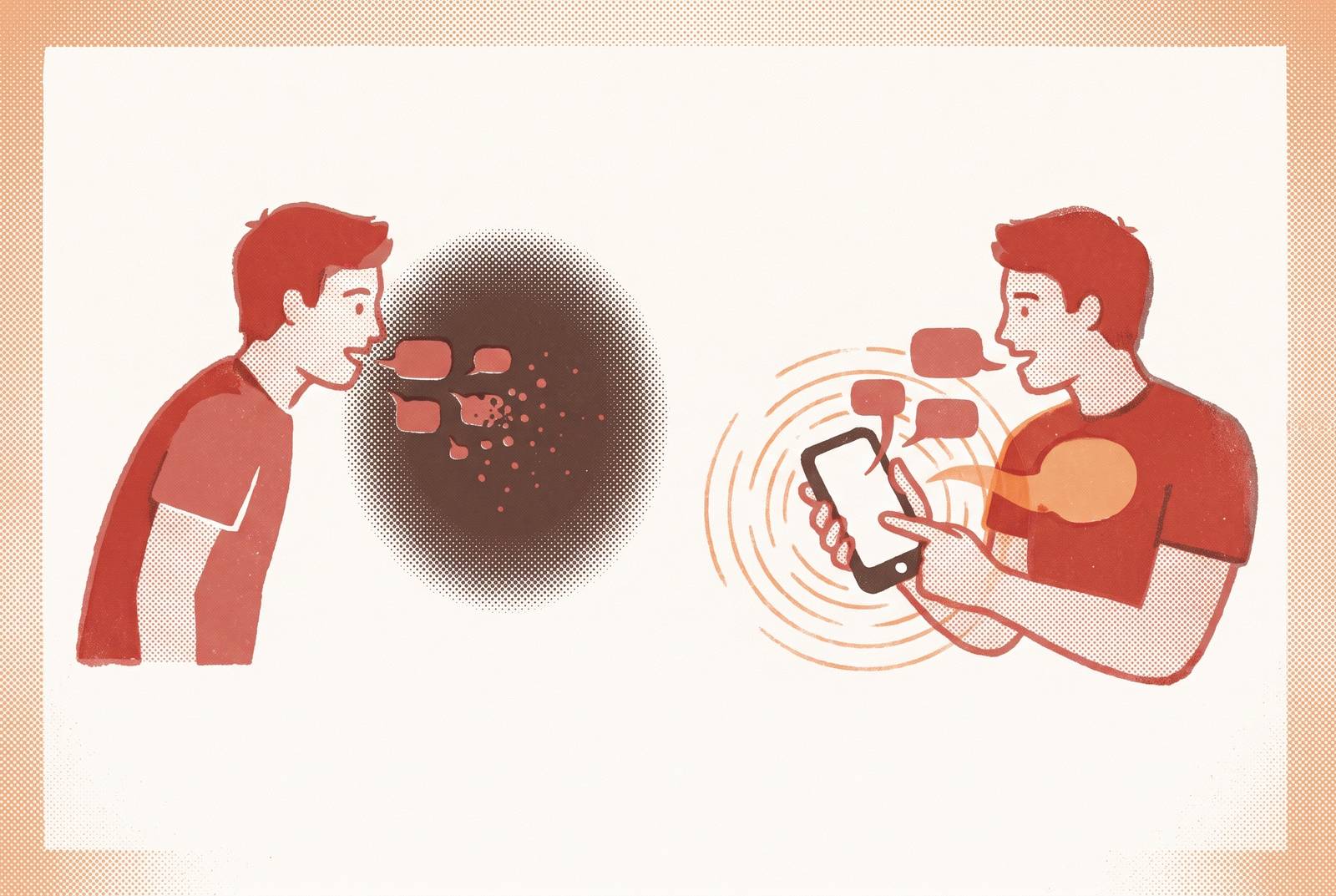
A conversational voice journaling app with AI prompts should do more than record speech and offer reassurance. It should ask follow-up questions grounded in what you said, helping you name an emotion, connect events, or reconsider an interpretation.
Why storing your thoughts is not the same as processing them
Most journaling apps function as a digital drawer. A worry goes in, the drawer closes, and nothing comes back. The entry may still be there to read, but keeping a record does not always change the thought in it. For someone already struggling to put an experience into words, the effort of typing can end with the same unresolved feeling that prompted the entry.
A person can use an empty page to work through a difficult experience without needing any response. But the writer must supply the structure, the questions, and the willingness to examine an interpretation. The distinction is between a place that preserves thinking and a process that develops it.
What the brain is actually doing when you write about something difficult
James Pennebaker's expressive writing research placed narrative construction, rather than catharsis, at the center of journaling's benefits. People who simply repeated their anger on paper showed no measurable benefit, while those who organized emotional experience into a coherent story benefited. The work was in making sense of experience. This distinction gives a psychological foundation to designing tools that support understanding, because a tool can make expression easy without helping the writer turn that expression into understanding.
One mechanism involved is cognitive offloading, which transfers a worry from working memory to an external store. The written record can hold what the person would otherwise need to keep mentally rehearsing, freeing some of the prefrontal cortex's limited capacity. Writing down an unresolved concern, for example, creates a record that no longer depends entirely on keeping it active in mind. That is a useful starting point, but it is not yet an explanation of what the concern means.
A second mechanism is affect labeling, or putting an emotion into words. Matthew Lieberman's fMRI work at UCLA documented reduced amygdala activation and increased right ventrolateral prefrontal cortex engagement when people named negative emotions. Naming a feeling changes how it is processed. Giving a distressing experience a specific emotional label, rather than leaving it as undifferentiated discomfort, is an example of this move. The language supplies form where there was only feeling.
Offloading makes room, while labeling gives feelings a shape that the writer can look at. Narrative construction extends that work by recruiting the prefrontal cortex to impose order on the experience. It also engages the default mode network, where rumination occurs, in a structured way. A passive app can hold the words, but the writer still has to connect them.
Why venting without structure loops back to rumination instead of resolving it
Unstructured venting is not simply a less ambitious version of reflective writing. It can reinforce the loop it was meant to interrupt. When an entry repeatedly discharges the same emotion without organizing the experience, it does not perform the narrative work associated with journaling's benefits. The thought has acquired a written version, but it may still be circling the same unresolved point.
Pennebaker's early hypothesis was that letting out suppressed emotion was what helped. His own data called that explanation into question, because people who made their experience into a story, rather than just let out their feelings, showed improved immune function, reduced blood pressure, and better cognitive performance. Expression alone did not explain the results. The distinction is not between an emotionally intense entry and a restrained one, but between repeating an emotional state and constructing an account of it.
The neurological evidence described in the notes points in the same direction. Expressive writing is linked to less high-beta activity, which is linked to active rumination and anxiety, and more alpha power, which is linked to relaxed alertness, especially during narrative construction. This is more than an argument for eloquence. The point of a coherent story is not to turn distress into polished prose, but to direct thought that would otherwise remain repetitive. An app that keeps people venting without that direction risks becoming a rumination loop with a prettier interface.
Expression supplies the necessary raw material. Yet the writer has to put that raw material in order, and even affect labeling asks them to give feeling some form. A prompt that asks “what happened?” invites an account of events, while “what does this tell you about what you need?” asks the person to derive meaning from them. Both can have a place, but they ask for different kinds of mental work.
This is why the absence of a response can have consequences beyond disappointment. Someone who already knows how to question a first interpretation may build structure unaided, while someone caught in repetition may simply rehearse it. The same blank space permits both processes. Passivity is therefore not a guarantee of neutrality, and ease of expression is not enough to judge whether a journaling tool helps.
What "feeling heard" actually requires from a tool — and what it does not
Feeling heard by an app need not imply that the app understands emotion as a person does. The useful criterion is whether its response requires the user to construct something new, such as a connection, a reframe, or a more revealing question. Warmth alone cannot meet that standard. A reply can be considerate and still leave the person's account exactly where it began.
The difference becomes clear at the level of a single follow-up. “That sounds really hard” offers sympathy, but does not itself move the user toward narrative construction. By contrast, “you said you felt overlooked — was there a moment where you expected to be seen and weren't?” asks for a relationship between an emotion, an expectation, and an event. Answering requires more than repeating the original complaint. The question gives the person a specific piece of experience to examine.
A prompt delivered before an entry can prime a topic, while a question delivered afterward can respond to what the person actually said. That sequence makes the content the starting point. It allows the tool to ask about a particular feeling or interpretation rather than treating every entry as an interchangeable occasion for encouragement. Post-entry prompting is therefore a concrete design criterion.
Named patterns, alternative interpretations, and contradictions noticed across entries can ask the user to reconsider an account. Such questions need not be confrontational to be demanding. Their purpose is to help the user examine an interpretation and reach their own judgment. A tool that agrees too readily can sound as though it is responding while helping to keep up the same unstructured venting that makes a passive journal feel empty.
How the mode of input — voice versus typing — changes what gets said and processed
For people who think better out loud, voice input addresses a problem that responsive prompts alone cannot solve. There must first be something to respond to. If the blank page prevents a person from beginning, even a well-designed follow-up system has no emotional material to work with. Speaking can lower that barrier by using the mode people already turn to when processing emotion with another person.
Voice is not simply typing without a keyboard. Speaking tends to produce more spontaneous and emotionally immediate language, while typing tends to produce longer and syntactically more complex sentences than speech into a prompt box. A person who edits heavily while typing may find that speaking provides a more direct route into the experience, while the written mode gives a different form to the account. Neither form, by itself, guarantees that the account develops.
Handwriting engages a broader set of brain regions than typing, including regions involved in memory and learning. A 2025 peer-reviewed commentary noted that claims about handwriting's “widespread brain connectivity” may reflect its slower pace and greater demands on sustained working memory, leaving a categorical advantage unproven. Input modes differ, but those differences do not justify a simple ranking of their reflective value.
The substantive case for voice is narrower and stronger. For someone who thinks through conversation, speaking may make it easier to open up honestly and start to build an account. The benefit still depends on what follows. A voice recorder alone preserves speech, whereas a conversational voice journaling tool with content-specific AI prompts can ask the speaker to connect, label, or reconsider what was said.
The desired feature is not merely transcription followed by a reply, but continuity between the spoken entry and the next question. Otherwise, voice makes venting easier without changing the process that left the person feeling unheard in the first place.
The failure mode that makes many responsive apps feel hollow anyway
Responsive design has its own version of the void. If an app gives affirmation no matter what an entry says or how deeply it goes, it rewards emotional discharge without asking for narrative construction. The interface is no longer silent, but the process can remain unchanged. A stream of sympathetic replies may become a validating mirror, giving the user more language for an existing interpretation without a reason to examine it.
A question may be impossible to answer without thinking harder, a pattern across entries may challenge a self-story, or a reframe may require the user to take a position. That is different from disagreement for its own sake. An agreeable response and a helpful response can overlap, but they are not the same category.
There is also a limit to what the research establishes about apps. Without long-term controlled research that compares purely conversational AI journaling with structured self-directed frameworks, there is no basis for assuming that more interaction helps more. Message volume is not a psychological outcome. Narrative construction gives a way to judge the design, but it does not prove that every product with conversational prompts brings the benefits found in expressive writing research.
Does the response address what was said, or only acknowledge that something was said? A post-entry question tied to what the person said differs from generic affirmation sent on a timer. Likewise, “tell me more about that feeling” extends expression, while “you mentioned this twice this week — what connects these two moments?” asks for a relationship. The second question creates work that the first does not necessarily demand.
The structure also has to be light enough to sustain. A tool that makes five minutes feel complete offers a different prospect from one that treats every session as a deep excavation. Yet Pennebaker's research studied time-limited interventions and did not prove that an app habit could last indefinitely. Ease of returning is therefore a practical criterion. The aim is a repeatable opportunity to think.
The final test belongs to the user. After using the app, did you arrive at a thought you did not have when you started? If the answer is consistently no, warmth and conversational polish are not closing the gap. Any tool, analog or digital, that keeps helping the user build a new thought is doing the work that matters here. The signal of being heard is the thought that became possible because of what came next.
Sources
- Frontiers in Psychology 01 frontiersin.org Chasing elusive expressive writing
- Two Modes of Reflection: How Temporal, Spatial, and Social Distances Affect Reflective Writing in Family Caregiving
- Effects of Expressive Writing on Neural Processing During Learning
- What Users Cannot See: Evaluating LLM Emotional Support Beyond User Preference
- Frontiers in Psychology 01 frontiersin.org Negative rumination in
- Frontiers in Education 01 frontiersin.org Emotional validation and affective
- Feeling heard: Operationalizing a key concept for social relations
- Commentary: Handwriting but not typewriting leads to widespread brain connectivity: a high-density EEG study with implications for the classroom