Notification Design and Anxiety Habituation
Frequent notifications harm focus more than total screen time, and design can fix it.
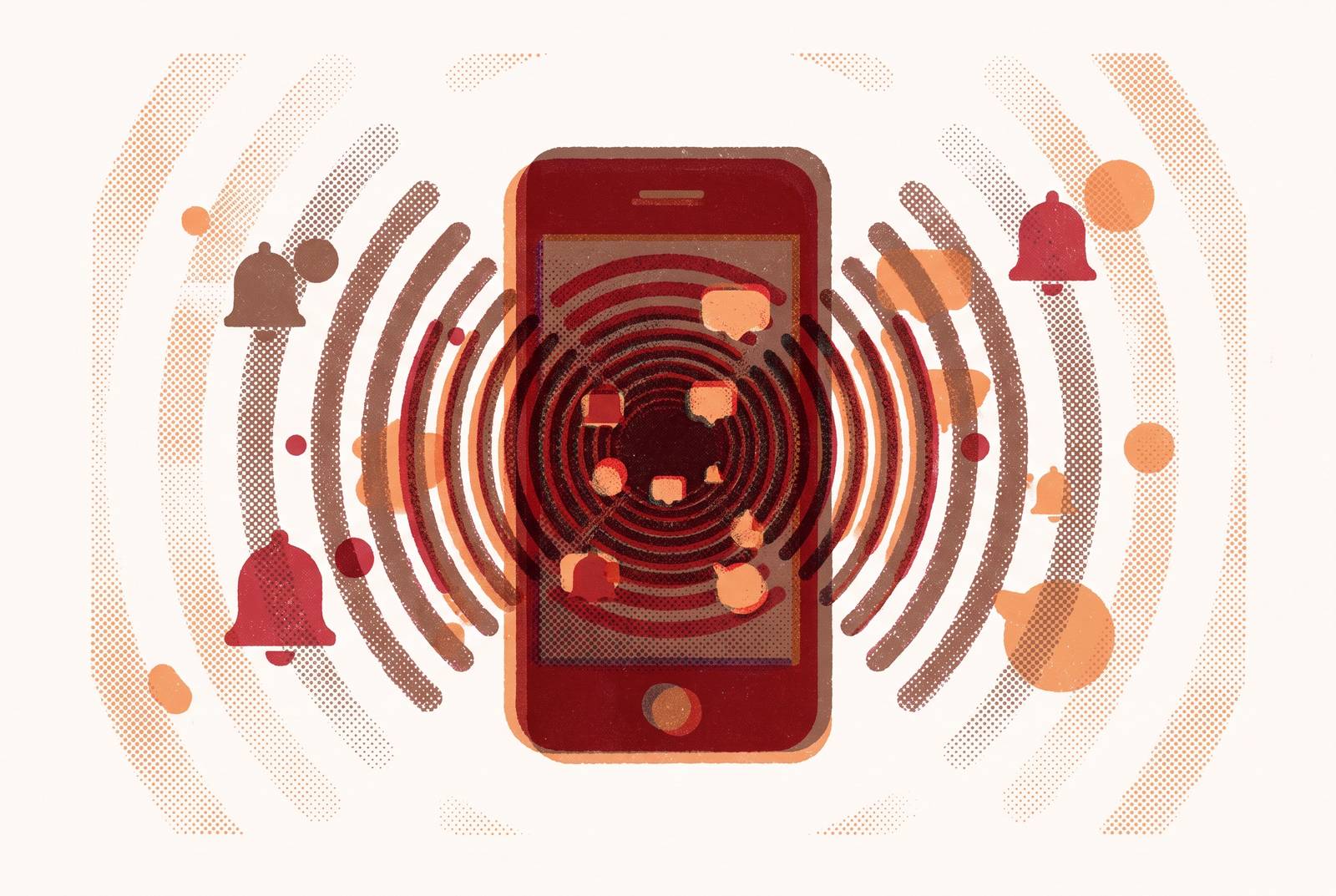
The advice to cut screen time treats the wrong variable. What actually predicts cognitive disruption is how often a phone interrupts a person, not how long that person spends looking at it, and research published in Computers in Human Behavior backs this up directly: notification volume and check frequency predicted attentional disruption more strongly than total daily screen time did. That single finding reorders the whole conversation about phones and focus, and it's the thesis this piece builds from.
Notification volume, not screen time, is the right measure of cognitive harm
Most people who want to use their phone less start by watching the clock. Screen-time trackers, built into every major operating system, treat minutes as the enemy, as if two hours of focused reading did the same cognitive damage as two hours fractured across sixty interruptions. The Computers in Human Behavior research suggests otherwise: check frequency and notification volume out-predicted total screen time as drivers of attentional disruption. A single notification cost participants roughly seven seconds of slowed cognitive processing, and that number looks trivial until you multiply it across the dozens of alerts a typical phone delivers in a day. None of those three mechanisms has anything to do with how many hours a screen stays lit. Interruption itself works against attention, which makes the problem structural. The fix has to target the interruption, not the clock.
Variable-ratio reinforcement turns the notification system into a conditioning engine
Notification systems don't become addictive by accident. They reproduce, with uncanny fidelity, the exact reinforcement structure a behavioral psychologist identified as the most powerful behavioral conditioning tool available: the variable-ratio schedule. A phone buzzing in a pocket works the same way. Any given alert might carry something that matters (a message from someone important, a deadline, a piece of news) or nothing at all (a promotional push, an app re-engagement ping), and the brain can't tell which before checking. That ambiguity is the entire mechanism. A person who feels a jolt of nervous energy every time their phone buzzes isn't malfunctioning or weak-willed. Their nervous system is responding as a variable-ratio schedule trains it to respond, and the unpredictability built into notification timing and content keeps the checking impulse alive even without any external buzz.
Habituation turns high-volume alert strategies against the senders who rely on them
The same brain that gets conditioned by unpredictable rewards also builds a defense against oversaturation, and that defense eventually wrecks the whole channel. Habituation is one of the oldest, most reliable findings in behavioral psychology. When a stimulus repeats without meaningful consequence, the brain learns to suppress its response to it, an adaptive shortcut that keeps a nervous system from wasting energy reacting to something harmless and constant. Applied to notifications, the pattern runs in a predictable loop: a low-value alert arrives, gets dismissed without action, a similar one follows, gets dismissed a little faster, and over time the dismissal becomes automatic across the entire notification stream, urgent alerts included. That's not a hypothetical risk confined to consumer apps. Clinicians, trained specifically to take alerts seriously, still learn to tune them out when too many fire for too little reason. Which raises an uncomfortable question for any sender relying on volume to stay visible: what happens when engagement drops because of habituation, and the instinctive response is to send more? More alerts accelerate the habituation that caused the drop in the first place, and the channel collapses faster than if nothing had been sent. Senders and users end up on the same side of this problem, whether they realize it or not.
The anxiety pathway that runs through the badge counter, not the content underneath it
Something separate from conditioning and habituation is happening with the small red number sitting on an app icon. The badge counter generates anxiety independent of whatever any individual notification actually says, because it functions as a visible marker of social debt, a reminder that something, somewhere, awaits a response. When people sense that a relationship or a responsibility is at risk because they haven't replied, their anxiety climbs, and the unread count becomes the symbol of that outstanding duty. This is a distinct pathway from the interruption anxiety covered above. A person can silence every sound, disable every pop-up, and still feel pulled toward the badge. Muting a phone doesn't fully resolve the anxious response. Guilt for being unreachable, checking phones at inconvenient or even inappropriate moments just to clear a number, and a low hum of unease at an unread count that's crept into the double digits are the behavioral evidence for this. The Computers in Human Behavior research adds a layer here: within personal (as opposed to generic or promotional) notifications, the relevance a participant assigned to an alert, essentially its social weight, significantly changed the magnitude of disruption it caused. Relational meaning doesn't just color how an alert feels. It amplifies the disruption on its own, independent of volume or timing.
Turning notifications off entirely produces its own anxiety rather than relief
The obvious fix, if volume and unpredictability are the problem, looks like silence. Turning everything off should break the conditioning loop, but the evidence shows the failure is specific. A controlled field trial tested several notification regimes against each other, and it found that batching alerts into three fixed check-in windows a day reduced stress and improved well-being. Switching off notifications entirely did the opposite: it produced more anxiety and a stronger fear of missing out, not less. That's a strange result if the theory is simply "fewer interruptions equal less stress," and it only makes sense once the badge-counter anxiety from the previous section gets factored back in. Removing all notifications doesn't remove the underlying sense of social obligation; it strips away the information a person would need to know whether that obligation has actually gone unmet, and the mind fills the gap with worry instead of certainty. Without an external buzz to respond to, users generated their own internal one, checking out of habit and anxiety rather than in response to any actual signal, which is what a conditioned habit loop would be expected to do once its trigger gets removed. And the picture gets more complicated once individual disposition enters the equation: the published field experiment behind this finding concluded that turning off notifications works best for people who score low on fear of missing out and medium to high on telepressure, the internal urge and preoccupation with responding quickly to messages. A blanket "turn it all off" recommendation simply doesn't fit everyone who might try it.
Notification design that treats attention as a resource rather than a target
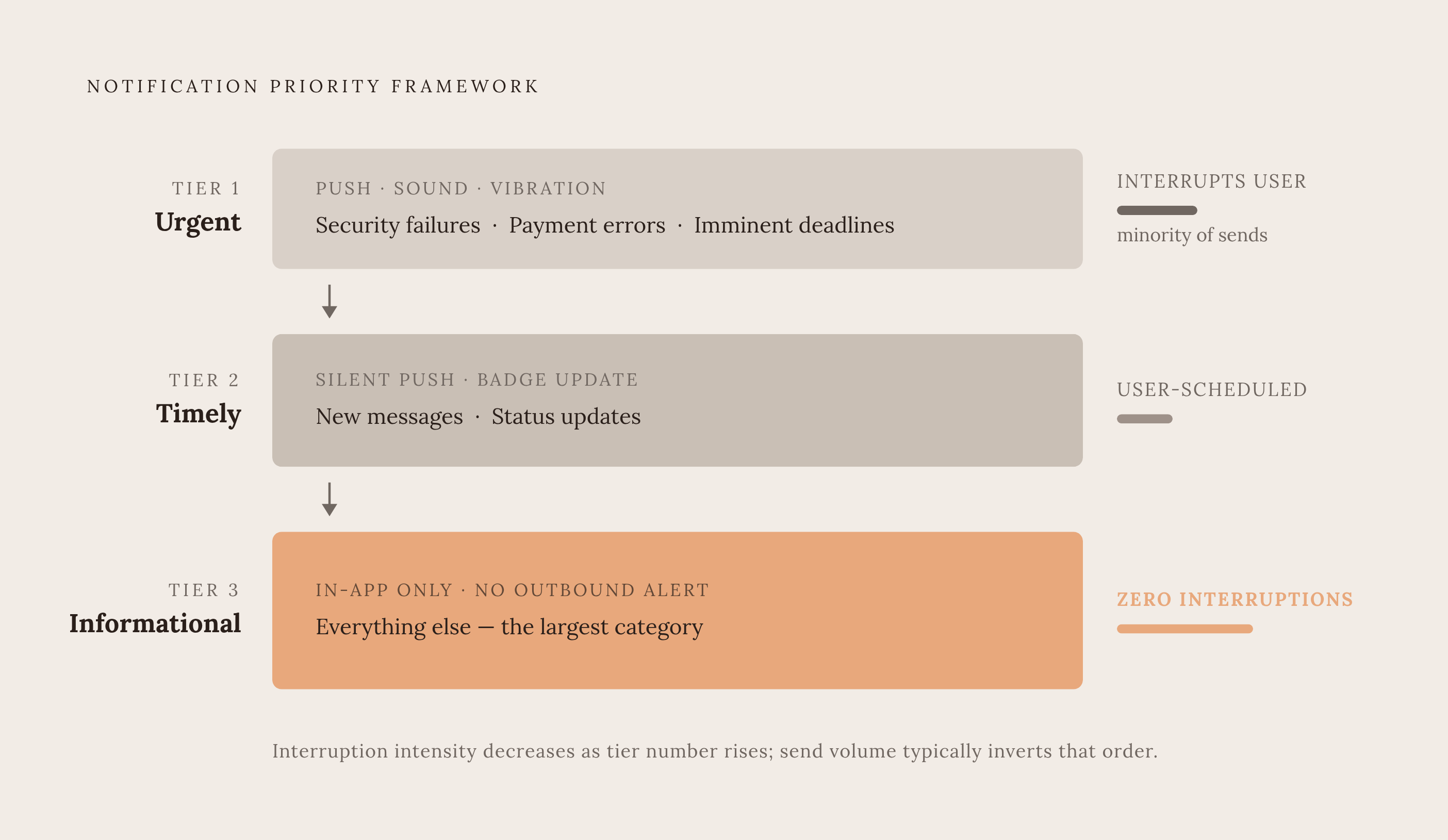
If silence doesn't work and raw volume causes measurable harm, the design question is how to match the intensity of an interruption to how urgent it actually is. A useful framework sorts alerts into three tiers. Alerts demanding immediate action (security failures, payment errors, a deadline closing in minutes) warrant a push notification with sound and vibration, and should make up a small minority of everything a system sends. Alerts that are timely but not urgent (a new message, a status update) warrant a silent push or a badge update the user discovers on their own schedule. Everything else, purely informational content, belongs inside the app, waiting for the user to open it. Real products already build around this logic. Slack lets users set notification levels per channel, schedule do-not-disturb windows, and defaults its global notification setting to direct messages and mentions only, while flashing a warning when someone is about to @channel a large group, treating a person's attention as a resource the product spends on their behalf. Two or three buttons turn what should be a half-second decision into a mini negotiation, adding cognitive load at the exact moment a person is least equipped to handle it. The moment of asking for permission matters just as much as the notification itself. Control isn't a feature bolted onto a notification system. It changes the subjective experience of the exact same ping.
The objection that relevance and control matter more than volume (and why both are true)
A fair challenge to everything above says the real driver of opt-outs and disengagement is notification fatigue born of irrelevance, not raw count, and that machine-learning targeting which surfaces only high-relevance alerts could solve the problem without touching send frequency. Notification harm is worse when alerts are impersonal or carry a negative tone, and personal, welcome, well-timed alerts cause real but smaller disruption than generic ones. That's a genuine limit on how far the volume argument can be pushed on its own. But relevance and control operate on the same underlying architecture that volume reduction addresses, which makes the two approaches complementary rather than rivals fighting over the same explanation. Even a flawlessly relevant notification arriving at a badly chosen moment still costs attention you can't immediately recover, because the interrupt itself has a price, whether or not its content turns out to matter. Where the two camps actually converge is predictability. Whether it comes from smarter targeting that trims the noise or from an explicit batching schedule that tells a user exactly when to expect alerts, what reduces anxiety is the ability to form accurate expectations about when something will arrive and what it's likely to contain. Relevance makes a notification system smarter. Predictability is what makes it bearable.
What the evidence on blocking internet access adds to the notification design argument
A study published in PNAS Nexus pushes the whole conversation one level deeper than notification design can reach on its own. Researchers found that blocking mobile internet access outright, not simply managing notifications, improved mental health, subjective well-being, and objectively measured sustained attention, with 91 percent of participants improving on at least one of those outcomes. This intervention works at the platform level, on the connection itself rather than on how any individual app chooses to deliver its alerts, and it suggests the conditioning loop described earlier in this piece runs deeper than alert design alone can interrupt. None of that undoes the case for better notification architecture. Reducing alert volume remains more cognitively protective than managing screen time, for all the reasons the earlier sections lay out. But it's a strong intervention within a system that may need structural limits beyond what any single app can offer on its own, not a complete fix in isolation. You should hold onto this as the honest edge of what thoughtful design can accomplish, and the honest place to stop before this argument oversells itself.
Regular journaling as a counter-mechanism to the cognitive residue notifications leave behind
Even a system with ideal urgency tiers, generous permission flows, and three-times-daily batching leaves something behind: the scattered, half-finished thoughts an interruption generates before it fades. That residue persists in silence, long after the alerts themselves have stopped. Journaling works against exactly this kind of leftover mental clutter, not by fixing the notification system but by restoring the internal coherence that fragmented attention erodes. The mechanism is cognitive offloading: writing down a worry or an unfinished thought frees working memory from the job of holding onto it, which lightens the background load that makes recovery after an interruption so slow. A second mechanism, affect labeling, the act of naming and structuring an emotion in words, reduces activation in the amygdala, the same region variable-ratio conditioning keeps on alert through unpredictable notification timing. A third, narrative construction, organizing anxious or scattered thoughts into something with a beginning and an end, lowers how threatening those thoughts feel, functioning as an internal version of the same predictability that well-designed notifications provide externally.
None of that works if the practice itself carries too much friction. A blank page demanding the same sustained, structured effort as a notification system demands attention is a cost that someone already depleted by a day of interruptions is unlikely to pay, and a voice-first, conversational tool is built to close that gap. Just as a single notification fragments focus by interrupting attention at unpredictable intervals, the decision to journal depends less on available time than on friction at the entry point. A voice journaling app like Joice removes that friction: you can speak a thought the moment it surfaces, without the setup cost of staring down an empty page, so the practice stays alive even on days when cognitive bandwidth is already spent.
Traditional journaling fails for the same reason notifications misfire: an unpredictable reward structure. The unpredictable reward structure that makes notifications so compulsive has a mirror image in the blank page: no prompt, no structure, no guaranteed payoff for showing up, so the impulse to start simply never fires.
And just as habituation teaches the brain to dismiss low-value alerts alongside the ones that actually matter, a journaling habit collapses once the format itself becomes a chore to open. Speaking is closer to how a thought first takes shape than writing is, which lowers the barrier enough that the habit can survive a day that was mostly interruptions. A tool built around that difference answers a separate question: what happens to a mind after the alerts stop, and what, if anything, puts the pieces back together.
Sources
- Attention hijacked: How social media notifications disrupt cognitive processing - ScienceDirect
- Blocking mobile internet on smartphones improves sustained attention, mental health, and subjective well-being
- Clinical reminder alert fatigue in healthcare: a systematic literature review protocol using qualitative evidence
- Investigating the Effects of a Notification-Disabling ...
- Non-urgent Messages Do Not Jump into My Headset Suddenly! Adaptive Notification Design in Mixed Reality
- What Do Patient‐Control Studies of Habituation in Anxiety and Stress Disorders Reveal? - Cancino - 2026 - Psychophysiology - Wiley Online Library