Why a Blank Journal Page Is the Worst Thing You Can Hand an Anxious Brain
Structure, not willpower, is what gets anxious writers started.
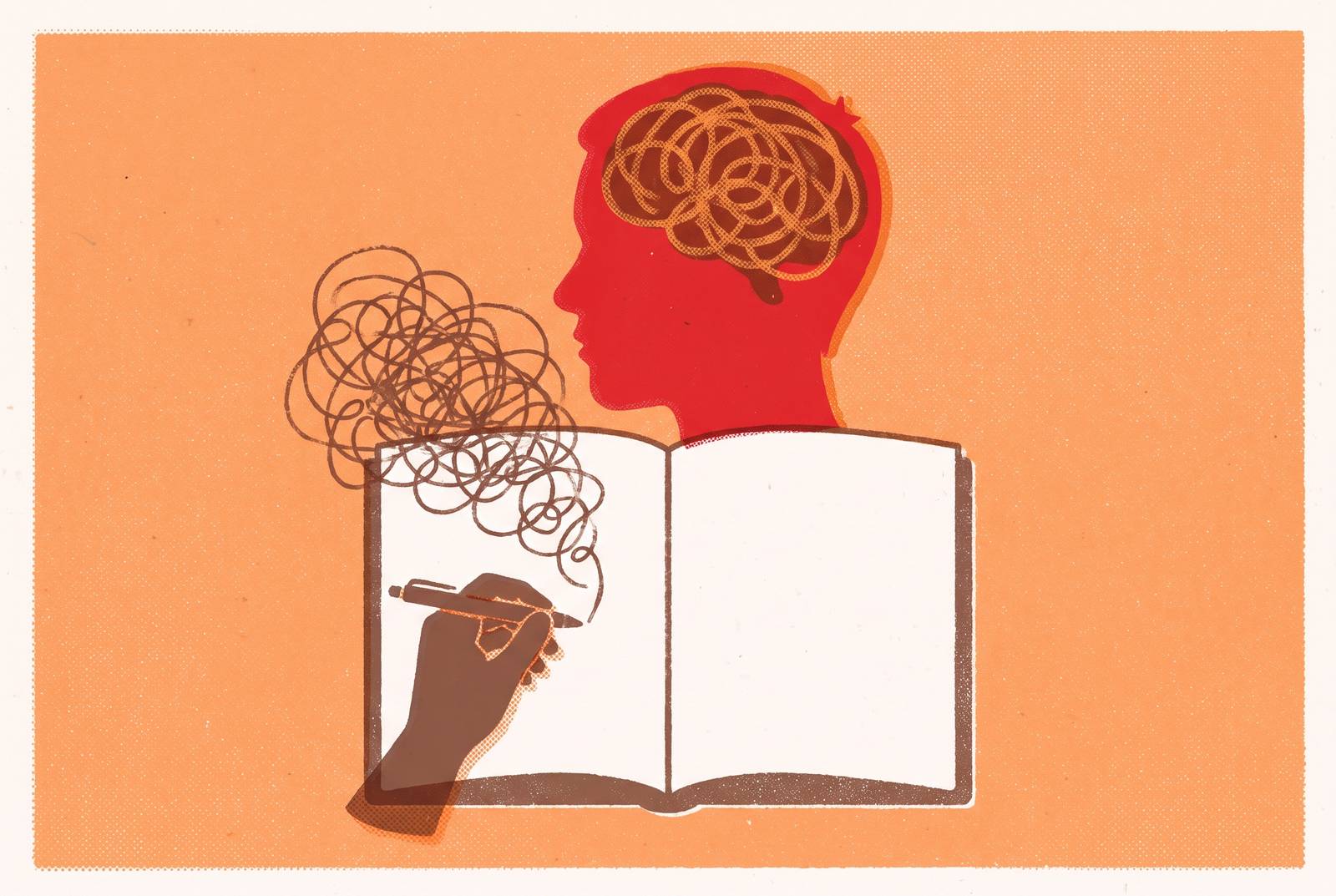
The decisions demanded by a blank journal page can overwhelm an anxious brain before reflective writing begins. A prompt, a defined exercise, or a tool that removes the question of where to begin offers a better starting point.
Why an empty page feels dangerous to an anxious brain
Journaling is often prescribed for anxiety, yet sitting down to do it can make anxiety worse. The apparent freedom of an empty page brings a sudden burden of choice. What belongs here, how should it sound, and what would count as a useful entry? For someone already worried about getting things wrong, those questions can feel less like an invitation than an examination. The page has become a test without instructions.
The threat is often evaluation. Perfectionism asks for the right beginning, while fear of negative judgment makes even a private entry feel exposed to scrutiny. Cheng et al. (2026) found that somatic anxiety, the physical side of writing anxiety, was especially harmful to writing performance and used up working memory needed for the task. A person can have plenty to say and still have too little room left in their mind to decide how to say it.
This distinction changes how the freeze should be understood. It is not necessarily creative block in the artistic sense, and it does not establish that journaling is unsuitable for the person attempting it. The format itself adds work. An empty page asks the writer to invent both the content and the method while managing the anxiety that made writing seem necessary in the first place.
What the brain is actually doing when it freezes at the page
Writing depends on working memory, which keeps information at hand while a person uses it. Anxiety competes for that same limited resource. The Flower–Hayes model describes writing as a “busy switchboard operator” juggling planning, translating ideas into language, and reviewing. Yoshida et al. build on this account by looking at problems in those processes and how they affect the way people write. The block can therefore begin before a sentence takes shape, or emerge while the writer evaluates one already written.
Stress also changes the conditions under which that work happens. Amygdala activity associated with threat can accompany a fight-or-flight state, while stress can suppress prefrontal cortex activity and impair the thinking needed to organize language. This is a way to understand why self-consciousness and alarm can make a familiar task suddenly difficult, without assuming that every stalled journal entry has an identical neural cause.
Cognitive Load Theory separates the demands into intrinsic load, the complexity of what is being expressed, germane load, the effort of constructing meaning, and extraneous load, friction imposed by the format or environment. A difficult feeling may already bring a great deal of intrinsic load. An unstructured page then adds decisions about topic, sequence, depth, and stopping point.
If writing creates all this work, why can it also help? UCLA neuroscience research documents affect labeling, in which naming feelings dampens amygdala activity and engages the prefrontal cortex. Putting a feeling into words can therefore do more than produce a satisfying metaphor for relief. But naming is different from endlessly rehearsing a worry. Unstructured venting can become rumination when anxious thoughts cycle without resolution, so more words do not automatically mean more benefit.
The useful distinction is between expression with a shape and expression without one. Cheng and colleagues found that metacognitive strategies, including planning, monitoring, and evaluating, had the strongest mediating role in the relationship between anxiety and performance. A prompt supplies part of that scaffold in advance. Does that mean it tells the writer what to think? No, because it narrows the entry point rather than prescribing the destination, leaving more capacity for exploring whatever emerges.
Techniques matched to what the anxious brain actually needs
Different structures help with different problems, so no one journaling method is best for everyone. Free-floating worry needs a boundary, while a specific negative thought may need a closer look. Working through a past event is a different task again. The exercise should match the work required, rather than be chosen on the assumption that the most emotionally intense entry is the most useful one.
For generalized worry, Scheduled Worry Time, also called a Worry Window, supplies a defined container and an endpoint. Thomas Borkovec’s research showed that structured worry time led to a significant drop in how often people with generalized anxiety worried. The NHS self-help guide for generalized anxiety also includes worry postponement as a recommended tool. The session can end without the writer having to turn every worry into a well-formed insight.
For a specific negative thought, CBT Thought Records offer a different kind of structure. Aaron Beck’s cognitive therapy framework underpins the process of identifying, examining, and reframing that thought. These records are among the most clinically validated forms of guided journaling. Their unit of work is one thought.
For anxiety that arrives as a spiral, the CATCH Method combines several kinds of support in a daily practice. Its steps are Capture, Appoint, Think, Challenge, and Harvest. The method integrates CBT worry postponement, thought records, and expressive writing to move from repetition toward structured problem-solving. The sequence provides a route through the task. It is aimed at a different difficulty from simply having nothing to write about.
For the writer who thinks better through movement than stillness, Morning Pages make the activity itself the guide. The constraints are three pages, longhand, first thing, without stopping. Here, the scaffold is not a set of questions but a fixed procedure that pushes beyond surface-level thinking. The writer need not keep redesigning the session.
The matching principle also extends beyond these methods. Expressive writing fits processing past events, cognitive restructuring fits specific intrusive thoughts, and gratitude practices address negativity bias. Emotional depth is not a competition. If deep emotional writing increases anxiety, a CBT-structured format focused on thoughts can be a better fit.
What app helps when anxiety makes a blank journal page impossible?
Grid Diary on iOS helps with the first choice in journaling by giving the writer a grid of daily structured questions in place of an open field. Its question library gives the writer a place to start before choosing what to write about becomes another task. This suits the “what should be written about?” freeze.
Apple Journal takes a more contextual approach. The free iOS app integrates with the iPhone and iPad ecosystems and surfaces photos, locations, and workouts as journaling prompts. The starting point comes from available context. Compared with a question grid, this reduces the need to retrieve an event worth writing about.
The Most Dangerous Writing App addresses a later obstacle, when reviewing interrupts drafting. It deletes text if typing stops for more than a few seconds, while Hardcore Mode also blurs the text and disables backspace. This is constraint with its teeth showing. The design targets writers who freeze because they edit as they go. Its pressure-based approach is plainly different from the gentler invitation of a prompt.
Cold Turkey Writer keeps the writer from leaving the task to do something else. It blocks the entire computer, including the browser, media players, and other apps, until a word count or time goal is met. The boundary sits around the writing session. Where a prompt answers what to write, this tool removes alternatives to writing, making it relevant to a different source of friction.
iA Writer narrows attention within the text through a Focus Mode that dims everything except the current sentence or paragraph, according to the user’s choice. It runs on Mac, Windows, and iOS, while Android support was discontinued in September 2024. There is no subscription. Its authorship tracking also highlights AI-generated text in a colorful gradient for writers concerned with keeping their own voice primary. This is an attention and authorship tool rather than a supplied journaling framework, a distinction that prevents a minimal interface from being mistaken for guidance.
Hardware that removes digital distraction from the writing environment
For writers whose anxiety rises in a browser-enabled environment, dedicated hardware moves the boundary out of software and into the object itself. The Freewrite Smart Typewriter lets people draft without a browser, notifications, or apps beyond writing. Its design makes the device single-purpose. The Freewrite Traveler pursues the same distraction-free drafting goal in a portable form for people who travel or write on the go.
The reMarkable 2 serves handwriters and annotators through a paper-like screen without a browser or social media. That makes it a different proposition from a dedicated keyboard. Its slower handwriting format may suit a practice that benefits from the deeper processing associated with writing by hand, although that association does not establish a guaranteed anxiety benefit from the device. The AlphaSmart Neo2, which can be bought used, is a cheaper way to type without distractions than modern hardware built for that purpose.
These devices change the writing environment. A writing-only machine can remove the need to resist digital distraction, but it does not itself supply the thought record or question a person needs.
Why the journaling habit fails even when the technique is right
People can give up even a method that suits them when they take a hard start as a sign that it has failed. The first entries may feel awkward, ordinary, or painful to write and offer no new insight. That mismatch can be discouraging for someone who began journaling specifically to feel better. But immediate relief and longer-term benefit are different measures. Judging the practice only by how a session feels can obscure what it is doing over time.
Pennebaker’s expressive writing research shows that it can help people feel less stress, have a better mood, and improve working memory, with these benefits building over weeks. It also reveals an awkward paradox. People can feel worse immediately after expressive writing while showing improvement in the days and weeks that follow. A profound entry on day three is therefore a poor test of whether the practice is useful, and early discomfort alone does not establish that it has failed.
That does not mean every unpleasant session deserves repetition. Emotional processing still differs from rumination, and a CBT format that focuses on a thought is still an option when deep emotional writing makes anxiety worse. Persistence and adaptation are not opposites.
Automaticity takes longer still, somewhere between two and five months for most people. Before then, starting can still take a conscious choice, and skipping it may not feel uncomfortable. Early friction is therefore not surprising. Knowing the timescale changes the interpretation of that effort, even if it does not remove the effort itself.
Cheng and colleagues found that writing self-efficacy predicted whether people would later use strategies, which in turn predicted less writing anxiety. That sequence gives short, completed entries a role beyond their content, because finishing helps build the belief that writing is manageable. The blank page was never the required starting point.