Digital Journaling Versus Paper for Emotional Processing
Handwriting activates more brain regions than typing, but only if you actually use it.
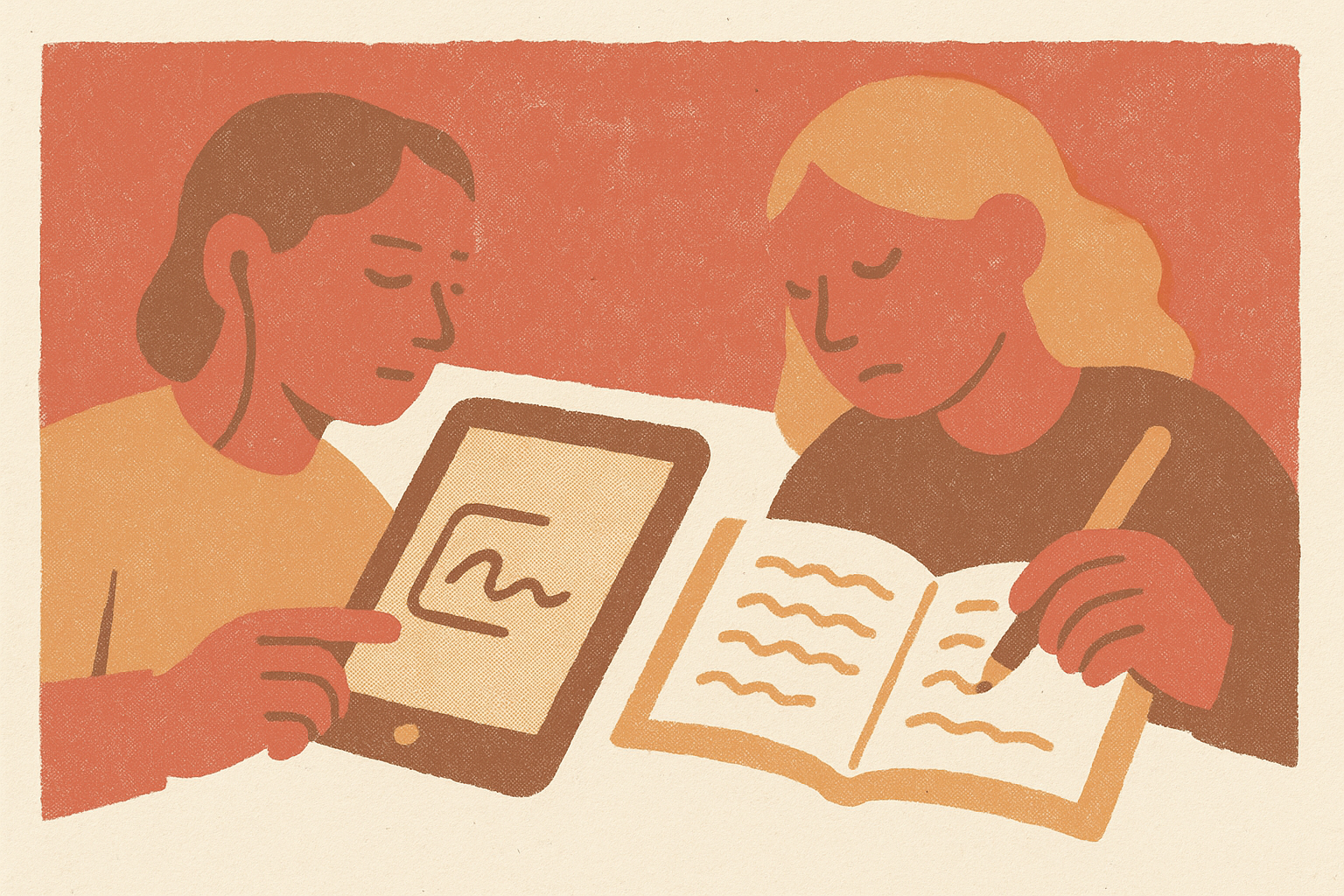
Whether someone journals on paper or on a screen is not a question of taste, like picking a coffee order. The neuroscience suggests it changes how your brain actually processes a hard day, a breakup, or a recurring fear while you write. That expressive writing helps, in some general sense, is not in dispute; decades of research on reflective writing back that up regardless of what tool produced it. What stays open, and what this piece spends its time on, is whether the medium changes the depth or quality of that processing, and what that means for anyone trying to build a habit that survives a Tuesday night when nobody feels like writing anything. No winner gets crowned here. Instead, the evidence gets traced honestly, toward a conclusion that has less to do with which medium is "better" and more to do with which one a person will actually pick up again tomorrow.
What handwriting does in the brain
A 2025 review published in the journal Life (Basel) lays out the clearest case for paper's neurological edge. Handwriting, the review finds, activates a broader network of brain regions tied to motor control, sensory input, and higher-order cognitive processing, while typing draws on a narrower set of circuits and produces what the review describes as more passive cognitive engagement. A hand gripping a pen gets simultaneous visual, proprioceptive, and tactile information, tracking where the hand is, what the fingers feel against the page, and what the eyes see, all at once. A keyboard flattens that feedback loop. Pressing a key changes the hand's position only slightly and produces nearly identical sensation whether the letter is an A or a Z, so the brain gets one undifferentiated signal repeated over and over rather than a fresh motor problem to solve with each new character.
Handwriting, by contrast, asks the brain to solve a small design problem letter by letter: picture the shape, direct the hand to trace it, register the friction of pen against paper as the stroke happens. That is a heavier cognitive lift than tapping a key, and the review ties this richer activation to brain regions involved in emotional processing and self-awareness, so much so that the authors raise handwriting as a possible complementary tool in psychotherapeutic settings and for conditions like mood disorders. Handwriting is slow, and a hand can only move so fast across a page, which forces a kind of editorial triage before anything reaches paper. The writer can't transcribe every thought as it fires, so she compresses and selects, and that looks like the deeper processing researchers tie to emotional benefit, not simple stenography.
But that neurological case assumes typing means a keyboard, and you should question that assumption on its own. Speaking draws on the brain's language production and auditory processing systems rather than the hand-eye motor loop that typing narrows and handwriting widens, sidestepping the keyboard-versus-pen comparison. Joice, a voice journaling platform, sits in that third category: neither keyboard nor notebook, but a spoken channel with its own cognitive signature that the handwriting-versus-typing literature was never built to measure.
Why the handwriting-superiority claim needs to be held carefully
The brain differences documented in the Life (Basel) review come from controlled lab tasks, which do not transfer cleanly onto a person writing about a fight with their sister at 11pm. Most of the underlying studies measured brain activation during structured tasks like note-taking or vocabulary learning in adult participants, not emotional disclosure, so you're already stretching those findings when you apply them to a diary entry. The EEG studies behind much of this evidence also used single-finger typing as the comparison condition, but that barely resembles how most digital journalers actually type, with two hands and ten fingers. Comparing single-finger hunt-and-peck typing to fluent handwriting and calling the gap a verdict on "typing" in general stacks the deck before the test even starts.
That translation problem runs in both directions. Laboratory typing setups don't match how people type in practice, and they leave out alternatives that remove the keyboard from the equation. A voice-first journaling app that captures spoken entries and surfaces patterns across them might replicate some of what handwriting offers, the slowing down, the mental filtering before the words leave the mouth, while sidestepping the friction that keeps a lot of people from writing by hand or by keyboard. None of this erases the neurological case for handwriting. What it does is narrow the claim: handwriting likely engages richer brain circuitry than typing does, but whether that richer circuitry produces a measurably deeper emotional processing outcome in a real journaling context, as opposed to a lab task, has not been directly tested. Its clinical size, for this specific use, is still an open question.
Where paper loses: privacy, searchability, and pattern recognition
Paper carries a structural weakness that rarely gets named: it can be found. A notebook left on a nightstand or in a desk drawer is discoverable by a roommate, a partner, a kid looking for a pen. So what you write changes before a single word hits the page. Expressive writing research has established that the benefit comes specifically from confronting the hard material directly, so you can't soften it or write around it. If something makes you pull punches, even unconsciously, it cuts against the mechanism that makes the writing useful. Self-censorship driven by a fear of being read is not a minor inconvenience. It can quietly dismantle the entire point of the exercise.
Digital formats solve a different problem that paper can't solve at all: finding what was written six weeks ago. A searchable archive lets a journaler notice that the same anxious script, catastrophizing about a job, assuming a friend's silence means anger, appears across entries written months apart. Spotting that kind of recurring thought pattern by flipping through a stack of notebooks is close to impossible; spotting it with a search bar is a matter of seconds. This is where voice journaling's searchability sharpens the advantage further. When spoken entries get transcribed automatically into searchable text, the pattern-recognition benefit doesn't require manual review at all, and the privacy risk that paper carries, the fear of being overheard or found out, drops away because there's no physical object sitting in a drawer. Joice's transcript-based structure is built around exactly that pairing: automatic search across spoken entries, without the discoverability problem that makes a paper diary feel risky to be honest in.
How habit failure erases paper's neurological advantage
None of paper's brain-activation advantage matters to someone who stops journaling after eleven days, which makes the neuroscience section almost beside the point. A notebook that sits unopened produces exactly as much therapeutic benefit as a smartphone with no journaling app installed, which is to say none. The medium with better wiring in the brain only pays off if the hand actually picks up the pen, and that turns out to be a much bigger "if" than the neuroscience debate suggests.
The friction that kills a journaling habit is well documented and has nothing to do with willpower or discipline. A blank page demands that the writer generate both the content and the structure from nothing, a cold start that a lot of people find genuinely paralyzing. Full sentences impose a grammatical tax on thoughts that arrive messy and half-formed. And there's a quiet performance pressure even in a private notebook, an internalized sense that the entry should sound coherent, as though some imagined reader might eventually judge the handwriting along with the content. None of that is a character flaw. It's a structural feature of the blank-page format, built into the format itself, regardless of who sits down in front of it.
That reframes the whole comparison. The real contrast is a blank page against a guided one, in either medium. A paper notebook with a prompt printed at the top removes a meaningfully different amount of friction than an empty page with faint blue lines. A digital app that lets someone speak instead of type removes a different kind of friction than one that just swaps a pen for a keyboard and changes nothing else about the cognitive demand. Guided prompts lower the activation energy required to start, which matters because most journaling habits die right at the first attempt, before a second one ever happens. Both paper and digital habits can fail the same way, through simple abandonment, so you have to ask which formats and tools lower that first-minute barrier enough for the habit to survive past the first week.
Choosing tools that match how you process emotion
The right tool is not the one with the best lab data behind it or the longest feature list; it removes the specific friction most likely to end the habit for a particular person.
For someone who stalls out at the blank page, or who journals in bursts and then quits for a month out of quiet self-consciousness about being overheard or found out, a conversational, prompt-guided format solves both problems at once. Speaking in response to a specific question is a structurally different task than staring at an empty box waiting for inspiration, and it carries little of the performance pressure that silent, written prose invites. Joice works this way: a voice-first format that asks a prompt and lets the response happen out loud, producing a searchable transcript afterward without requiring the discipline of typing or handwriting a polished-sounding entry. For a journaler whose real obstacle is getting started and whose real fear is being read, that pairing, low-friction entry plus private, searchable review, addresses the two things most likely to end the habit before it becomes one.
If you already have a dependable pen-and-paper habit and want the richer neural engagement the Life (Basel) review documents, you can stick with a dedicated analog notebook, choosing paper quality that makes the physical writing experience pleasant enough to return to. The condition that makes this work is the condition this whole piece keeps circling back to: the habit actually has to hold.
If you want a digital format but prefer typing to speaking, and you care about privacy and moving between devices, you can find dedicated journaling apps that offer end-to-end encryption along with structured entry formats. The deciding factors there are platform, whether the app favors one major mobile operating system, the other, or works cleanly across both, and whether it includes prompts, since a blank digital page carries the same cold-start problem as a blank paper one.
For someone who wants to type but wants the screen itself out of the picture, distraction-free hardware offers a middle path between a notebook and a smartphone. The Freewrite Traveler, priced at $549, uses an E Ink display, weighs 1.6 pounds, runs a scissor-switch keyboard, and holds a charge for up to four weeks under normal use. A firmware update called Sailfish, available for the Traveler starting November 19, 2025, makes typing on the E Ink screen noticeably faster than it was before. If you want a lower-cost option with a similar philosophy, you can find the AlphaSmart Neo2 secondhand, a battery-powered device that stores files for transfer over USB, so budget-conscious writers get a distraction-free typing surface without the premium price tag of newer hardware.
How to structure emotional journaling sessions regardless of medium
Once a given person has settled on a medium, what actually happens during the session itself becomes the next thing that matters. Three structures, each independent of whether the tool is paper, keyboard, or voice, change what a journaling session produces.
One structure has the writer address a specific person directly, with no intention of ever delivering it. Removing the imagined audience removes a layer of self-editing that creeps into writing meant to be read by someone else, even writing that never actually will be.
The Split-Page Reframe divides the page in two: raw, unfiltered feeling on the left, a more compassionate or reasoned interpretation of that same feeling on the right. That second column builds in the cognitive reframing step that expressive-writing research identifies as the active ingredient in the practice, the part where venting turns into actual processing.
The Values Anchor opens with a short paragraph about a core personal value before it names the stressor at all, then revisits the difficult material through that lens. Starting with values before grievance changes the frame the stressor gets interpreted through.
For someone just starting out, a prompt matters most at the exact moment the session begins, since that's where most journaling habits fail, so prompt-guided formats are a structurally better bet if you want a practice that lasts longer than a few weeks. Applied consistently, any of these three structures, in any medium, outperforms an occasional, unstructured session in whatever format claims the strongest neurological backing. The best journaling practice is the one you actually return to: it asks for real processing rather than simple venting, in whatever medium makes picking it up again tomorrow the easiest possible decision.
Sources
- The Neuroscience Behind Writing: Handwriting vs. Typing—Who Wins the Battle? - PMC
- The Neuroscience Behind Writing: Handwriting vs. Typing—Who Wins the Battle?
- Commentary: Handwriting but not typewriting leads to widespread brain connectivity: a high-density EEG study with implications for the classroom