The Attention Economy's Effect on Deep Reading
Moment-to-moment competition for attention structurally favors shallow content over deep reading.

Daily reading for pleasure in the United States fell by more than 40% over the past twenty years, a decline researchers tracked from 2003 to 2023. The timing lines up too closely with the rise of platforms built to capture and hold attention for that to be a coincidence, and that alignment is what drives the decline this piece examines.
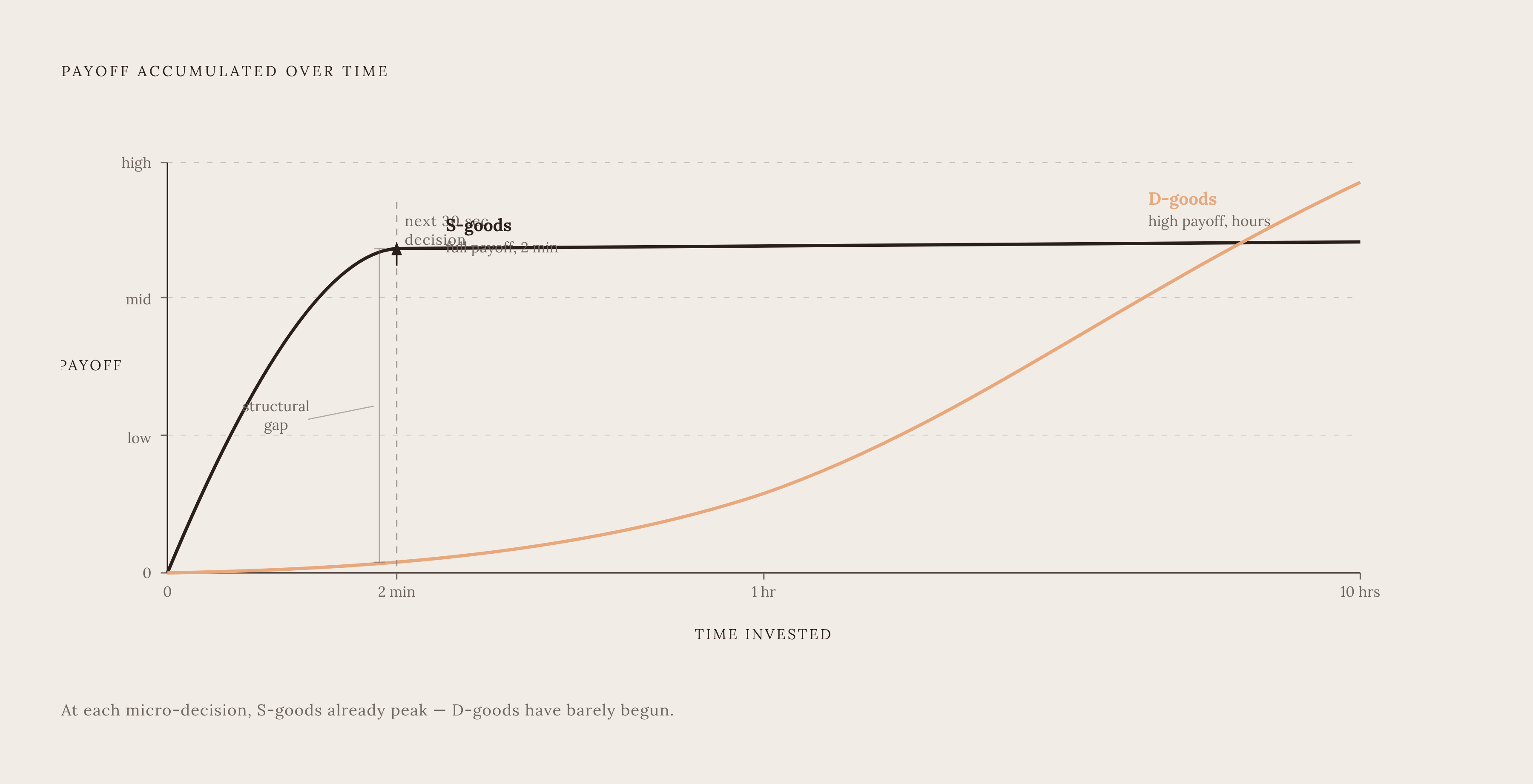
The decline predates smartphones by decades: among American 17 and 18 year-olds, daily reading of a book or magazine had already fallen from a majority in the late 1970s to a small fraction by 2016, before mobile social media had any real grip on daily life. The deeper cause takes an economic shape. Researchers modeling the attention market distinguish deep content, which pays off only after sustained effort, from shallow content, which delivers its full reward in small, self-contained units; when attention gets spent moment to moment, the faster-paying format keeps winning the next thirty seconds, and the next, structurally crowding out slower forms like books regardless of what any individual reader prefers. That crowding-out pressure intensified over two decades as more and more content producers competed for the same scarce attention, and more competition in this market pushes outcomes toward shallower formats rather than better ones. Smartphones accelerated a slope that market structure had already set in motion.
Why did daily reading for pleasure fall so sharply in the US over the last twenty years?
Bone, Bu, Sonke, and Fancourt (2025) trace the US decline from its peak down to where it sits now, and the shape of that decline matters as much as its size. It is a slope, a steady year-on-year contraction stretched across two decades, which rules out the easy explanation that some single cultural event knocked reading off its perch. A habit does not erode that evenly by accident.
The same research team found a matching pattern in another country: children's reading for pleasure there dropped across 2017 to 2022, and over that same stretch, the share of children logging heavy screen time climbed sharply. Two countries, two different school systems, two different media markets, and the same trajectory over the same years. When unrelated populations move in lockstep like that, the cause usually sits outside either population, in whatever environment both happen to share.
Here is where the story gets more interesting than "phones ruined reading." Among American 17 and 18 year-olds, the share who read a book or magazine daily fell from a majority in the late 1970s to a small fraction by 2016. That decline was already well underway before mobile social media had any real grip on daily life. Smartphones didn't start this. They stepped onto a decline already in motion and pressed the accelerator. That raises a real question: if the decline predates the device everyone blames, what was pulling attention away from books before anyone had a feed to scroll? The answer takes an economic shape, and that shape is where this piece turns next.
Why this is an economic crowding-out problem, not merely a distraction problem
Calling this a distraction problem makes it sound like a willpower shortfall, something solved by a stricter phone habit or a sturdier bookmark. The sharper explanation treats attention as a market, and in that market, shallow content holds a structural advantage that has nothing to do with anyone's discipline.
Akerlof, Carvalho, Holden, and MacMillan built a formal model of exactly this market in 2026, sorting content into two types. Deep goods, what they call D-goods, pay off handsomely but only after sustained effort: a long, demanding novel rewards the reader who sticks with it for hundreds of pages, but offers very little to someone who reads three paragraphs and quits. Shallow goods, S-goods, work on a flatter curve: a two-minute microdrama episode delivers close to its full payoff whether someone watches once or watches twenty times in a row, because each unit is built to resolve on its own. When attention is scarce (and for everyone, it is always scarce), the content that pays off in small, reliable units wins the competition for the next thirty seconds, even if the deeper content would have paid off better over the long run. That is the crowding-out mechanism: in a market where attention gets spent moment to moment, the format with the faster, flatter payoff keeps winning the next moment, and the next, until the slower format rarely gets picked up.
A result from that same model cuts against ordinary economic intuition. In most markets, more competition helps consumers: more sellers, lower prices, better products. In the attention market, more competition among content producers can make outcomes worse, pushing the whole market further toward shallow content and away from deep content. Standard competition increases choice. Attention competition increases the pressure toward whatever format can be produced fastest and consumed in the smallest units, and that pressure does not relent just because a reader would, in principle, prefer a novel to a feed.
A shopper chooses between a banana and an apple, but a reader does not fully choose between a chapter and a notification, since attention itself can be captured before a conscious choice is made. Firms have built systems that grab attention before a conscious choice gets made, through autoplay, through push alerts, through feeds engineered to refill themselves. The AI & Society manifesto, published in 2026, describes this as a form of enclosure, attention treated as territory to be claimed and commodified, reaching into the texture of a person's inner life as well as their calendar. That framing matters because it moves the problem out of the realm of personal productivity and into the realm of market structure, which is exactly the distinction the next two sections build on.
What happens inside the brain when shallow content repeatedly wins
Losing the market competition for attention would be a purely economic story if the brain simply snapped back to form the moment a reader picked up a book. It does not work that way. Repeated shallow engagement changes the brain's operating preferences over time, and that change is the real cost of losing the crowding-out fight described above.
The AI & Society manifesto points to the mechanism. Attention-commodifying platforms are built to target subcortical reward-learning circuits, the older, faster systems that drive craving and habit, while largely bypassing the frontal lobe, the region responsible for voluntary, sustained control. Deep reading runs almost entirely on that frontal machinery: holding a plot thread across two hundred pages, tracking an argument through a dense paragraph, resisting the pull to check a phone mid-chapter. Every time shallow content wins the moment-to-moment competition described in the last section, it strengthens the reward circuit that favors shallow content and gives the frontal circuit one less rep.
That sets up a feedback loop, and feedback loops are what make this a brain problem as much as a habits problem. The less often someone exercises voluntary, sustained focus, the harder that focus becomes to summon the next time it is needed. Skip the gym long enough and the stairs get harder, because the legs weakened from disuse. Sustained attention works the same way: skip the exercise long enough and the capacity itself shrinks from disuse, which makes the next attempt at a long book feel heavier than the last one did, which makes the shallow alternative look even more appealing by comparison. The loop feeds itself.
The manifesto names the paradox at the center of all this: expanding access paired with shrinking comprehension. The same digital infrastructure that puts nearly the entire written record of human knowledge within reach of a phone screen is, at the same time, wearing down the cognitive capacity required to sit with any of it long enough to understand it. Access keeps expanding. Comprehension keeps shrinking. Those two trends used to move together, and now they don't, which is as strange a contradiction as a kitchen stocked with every ingredient imaginable attached to a cook who has forgotten how to chop an onion.
How distraction inside digital reading compounds the damage
Even on the occasions someone does sit down to read on a screen, the screen itself tends to work against them, adding a second layer of damage on top of the crowding-out and the neural drift already described.
Yamin Shen's 2025 meta-analysis pulled together 32 separate empirical studies and found a real, measurable negative effect of attentional interference, in networked reading environments, on comprehension. It is a pattern replicated across three dozen independent studies, which is about as close to settled as this kind of research gets.
Not all distraction behaves the same way. Interference that demands conscious effort, answering a message mid-paragraph, deciding whether to open a notification, does far more damage to comprehension than distraction that just sits in the background. A banner ad flickering at the edge of the screen slows reading speed and makes text processing less efficient, but it does not demand the same kind of decision a buzzing phone does. The villain in this story is the active kind of interruption, the one that pulls a decision out of the reader, not the merely visible kind.
An eye-tracking study by Ronconi (2025) found that simple, static on-screen distractions did not meaningfully hurt comprehension for university students reading expository texts. At first glance that looks like a direct challenge to the whole argument: if distraction doesn't actually hurt skilled readers, maybe the attention economy's effect on reading has been overstated. Look closer and the finding points the other direction. What protected those students was top-down attentional control, the very frontal-lobe capacity the previous section described as the thing repeatedly eroded by subcortical, reward-driven engagement. Ronconi's subjects were university students, practiced readers with that control still intact. The real question the study raises is what happens to comprehension once that control capacity has been worn down by years of the feedback loop described earlier, not whether static distraction is harmless in a single sitting. The danger was the slow attrition of the control that makes any reading session survivable at all, not any one distracted reading session.
Who bears the deepest cost
Treat all of this as a personal productivity problem, something solved by a better app or a stricter bedtime for the phone, and the stakes get badly understated. The crowding-out of deep reading lands hardest on the people with the least existing capacity to resist it, and the costs compound.
Children sit at the center of that. The Australian data already cited showed a real decline in children's reading for pleasure between 2017 and 2022, running alongside a sharp climb in heavy screen use. A habit formed at age eight is a different proposition from a habit formed at thirty-eight: the frontal circuits that support sustained attention are still developing in children, and a childhood spent mostly inside the fast, flat reward loop of shallow content shapes which circuits get strengthened before the slower, deeper ones ever get much of a workout. Reversing a habit set that early is a much longer project than adjusting one set recently.
The cost does not stop at childhood or stay confined to reading. The Journal of Bioethical Inquiry introduced a term for where this heads next in 2026, "neuro-capitalism," describing how generative AI tools entering the workplace extract rising levels of what the paper calls neuro-capital from workers. Workers whose sustained-attention capacity has already been worn down by years of shallow-content competition show up to that new economy at a real disadvantage, competing against colleagues whose capacity for deep focus held steady. The reading decline measured earlier in this piece is an early marker of a cognitive capacity now being priced into the labor market.
That is why the AI & Society manifesto argues against treating attention purely as a personal resource each person is responsible for managing on their own. Framing it that way hides the structural nature of what's happening and quietly shifts the blame onto individuals for losing a market contest that was, per the modeling in the second section, built to favor shallow content regardless of what any individual wants. Responsibility for the biopolitical weight of attention-commodifying systems lands on the neuroscientists and platform designers who build these systems, not only on the users caught inside them. Personal fixes still matter. They are not sufficient on their own, which is exactly the gap the final section turns to.
What reclaiming deep reading requires at the cognitive level
If the problem really is neurological, a worn circuit rather than a bad habit, then the fix has to be treated as training, not scheduling. Blocking off forty-five minutes for reading does nothing if the attention circuit required to use that time well has atrophied from disuse. One major scientific body frames sustained concentration as a neurological prerequisite for durable learning, and a prerequisite has to be built, the same way a muscle has to be built, not merely protected by cutting back on competing uses of time.
Writing turns out to be one of the more direct ways to rebuild that circuit. Neuroscience research describes writing as engaging a loop that spans the prefrontal cortex, the hippocampus, and the brain's language centers, taking scattered, half-formed thoughts and forcing them into an organized, structured representation on the page. Writing demands the same frontal, voluntary, sustained engagement that reading a long and demanding text demands, making it a counterpractice by design.
The AI & Society manifesto offers a name for the broader category this fits into: an ecology of attending, treating attention as something embedded in a practice that generates meaning rather than a fixed resource to be rationed out across a day. That framing covers more than any single app or habit. What they share matters more than which one a given reader picks: each asks the frontal circuitry to do real work, repeatedly, and repeated work is what makes a worn circuit stronger again.
None of this holds up against raw willpower, and expecting it to is where most personal fixes quietly fail. The more durable approach designs the environment so that sustained attention becomes the easiest available option. Anchor the practice to a fixed moment that already exists in the day, right after the coffee finishes, right before the lights go off; a trigger tied to an existing moment survives on days when motivation does not show up. Separate the environment itself from anything carrying a feed: a dedicated device with no notifications, a physical book, an app built with no social layer at all, each one strips out the active, decision-demanding interference that Shen's meta-analysis flagged as the real source of comprehension damage. None of this asks a reader to out-willpower a market built by well-funded firms to win the next thirty seconds of attention, over and over, forever. It asks for a change in the immediate terrain, small enough to control, so that the next choice tilts toward depth. That is the whole task: not defeating the market, just stacking the local odds.
Sources
- Beyond the attention economy, towards an ecology of attending. A manifesto
- Neuroethics, Biocapital and the Attention Economy in the Times of Generative AI and Human–Machine Teaming
- Frontiers
- Effects of Digital Reading With On‐Screen Distractions: An Eye‐Tracking Study - Ronconi - 2025 - Journal of Computer Assisted Learning - Wiley Online Library
- An attention economy model of co-evolution between content quality and audience selectivity
- Children and young people’s reading in 2025
- Reading for pleasure in free fall: New study finds 40% drop over two decades News