Online Identity Curation and Authentic Self-Perception
Constant audience awareness gradually suppresses your internal sense of self.
The habit is mundane. Cropping a photo, swapping a filter, rewriting a caption three times before posting it: none of this feels like a cognitive event, but each small choice still redirects attention toward audience reaction.
The gap feels real because it is real. Each small curation choice, adjusting an angle, rewriting a caption, picking a hashtag for reach rather than accuracy, redirects cognitive attention outward toward an imagined audience rather than inward toward actual experience. Over time that outward orientation suppresses the internal signal that would otherwise inform a person's sense of who they actually are: the signal doesn't disappear, it just gets outcompeted. Whether the gap is a problem depends on what is driving the performance; when curation is shaped by fear of judgment or desire for acceptance rather than examined values, research links it directly to less online authenticity and measurably higher social anxiety, with inauthenticity acting as a significant partial mediator between the two.
Why does the person I present online feel different from who I really am?
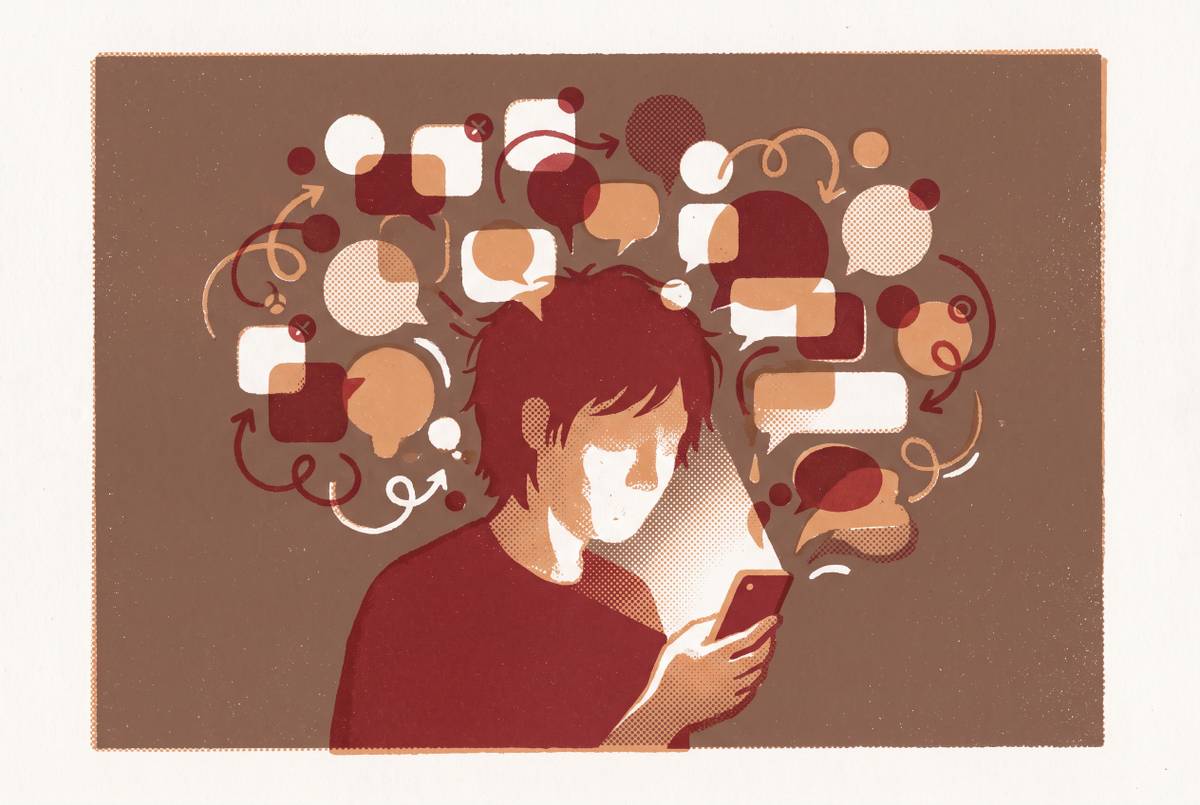
Picture the fifteen seconds before a photo goes up. The angle gets adjusted, the filter gets tested against two or three alternatives, the caption gets drafted and redrafted, and a hashtag gets chosen because it performs well rather than because it's accurate. None of this registers as effortful in the way solving a math problem does. It feels like habit, the kind of tinkering you do without even noticing you do it. But each of those small choices needs you to guess how an audience will react before it has reacted. The brain asks how the photo will land rather than what it represents, a cognitive task aimed outward by design.
Virtual anonymity complicates this further. The relative distance of an online profile can feel like freedom, room to try on identities without the social cost of testing them in person. But that freedom creates its own tension: a gap opens between the self being performed online and the self being lived offline, and somebody has to manage that gap. The management occurs as self-censorship, visible in what gets edited out before anything is published. Awareness of how an image or statement will read on a platform acts as a filter before anything gets published, and the person doing the filtering is constantly weighing authenticity against the version of themselves they feel obligated to maintain. The weighing itself is the cognitive redirect. Attention that could go toward understanding why a comment stung or why an achievement feels hollow gets spent instead on calibrating how it lands with others.
What drives that calibration isn't intrinsic. Fear of judgment, a desire for acceptance, worry about social fallout: these are reactions to an imagined audience, not expressions of a person's own values. The self being constructed under those pressures is shaped by guesses about what other people want to see. That's the mechanism the rest of this piece builds on. Once attention habitually orients toward audience response, the internal signal, the one that would otherwise inform a person's sense of who they actually are, gets quieter by comparison. Not erased. Just outcompeted.
How a curated identity erodes accurate self-knowledge
Sustained over months or years, that outward orientation has a cost, and the cost is specific: it degrades the accuracy of self-knowledge. One reason is structural. A curated identity tends toward one dimension because a single, consistent persona reads more clearly to an audience than a complicated, shifting one does. But actual identity doesn't work that way. A person's internal landscape changes day to day based on experience, mood, context, and relationship, and flattening all of that into a stable, presentable persona suppresses the very variability that constitutes genuine self-knowledge. The curated version becomes a kind of average, smoothed for public consumption, and the smoothing obscures the texture underneath it.
Research on first-year undergraduates traces this chain directly. Heavy identity curation correlates with less online authenticity, and less online authenticity predicts more social anxiety, with inauthenticity acting as a significant partial mediator between curation and anxiety even after you control for gender and time spent on social media. The anxiety is the signal that the performed self and the experienced self have drifted apart, leaving the person to hold both versions at once.
That drift costs something internally too, and there's a neurological account of why. The brain's default mode network, the circuitry most associated with self-referential thought, runs a kind of background process: unresolved worries, open loops, emotions that haven't been metabolized yet. When attention gets consumed by outward curation, that background process doesn't stop. The background process gets deferred instead, left unresolved by the attention that curation consumes. The unresolved material stays unresolved, and it continues occupying working memory rather than clearing out of it.
One might argue a curated identity could eventually become the real one, that aspirational self-presentation shapes who a person actually grows into. There's something to that, but it depends entirely on what's driving the aspiration. Aspiration shaped by audience approval is reactive: it changes direction whenever the audience's taste changes. But if aspiration is shaped by examined values, it's chosen, so it holds steady even when nobody's watching. The two can look identical from the outside and function completely differently on the inside.
Writing runs the cognitive traffic in the opposite direction. Instead of modeling how something will read to an audience, writing engages the prefrontal cortex in organizing scattered, raw thoughts into a structured representation, so it lowers cognitive load and shifts emotional processing from reactive limbic activity toward regulated prefrontal engagement. Researchers point to affect labeling as the mechanism, the simple act of putting a feeling into words. Matthew Lieberman's fMRI studies at UCLA found that labeling an emotion decreases amygdala activation and increases activity in the right ventrolateral prefrontal cortex, a measurable reduction in the neural markers of emotional reactivity. A second mechanism, cognitive offloading, works alongside it: an unresolved concern occupies working memory continuously until it gets externalized onto a page, at which point the brain treats the written record as an external store and releases that memory slot. The concern hasn't disappeared. It no longer has to be held actively in mind, which is most of the burden to begin with.
Research by a psychologist studying expressive writing backs this up with longitudinal data: writing about difficult experiences in short sessions, repeated over several consecutive days, produces measurable improvements in mental and physical wellbeing that persist for months or years afterward. What makes the writing work is a specific detail. Emotional release alone doesn't do it. Pennebaker's own findings show unstructured venting produces no lasting benefit, and if you write only about emotions, without the surrounding event, it performs worse than writing about both together. What changes the outcome is the act of translating a raw, formless emotional experience into a linguistically structured account. Structure, not catharsis, appears to be the active ingredient.
Handwriting and voice versus typing on a social platform
Handwriting recruits more of the brain than typing does, because forming letters by hand requires coordinating fine motor control, tactile feedback, visual processing, and spatial judgment about letter shape, all at once, in a way that repetitive keypresses don't ask for. The added effort supports deeper encoding into memory: because handwriting is slower and requires actively constructing each letter, the brain has more time and more sensory input to process and organize the material. Typing on a social platform asks for something nearly opposite. A platform's text box is built for performance, complete with character limits, a public audience, and like counts visible before a word is even posted, while a private voice note, a handwritten page, or a prompt-guided spoken entry is built for capture, with no audience shaping what gets said before it's said.
That distinction matters most for the specific job this piece is concerned with: recovering an accurate sense of self from a narrative that's been shaped by years of audience approval. Future Self Journaling asks who someone is becoming versus who they're currently presenting, so it puts the performed self and the developing self side by side where you can see the gap between them. Values Clarification Journaling surfaces a person's core values independent of whatever social feedback has been reinforcing a certain self-image, putting those values on the page before any audience has an opinion of them, and Identity Mapping takes a more structural approach, laying out what someone expresses publicly against what they actually prioritize in private, which gives the gap itself a shape rather than leaving it as a vague discomfort.
Two broader frameworks back that work by giving the reflective process a sequence to follow instead of leaving it open-ended. Gibbs' Reflective Cycle moves through six stages, description, feelings, evaluation, analysis, conclusion, and an action plan, forcing a person to travel from raw experience to an examined conclusion rather than looping on the same unresolved feeling indefinitely. CBT Thought Records do something more targeted: they identify the specific cognitive distortion embedded in a self-narrative and build a more accurate alternative in its place, which applies almost directly to the distorted self-narratives that sustained curation tends to produce. Neither framework asks for more raw expression. Both ask for evaluation of what's already there, which is the step unstructured venting skips.
The objection that journaling can entrench distorted self-narratives rather than correct them
There's a real risk buried in all of this, and it deserves to be named rather than waved off. If your self-narrative has been shaped by years of curation, you might sit down with a private journal and simply rehearse that same narrative, giving it more airtime rather than examining it. Writing something down doesn't automatically make it true, and it doesn't automatically make it examined. A journal can become an echo chamber of one.
The counter to this is that the problem lives in the method's design, not in journaling as a category. Structured frameworks, Gibbs' Reflective Cycle, CBT Thought Records, a Stoic-style evening review, generally outperform free-form journaling for changing emotional patterns in many, though not all, contexts, specifically because they force evaluation rather than permitting expression to stand in for it. Free-form writing lets a narrative run unchallenged. A structured framework interrupts it at a specific point and asks: is this conclusion actually supported by what happened, or is it the same story being told again?
A second objection is more practical than psychological. For someone already overwhelmed by screens, adding another screen-based habit risks reproducing the exact problem the habit is meant to solve, since the same device and the same cognitive environment that enable curation also host the journal meant to counteract it. If AI-guided prompts stay private, unseen by advertisers, unshared on any platform, they preserve the inward direction that the whole exercise depends on. But that answer carries its own tension. The moment a reflective tool connects to a platform with an audience architecture, even a soft one, the risk of performance creeping back in resurfaces, and no framework fully neutralizes that risk on its own. Writing tools built around AI exist on a spectrum from fully private to deeply networked, and where any given tool sits on that spectrum matters more than whether it uses AI at all.
What the research does settle more confidently is the question of habit formation. Consistency outperforms duration, and the practice likeliest to survive contact with an actual life is the one with the least friction at the moment of sitting down to start it. Studies suggest 15 to 20 minutes, three to four times a week, as the threshold where benefits become measurable, and more time spent doesn't necessarily produce more benefit, which takes the pressure off treating this as a major daily commitment. Format can follow personality rather than convention. Handwriting asks for the most cognitive engagement, which makes it suited to deeper sessions where the extra time spent forming each letter supports more thorough processing. Voice journaling asks for the least friction, skips the blank page entirely, and captures something closer to an unedited first reaction, so it works as a strong entry point if you find writing effortful or think more clearly out loud. Typed digital journaling moves fastest and stays easiest to search and revise, so it suits structured frameworks you want to review later rather than write once and leave. What holds all three formats together is privacy architecture: the mechanism that makes any of this therapeutic depends on the absence of an audience, and a journal stored or shared on a platform with social features reintroduces the same performance dynamic that curation created. Local-first tools, or anything kept off-platform, preserve the inward direction that makes the practice work.
That direction, inward rather than outward, is the entire distinction this piece has been tracing. Curation asks a constant, quiet question: how does this read to someone else? If you ask the first question enough times, it reshapes you around an audience that was only ever imagined. The second, given a consistent framework and a private place to happen, hands the accuracy back to where it belongs.
Sources
- The Instrumental Dissolution of Typing: Why AI Challenges the Keyboard Era in Knowledge Work
- Navigating the self online
- Online Self-Presentation and Identity: Insights from Diverse and Marginalized Youth
- Unmasking the True Self on Social Networking Sites
- Conservateur of a Former Self: Algorithmic Curation, Identity Exhibition, and Digital Well-Being
- The Neuroscience Behind Writing: Handwriting vs. Typing—Who Wins the Battle? - PMC