When Your Brain Races Faster Than Your Fingers Can Type
Voice journaling lets thoughts flow at speaking speed, not typing speed.
For anxiety and overthinking without typing, voice journaling offers a practical way to express thoughts before the effort of writing interrupts them. “When Your Brain Races Faster Than Your Fingers Can Type” explains why that mismatch can derail journaling, and why speaking can be a better fit. The useful criteria for a voice journaling app are spoken capture and conversational prompts that help turn racing thoughts into a coherent account.
Why the brain outpaces any manual output channel
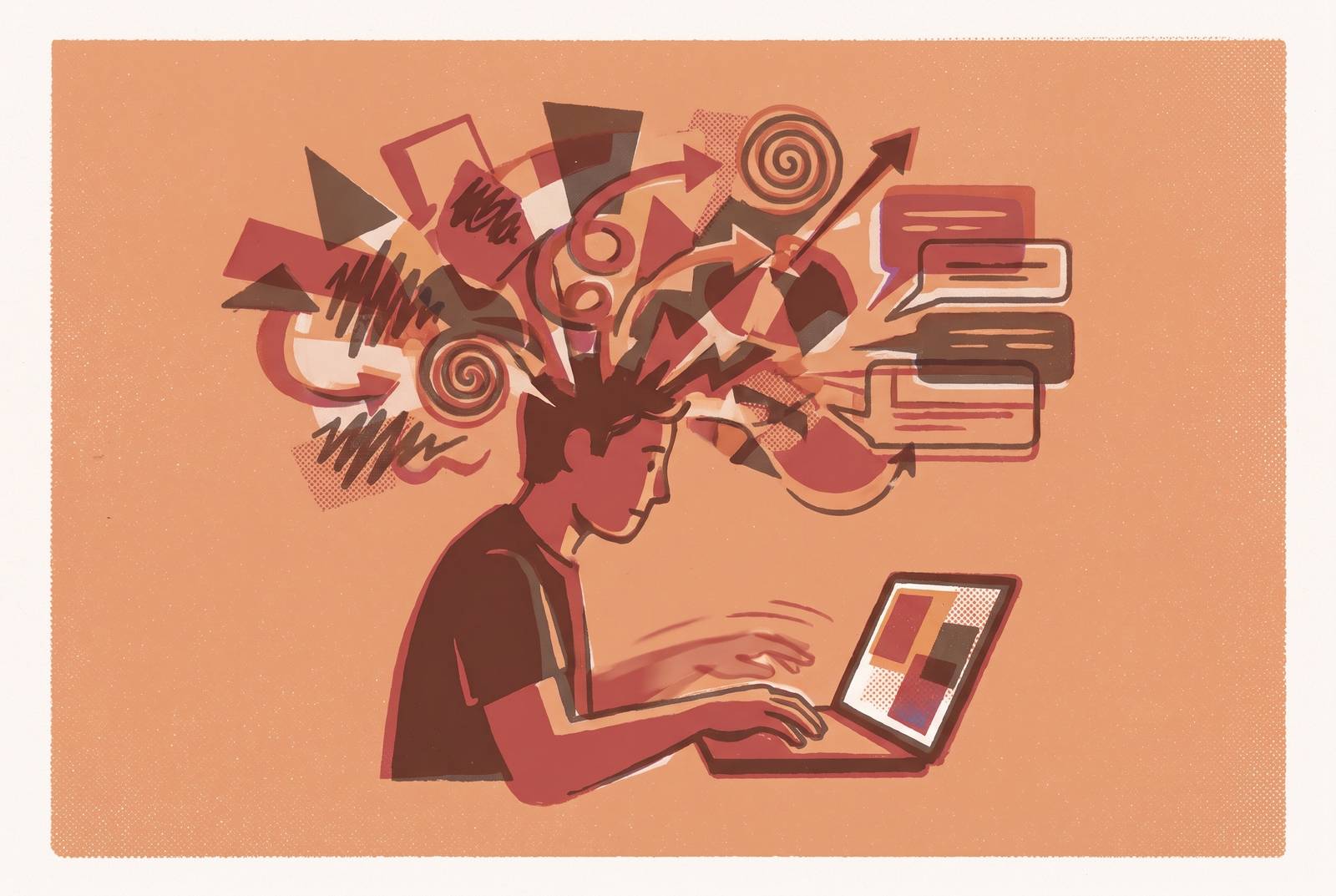
A thought does not arrive as a finished sentence. An idea may arrive with an emotion, a memory, and an unfinished concern attached, while a hand can record only one word after another. Before the opening sentence is complete, the next association may already be competing for attention. A person can genuinely want to journal and still struggle to move a fast, shifting experience through a slower manual channel.
The Zeigarnik effect describes how tasks that are not finished stay active in memory and keep drawing attention. The mind has not agreed to form an orderly queue. Its unfinished business can keep returning while the writer is still trying to describe the first concern.
Handwriting adds work of its own because forming letters takes movement, sensation, language, and attention working together. Typing reduces some of that work, but it still asks the writer to turn a changing inner experience into a sequence of keystrokes. Neither method is defective. Both impose a pace and a form on material that did not arrive at that pace or in that form. The frustration begins when that constraint feels like an inability to think clearly.
What the brain is actually doing while you try to write
The default mode network helps explain why the mind keeps coming up with thoughts while a person writes an entry. Its regions include the medial prefrontal cortex, posterior cingulate cortex, and temporal-parietal junction, and it is active during self-referential thinking. This is the territory of thoughts about oneself and unresolved experience. The writer must compose an account while the subject of that account keeps developing.
Harvard psychologists Killingsworth and Gilbert found that mind-wandering predicted unhappiness whatever people were doing. That finding links wandering attention to how people feel, though it does not show that every wandering thought is harmful. Part of the mind is trying to make a sentence, while another part keeps returning to what remains unsettled. The entry is chasing a moving target.
Cognitive offloading changes the task by moving a thought into an external record. The writer now has a place outside working memory to hold the whole concern, freeing them from having to keep it all in mind. That can release capacity for what comes next. Ramirez and Beilock’s 2011 University of Chicago study found that a brief session of expressive writing before a high-stakes exam freed working memory from anxiety and produced measurably better performance. The benefit was not simply having filled a page.
A method’s usefulness depends on both how much thought it stimulates and how effectively it lets a person put that thought down. Depth and capture speed are different qualities. A slow method may encourage careful processing while making it harder to preserve a rapidly unfolding emotional experience. A faster method may make it easier to catch those feelings without doing all the same work in the mind.
How handwriting and typing each resolve the gap — and what each costs
Handwriting makes slowness part of the process. Coordinating language with movement can support elaborate neural connections, including those involved in memory formation. For someone who wants to dwell on an experience, this deliberate pace can be an advantage. The pause is part of the value. Choosing what deserves a place on the page can help turn a crowded experience into something more considered.
That selection also has a cost. A handwritten entry is a curated record rather than a complete account of everything that passed through the mind. When emotions surge, choosing which thought to keep can be one more task that draws on the little attention a person has to spare. The same care in choosing what to write can help one person go deeper and keep another from starting.
Typing shifts the balance toward quicker capture. It cuts down on the work of forming letters by hand, though it does not engage the mind in all the same ways as handwriting. A 2025 systematic review in Frontiers in Neurology documented benefits from writing-based therapies, including handwriting and typing, for cognitive rehabilitation in mild cognitive impairment and dementia.
Pennebaker’s expressive-writing protocol gives a strong reason to question a change of channels. Writing works, so why depart from it. The distinction is between the method studied and the work it enables, including naming emotions and organizing experience into a narrative. Those processes need not be reduced to the movement of a pen or fingers. A different channel would need to preserve that work while removing a barrier to doing it.
Why the journaling habit breaks at the moment of the gap
People often get stuck before they have written enough to judge. A person opens the journal, tries to choose a beginning, and discovers that the thought has already changed. The first sentence now feels late or incomplete. Perfectionism adds another delay by demanding an accurate account before any account exists. What began as a wish for relief becomes a small editing assignment.
This is where intention and behavior separate. The person still means to journal, but getting ready, finding words, and catching up with the thought all stand between intention and expression. The feeling passes before the person has put an entry together. On the next occasion, the same activity arrives with the memory of that difficulty attached. A problem of capture starts to look like a failure of commitment.
Journaling only during crises can deepen that resistance because the practice becomes associated with pain. Ordinary entries about wins and small moments offer a different association, making the journal somewhere to go without first being overwhelmed. One sentence or five minutes can establish the practice before it expands into something more ambitious. Anchoring it to morning coffee, a commute, or the minutes before bed also removes the repeated decision about when to begin.
The embodied journaling research presented at CHI '26 offers a useful perspective on the role of the channel itself. When writing-based norms were absent, participants tended toward unfiltered emotional expression, often forgoing words altogether. The impulse to express had not disappeared. What changed was the form available to it. That finding casts doubt on the idea that people who struggle to write have nothing worth expressing.
What speaking does that writing cannot — the output channel that matches thought speed
Speech allows language to unfold at conversational speed, without waiting for letters to be formed or keys to be pressed. For people who naturally work through ideas aloud, expression can develop with the thought. The manual bottleneck is removed. This makes speaking a natural match for verbal thinking, though it need not capture every association or emotion to be useful.
Affect labeling explains why that spoken expression can do more than preserve information. Naming an emotion can reduce amygdala reactivity and increase prefrontal engagement. The relevant act is giving the feeling a name. Written words can do that, but spoken words are language too. A person does not need to transcribe an emotion before beginning to identify it.
Narrative construction supplies the next step. Pennebaker’s core mechanism turns a jumble of painful feelings into a story that makes sense, giving what felt like separate pieces of distress links and an order. A spoken account can perform that organizing work. Speed is useful when it allows more of the experience to enter that process before the thread is lost.
The obvious objection is that speaking offers less opportunity to think before expressing something. Yet that filtering is sometimes the obstacle. During a rush of anxious thoughts, demanding a polished sentence can prevent the less orderly but more revealing account from emerging. The embodied journaling findings suggest that loosening written norms can allow participants to express what those norms constrain. Speech is therefore valuable because it is faster and can let the person begin before an internal editor takes charge.
What lets you talk out anxious thoughts instead of writing them down?
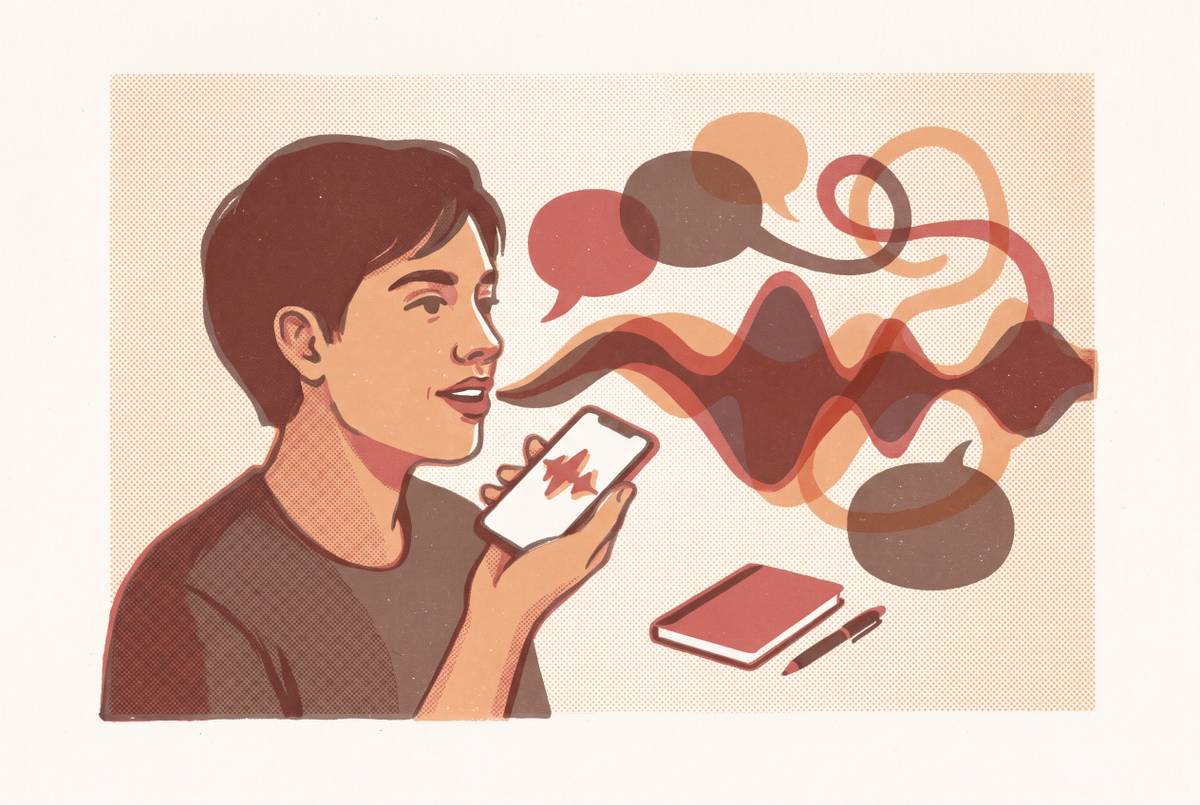
A voice journaling app applies this logic by making spoken capture the entry point. Instead of holding a worry while trying to write it, the person records an account aloud. The mechanism remains cognitive offloading. Naming the emotion adds affect labeling, and telling what happened gives the account a narrative.
Conversational prompts address a separate obstacle that recording alone may leave intact. “What's still on your mind from today?” asks the person to continue something already underway. That is a smaller demand. For someone who freezes when trying to journal about anxiety, this difference may be as useful as avoiding typing.
Spoken capture avoids the wait for the hands to catch up, while conversational prompts help a person get started. Prompt-guided structure can then support the move from an anxious fragment toward an account of the experience. Those functions have different jobs. An app for overthinking without typing needs to help where a person tends to get stuck putting thoughts into words, beyond giving them another place to store text.
Voice also changes where an entry can happen. A phone allows journaling during a commute, a walk, or a moment between tasks without preparing writing materials or sitting down at a page. Less setup leaves fewer steps between noticing a thought and expressing it. Even when an entry is easy to record, the person still needs to pay enough attention to name the feeling or tell the story more fully.
Matching the method to how you actually think
The best fit starts with the job the journal is meant to do. Expressive journaling, whether written or spoken, processes difficult emotions, while gratitude journaling builds positive affect. Morning Pages and stream-of-consciousness writing work well for clearing the mind each day. Bullet journaling serves tasks and structure. Choosing between them is not simply choosing a preferred surface.
Thinking style then helps determine the channel. Someone who discovers an idea by talking through it may find voice a better primary method than handwriting. Someone who finds it helpful to choose carefully what to write may prefer paper, while someone else may use both spoken and written entries. Cognitive depth should not be confused with the complexity of the hand movement required.
The SoulNote research at CHI '26 shows why it helps to look at how the medium affects whether people keep up a practice. In a study specifically focused on individuals with hearing loss, repeated songwriting with generative AI music tools produced growth in self-insight, emotion regulation, and everyday attitudes toward emotions and self-care. This was songwriting research. A different medium enabled an ongoing expressive practice.
The practical decision is to choose a channel that is easy enough to keep and suited to the work at hand. Paper works well when it helps to slow down, and typing works well when putting thoughts into writing suits the person. Voice earns its place when the act of writing repeatedly interrupts the thought. For that person, speaking is the journal.
Sources
- Reflective Motion and a Physical Canvas: Exploring Embodied Journaling in Virtual Reality
- From Daily Song to Daily Self: Supporting Reflective Songwriting of Deaf and Hard-of-Hearing Individuals through Generative Music AI
- Writing as cognitive rehabilitation in MCI and dementia: a systematic review of therapeutic benefits and applications