Parasocial Relationships and Loneliness Compensation
These one-sided bonds feel real but rarely cure the loneliness they're meant to treat.
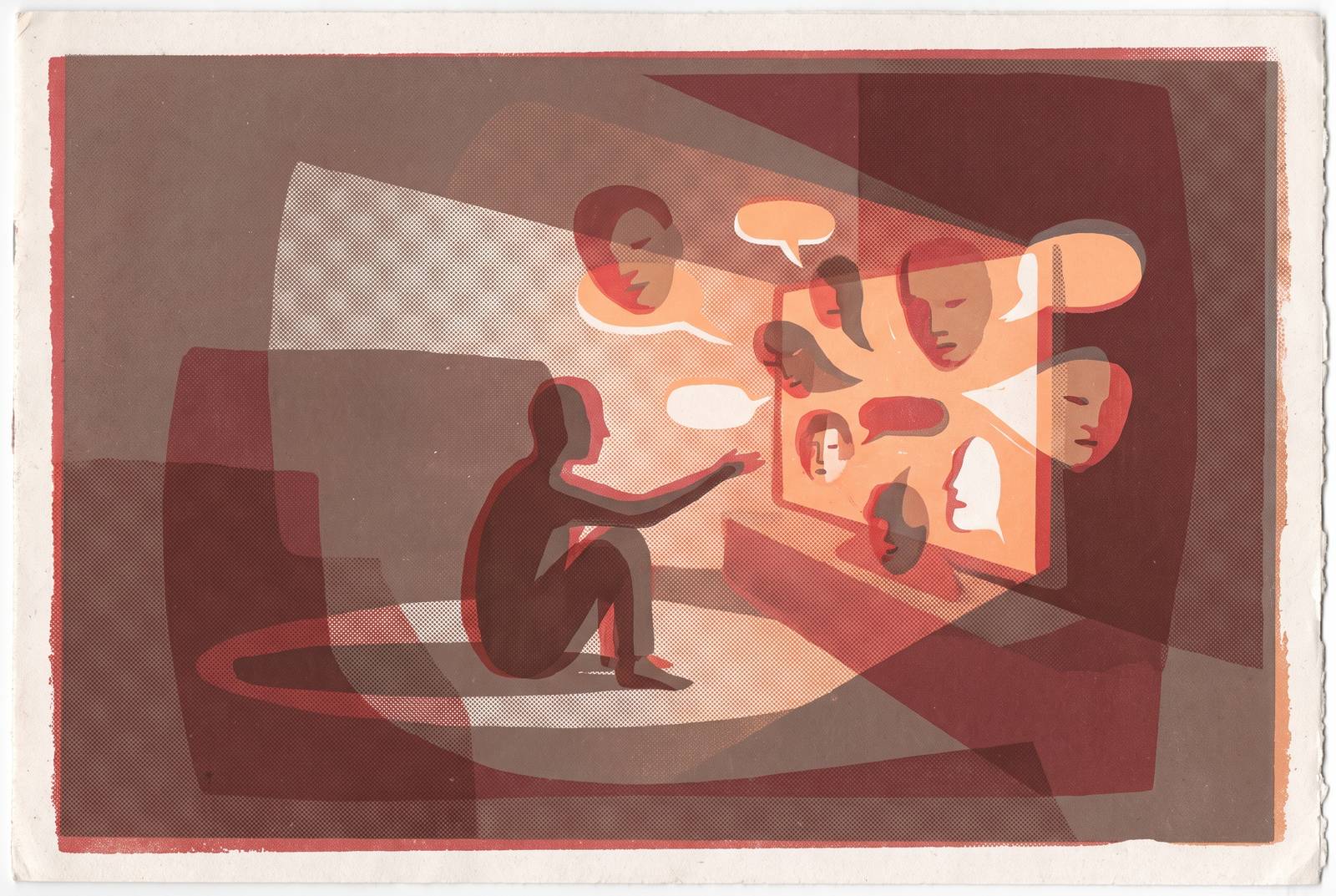
Loneliness has become a measurable, worsening condition across the globe, and parasocial relationships (the one-sided bonds people form with media figures, influencers, and now AI companions) are one of the main ways people are responding to it. This piece asks a simple question with a complicated answer: do these bonds actually help, or do they just feel like they do?
Why loneliness at this scale makes parasocial bonds worth understanding seriously
The WHO Commission on Social Connection's global report found that a substantial share of the world's population is affected by loneliness, and the condition is not retreating. Who's bearing the brunt of this? Not retirees. Cigna's 2024 survey classified a large majority of U.S. Gen Z adults as lonely, which puts the condition squarely in the demographic that has grown up most saturated by social media feeds and, increasingly, AI companions.
The timing of the Cambridge Dictionary's decision to name "parasocial" its 2025 Word of the Year tracks with all of this. A term that used to live in media studies journals is now something people reach for casually, the way they'd say "burnout" or "gaslighting," to describe a specific and recognizable feeling. That linguistic shift is itself a kind of data point: when a population needs a word badly enough to borrow it from academia, the phenomenon it names has probably already arrived at scale.
Put those two trends next to each other. Loneliness is rising, and the tools for forming one-sided emotional bonds (social media feeds, parasocial influencer culture, conversational AI) have never been more accessible or more convincing. If millions of people are lonely and the easiest available response is a relationship that doesn't require the other party to show up, the obvious next question is whether that response actually works. That's the question this piece spends the rest of its length answering, and the answer, it turns out, depends heavily on who's asking.
What a parasocial relationship is
A parasocial relationship is a one-sided emotional bond: one party, the audience member, develops a sense of familiarity and closeness toward a media figure who has no idea they exist. The bond is real as a felt experience even though only one side is actually participating in it. Viewers accumulate a shared history with that persona over time, and each new appearance carries the weight of everything that came before it, the same way running into an old friend feels different from meeting a stranger.
Ravi and Patki, writing in 2025, describe the interaction as "one-sided, non-dialectical, led by the performer, and devoid of mutual development." The performer doesn't know the audience member exists, let alone that they've been paying close attention for years.
Social media changed the mechanics considerably. A television host from the 1956 era appeared at a scheduled time and then vanished until the next broadcast. The accessibility and continuity are new. The fundamental asymmetry is not.
It helps to distinguish parasocial relationships from their more extreme cousins. Most parasocial bonds are mundane: a podcast host who feels like a friend, a streamer whose stream functions as background company, a fictional character whose absence after a show ends produces a small, real pang of loss. AI companions introduce something structurally new into this picture. A user interacting with an AI agent isn't observing a persona from a distance, but engaging with a responsive system built to simulate reciprocity, which changes both the mechanism behind the bond and the risks that come with it (a distinction the later sections take up directly).
The two competing explanations for why people form parasocial bonds
Two schools of thought explain why people form these bonds, and they don't agree. The substitution hypothesis holds that parasocial relationships compensate for a social deficit: they offer the texture of social experience without the risk of rejection, and without requiring the social skills that real relationships demand. Under this view, someone forms a parasocial bond with a media figure in place of the real connection they can't or won't pursue.
The opposing hypothesis takes the opposite position. It argues that parasocial relationships draw on the same psychological machinery as real social bonds, which would make them an extension of a person's social capacity rather than a workaround for its absence. Under this view, forming a parasocial bond is what a well-socialized brain does by default when it encounters a consistent, familiar figure.
Which one is right? The data suggest both are, depending on who's being studied. Kurt, Bulut-Ateş, and Doğanülkü (2026) found that loneliness significantly predicts the formation of parasocial relationships, with social media use and life satisfaction functioning as serial mediators in that chain. That result lines up neatly with the substitution hypothesis. Participants in their study described parasocial relationships coexisting comfortably alongside real ones, without displacing them, and most of those participants understood clearly that the parasocial bond wasn't a stand-in for the real thing. That result fits the enrichment hypothesis just as neatly.
Both studies can be correct at once if parasocial relationships simply do different jobs for different people. Which hypothesis applies to an individual seems to turn on that person's baseline social health going in. The baseline matters because the next section explains precisely when it moves from incidental factor to the thing that determines the outcome.
What the brain does with a one-sided bond
None of this works, as a psychological phenomenon, unless the bond feels genuinely real to the person forming it. It does, and the explanation lives in basic neurological wiring rather than in any kind of wishful thinking on the audience member's part. The brain processes familiar media figures using much of the same circuitry it recruits for real relationships. That overlap is why the sense of connection carries real emotional weight even though the relationship itself has no structural reciprocity behind it.
The dopamine reward system plays a central role here. Parasocial stimuli, a favorite podcast host's voice, a familiar streamer's greeting, activate the brain's reward circuitry and produce authentic pleasure, establishing a stimulus-response loop not unlike the one built by any other rewarding, repeated behavior. That loop explains the appeal of parasocial bonds and their risk of overconsumption in the same breath, since a reward circuit doesn't come with a built-in sense of moderation.
This mechanism isn't limited to lonely brains. A person with a full calendar of friends can still feel genuinely attached to a fictional character or a favorite creator, because the circuitry doing the attaching doesn't check anyone's social calendar first.
The clearest evidence that these bonds are neurologically real, not imagined, comes from what happens when they break. People didn't shrug off a software patch. They grieved something closer to a relational rupture, because as far as their brain's reward and attachment circuitry was concerned, that's precisely what had happened.
Compensation's limits
Parasocial bonds provide emotional relief that is real but bounded. They can lift a person's mood in the moment and create a temporary sense of connection, but they don't resolve loneliness as an underlying trait, and their power to compensate breaks down exactly when loneliness is at its worst.
The dilution disappeared among people reporting high loneliness.
Translate that into a concrete picture: parasocial bonds do the most good for people who are mildly or situationally lonely, someone between jobs, between cities, between friend groups. For people carrying a severe, chronic social deficit, the same bonds become least useful, and possibly counterproductive. That's the dividing line between compensation and enrichment in practice. For someone with a serious social deficit, the same bond offers a short-lived mood lift without closing the gap underneath it, a strictly limited form of compensation.
The mood lift matters less than the fact that it doesn't fix the underlying loneliness. It matters because a tool that masks a symptom without addressing its cause can quietly remove the motivation to go looking for actual connection. A bounded benefit that feels sufficient is, in its own way, more dangerous than an obviously insufficient one, because it doesn't send the person looking for anything better. That risk is exactly what the next two sections dig into, first through AI companions, then through the broader risk research.
AI companions as an intensified version of the same dynamic
AI companions run the same parasocial dynamic through a much stronger amplifier, boosting both what it can offer and what it can cost. The first causal evidence that generative AI companions ease momentary loneliness found effects on par with talking to an actual person, outperforming watching YouTube, journaling, and doing nothing. That's a genuinely striking result for a chatbot. But the same research found that the benefit didn't accumulate session over session, so a user wasn't building toward less loneliness over time. They were resetting to the same starting line each time.
A Harvard Business School study dug into the mechanism and landed on "feeling heard" as the operative ingredient: messages that read as attentive, empathetic, and respectful did the actual work. The AI companion is simulating, with considerable fidelity, the specific experience of being listened to.
Heavy daily users didn't see their loneliness keep shrinking. They saw it climb, a more compressed, more measurable version of the same ceiling effect Baker and Cohen documented in traditional parasocial relationships. More exposure didn't mean more benefit past a certain point; it meant the opposite.
There's also evidence that attachment to AI companions forms faster than attachment to a human media figure typically would. The brain, in other words, naturalizes an AI companion into its existing relational framework quickly, and attachment follows close behind.
James Muldoon and Jul Jeonghyun Parke, writing in New Media & Society in 2025, call this "cruel companionship. Their argument is that AI companions fill a genuine care vacuum while being built and shaped by the commercial logic of platform capitalism at the same time, meeting a real emotional need in a way that may ultimately serve platform retention metrics as much as it serves the user sitting across from the screen. That's a critical lens worth taking seriously, though not a verdict to adopt wholesale. The relief these systems provide is measurable and real, and so is the incentive structure of the company that built them.
The documented risks that the compensation narrative obscures
Severe loneliness and difficulty forming or sustaining real-world connection make parasocial bonds most appealing, and those same conditions raise the likelihood of their documented risks.
Researchers describe one such risk as "deskilling": relying on AI companions may reshape a person's relational habits in ways that make human-to-human connection harder to access over time, rather than easier.
A systematic review in Computers in Human Behavior: Artificial Humans sorted the risks specific to AI parasocial relationships into five categories: commercial persuasion, displacement of human relationships, emotional dependence, privacy and data exploitation, and behavioral addiction. Those categories aren't evenly distributed across the population, either. AARP's 2025 study, surveying 3,276 adults, found a significant rise in loneliness among adults 45 and older compared to earlier surveys, and nearly a quarter of lonely adults in that cohort said they were interested in AI companionship technologies. The population reporting the most interest in these tools is also the population the ceiling effect suggests benefits least from them.
The Meta AI chatbot case, investigated by Reuters, is the real-world illustration of what happens when a platform's commercial incentives and a user's wellbeing point in different directions. None of this means parasocial bonds are a trap by design. It means the risks concentrate precisely in the users the benefits help least, a structural problem built into how these tools are deployed rather than a personal failing of anyone who turns to one.
When parasocial bonds genuinely enrich rather than merely compensate
For someone with a stable social life and only situational, mild loneliness, a parasocial bond, whether with a podcast host, a fictional character, or an AI companion, functions as enrichment: additional warmth layered onto a foundation that was already holding. Ravi and Patki's participants, who maintained strong parasocial attachments alongside real relationships without one crowding out the other, are the clearest picture of what this looks like in practice.
For someone carrying a severe, chronic social deficit, the same bond runs into the ceiling Baker and Cohen documented, and findings from a study on heavy AI companion use show that ceiling in sharper, faster resolution. The relief is genuine in both cases. The difference is whether that relief sits on top of an already-functioning social world or stands in for one that isn't there. Loneliness at the scale the WHO, the APA, and the BLS have each documented isn't going away soon, and parasocial bonds, in whatever form they take next, aren't going away with it. What matters going forward is not whether these bonds are good or bad, but which of the two jobs, enrichment or compensation, a given bond is actually doing for the specific person forming it.
Sources
- Parasocial Compensation or Enrichment? Investigating the Relationship Between Age, Loneliness, Parasocial Relationships and Eudaimonic Motivations Through The Lens of Socioemotional Selectivity Theory - IGEL 2025 - Concordance
- Parasocial relationships, social support and well-being
- Frontiers
- Disconnected: The Escalating Challenge of Loneliness Among Adults 45-Plus
- People perceive parasocial relationships to be effective at fulfilling emotional needs
- Parasocial relationships with artificial intelligence (AI): A systematic review of benefits and risks - ScienceDirect
- PARASOCIAL RELATIONSHIP - Cambridge English Dictionary
- Social connection linked to improved health and reduced risk of early death