Expressive Writing as a Burnout Recovery Tool
Writing about work stress helps the brain transform emotional overwhelm into coherent meaning.

Burnout doesn't respond to venting the way most people assume it does. The research on expressive writing points somewhere more specific: the practice works by helping the brain build meaning out of stress that's gone unprocessed, not by letting off steam. That distinction changes how the technique should actually be used, and it starts with understanding what burnout is doing to the brain that ordinary stress isn't.
Stress, even bad stress, tends to leave a person believing things could still turn around. Burnout is defined less by pressure and more by disengagement. It's defined less by pressure and more by disengagement: a flatness, a sense of emptiness where meaning used to sit, a detachment from work that once felt like it mattered. That's a different animal than the acute overwhelm of a bad quarter or a rough deadline, and it means the writing approach that helps someone who's stressed can miss entirely for someone who's actually burned out. Worse, burnout chips away at the very capacity for self-reflection that expressive writing depends on, so any method aimed at burnout has to be built to work around that resistance rather than assume it isn't there.
What Pennebaker's original research showed, and where the evidence stands today
James W. Pennebaker built the expressive writing paradigm in the mid-1980s, and the seminal study was almost stubbornly simple. Participants wrote about a past trauma, digging into their deepest thoughts and feelings about it, for 15 minutes at a stretch. A control group wrote too, just about something inert and emotionally neutral, which gave researchers a clean comparison: same act of writing, same time commitment, only one group actually disclosed anything emotionally loaded.
The standout result wasn't psychological at all. It was physical. The group that wrote about trauma made significantly fewer visits to the doctor in the months afterward, a body-level signal produced by what looked, on paper, like a purely mental exercise. That finding is what turned expressive writing from a curious lab result into a genuine research program.
Later work backed it up in less abstract populations. Smyth and colleagues published a 1999 trial in JAMA that extended the effect to patients with asthma and rheumatoid arthritis, both chronic conditions with a strong inflammatory component, and found measurable symptom reduction after participants wrote about stressful experiences. That's not a small claim: a writing exercise moved the needle on conditions doctors treat with medication.
How the brain processes unresolved work stress
Unresolved stress keeps the brain locked in reactive mode. The amygdala, the brain's threat detector, stays lit up, and that activation eats into working memory, the same mental workspace needed for the kind of reflective processing that turns raw experience into something coherent. Burnout pushes this further: the brain defaults to a survival posture, short-horizon and self-protective, which makes it genuinely hard to step back and notice patterns in one's own experience. Ask someone deep in burnout to explain what's actually going on, and often they can't, because the machinery for that kind of pattern recognition has been throttled.
Writing intervenes directly in that circuitry. It recruits the prefrontal cortex, the region doing the heavy lifting in reasoning and decision-making, and it engages systems tied to language, introspection, and memory consolidation, the parts of the brain involved when a person isn't focused on a task but is instead making sense of their own life. Converting a vague, diffuse emotional state into actual words, what researchers call affect labeling, appears to dial down amygdala overactivity. Research on affect labeling suggests this shift occurs: activity moves from the reactive limbic system toward more regulated prefrontal engagement. In plain terms, naming the thing quiets the alarm bell attached to it.
Why meaning-making is the active ingredient, not emotional release
Pennebaker's own theory of why this works centers on inhibition, not expression. Actively suppressing thoughts and feelings about something distressing takes ongoing effort, and that effort functions as a slow-drip stressor on the body. Suppressing thoughts and feelings about something distressing raises physiological activity and produces the kind of obsessive rumination that keeps a person circling the same unresolved thought without ever landing anywhere.
Releasing that inhibition matters, but it's a precondition, not the mechanism. What actually produces the benefit is the construction of a narrative, the act of assembling something coherent out of experience that had been fragmented and unprocessed. Burnout is, almost by definition, a flattening of meaning in work specifically. Work-related expressive writing carries particular weight for this population because of that. It also explains why an open "how do you feel today" prompt tends to underperform prompts that push the writer toward locating agency, or meaning, or some shift in understanding, however small.
A study in the Quarterly Journal of Experimental Psychology tested this more precisely, comparing reappraisal-based expressive writing against self-compassion-based expressive writing on emotion regulation outcomes. One route asks the writer to reframe the situation; the other asks the writer to treat themselves with more kindness about it. Both are trying to get to the same destination by different roads, which raises a fair question for anyone building or choosing a writing practice: is the goal to see the problem differently, or to feel differently about being the person stuck in it? The honest answer is probably that it depends on the person, and the research is still sorting out for whom which route works better.
Dose and format: sessions, duration, and structure
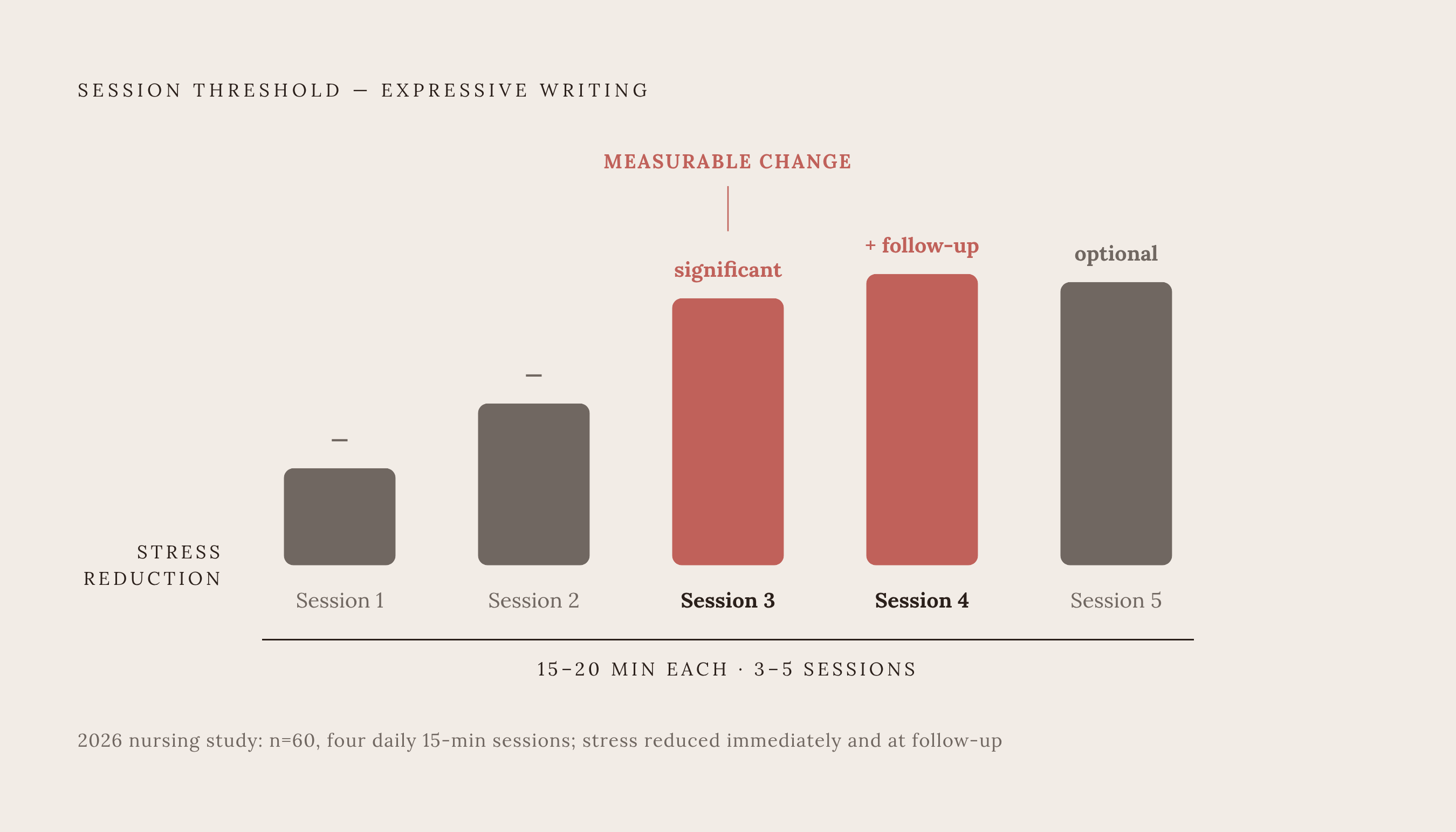
Pennebaker's paradigm is a timed, repeated protocol rather than an open-ended diary habit. It's timed, and it's repeated, which is a meaningfully different instruction than "write when you feel like it." The standard protocol runs 15 to 20 minutes per session across three to five occasions, and that's the dose at which the literature keeps finding consistent effects. Not ten minutes once. Not an hour every day for a month. A handful of sessions, a quarter of an hour each, roughly.
A 2026 study of nursing students tested a compressed version of this: four consecutive daily 15-minute sessions, each aimed at specific academic stressors like exam pressure, workload expectations, and the general grind of college life. The intervention group, 30 students, showed significant reductions in overall stress compared to a control group of 30, both immediately after the sessions and at follow-up. Measurable change showed up within three to four sessions. Measurable change showed up within three to four sessions, closer to a long weekend than a months-long commitment. It's closer to a long weekend.
Expressive writing's performance in occupational and burnout contexts
Laboratory studies are one thing. Work is another. A study published in the Journal of Workplace Behavioral Health looked at expressive writing as a countermeasure to work stress specifically, and measured it against a wider net than most academic research bothers with: burnout, irritation, psychosomatic complaints, affectivity, life satisfaction, and general well-being. That's a broader scorecard, and it matters because burnout appears across many symptoms rather than as one clean symptom. It appears as a headache, a short temper, a recurring sense of dread before the week ahead, and a dozen other things that don't always get filed under "stress" until someone adds them up.
A separate study, published in Cogent Psychology, split 35 teachers and 31 non-teachers into two groups: one did three consecutive days of positive expressive writing, the other a neutral writing control, both online, both 20 minutes. State anxiety dropped more in the positive writing group, and the researchers describe this as the first observation that positive expressive writing might help boost job satisfaction in full-time workers. The study itself reports that the intervention helped some dimensions of job satisfaction, but it didn't move burnout directly. The intervention helped some dimensions of job satisfaction without moving burnout directly, a reminder that burnout and job satisfaction are related but not identical, and a technique that lifts one doesn't automatically lift the other. It's a reminder that burnout and job satisfaction are related but not identical, and a technique that lifts one doesn't automatically lift the other.
Continued interest in this specific occupational angle appears again in a study out of the University of Parma, published in the Journal of Clinical Psychology in Medical Settings (vol. 33, no. 1, pp. 192 to 203), which examined expressive writing as a self-care tool for palliative care professionals, a group operating about as close to the edge of burnout risk as any profession gets.
Choosing between expressive writing approaches depending on where someone is in burnout
Deep burnout, the kind marked by real emptiness and disengagement, is not the same starting line as early-stage burnout, where someone is still invested but drowning in workload. Treating those as interchangeable is a bit like prescribing the same physical therapy for a sprained ankle and a broken one: technically the same body part, wildly different tolerance for load.
One staged structure for burnout-specific writing organizes prompts around four phases: recognizing burnout, processing the overwhelm, rebuilding, and prevention. The stage a person is in should shape both what they're asked to write about and the emotional register of the prompt itself. Someone newly aware they're burning out needs something different from someone six months into rebuilding a sustainable version of their job.
Pennebaker's original expressive writing protocol, the timed exercise repeated across sessions, is built for processing what's already happened. It's suited to the accumulated weight of a burnout period, the backlog of unprocessed stress sitting in the amygdala, still unresolved. Positive expressive writing shifts the lens toward meaningful or positive work experiences rather than stressful ones, and the teacher and worker study above suggests it does more for job satisfaction and anxiety than for burnout directly. That makes it a better fit for early recovery or prevention than for someone in the thick of acute burnout, where there might not be much positive material readily available to write toward anyway.
What effective burnout-focused writing sessions look like in practice
Session mechanics affect whether the writing produces measurable benefit, down to details like spelling and structure. The evidence base points to 15 to 20 minutes, uninterrupted, guided by a specific prompt rather than a blank "write about your feelings" invitation. Spelling, grammar, sentence structure: all explicitly off the table. The instruction is to keep writing, continuously, even if that means repeating a phrase or circling the same sentence twice.
A useful internal structure for a burnout-focused session moves in three parts within a single sitting. Start with what's depleting or unresolved right now. Move to how that's affected the sense of self or the sense that any of it means something. Close with whatever changed understanding results, even if it's partial or unsatisfying. That arc, start to middle to end, is a small-scale version of the meaning-making process the research identifies as the actual mechanism at work, compressed into a single writing session instead of stretched across weeks.
Prompts built for each stage might look something like this:
Recognition: "What's felt heaviest at work recently, and when did it first start feeling like too much?"
Processing: "What has this period actually cost, beyond the obvious work terms, and what does that cost say about what actually matters here?"
Rebuilding: "What would a sustainable version of this job look like, and what would have to change to get there?"
Prevention: "What patterns showed up before this burnout started, and which early signals got missed or waved off?"
The instruction to keep writing even when it feels repetitive is deliberate advice. The instruction to keep writing even when it feels repetitive is deliberate. The moment writing gets uncomfortable is usually the moment it starts working, and stopping to escape that discomfort is exactly the exit the exercise is designed to close off.
What the tool needs to support when choosing where to write
The cognitive demands here are narrow and specific: the tool needs to get out of the way. It needs to support timed, uninterrupted writing, and it should not introduce anything that pulls a person out of the reflective state the session depends on. A notification, a formatting menu, a suggestion to try a new feature, any of it can break the thread.
Distraction-free, prompt-guided setups tend to outperform feature-heavy tools for this specific purpose, and the logic isn't complicated. More features mean more decisions, and burnout, almost by clinical definition, leaves people with less capacity for decisions, not more. Choosing a font is a decision. Choosing whether to journal at all, after a ten-hour day, is already the harder one.
That raises a fair question about medium. Does it need to be typed? The actual requirement is continuous, low-friction engagement, and for a lot of people, typing itself is the barrier: the blank page, the slow hunt-and-peck at the end of a shift, the small dread of watching a cursor blink. Speaking through a session instead of typing removes some of that friction. Voice-first, conversational, prompt-guided formats, where talking replaces typing and a prompt replaces the blank page, address the two most common ways this habit dies before it starts: the effort of sitting down to write, and the effort of knowing what on earth to say once seated. Neither of those frictions has much to do with whether the underlying science works. They have everything to do with whether anyone actually does the exercise on a Tuesday night when the alternative is falling asleep on the couch.
Sources
- Full article: Expressive writing as a practice against work stress: An experimental study
- Full article: Positive expressive writing as a tool for alleviating burnout and enhancing wellbeing in teachers and other full-time workers
- Write to heal: the impact of an expressive writing intervention on stress in first-year nursing students
- (PDF) Emotional and physical health benefits of expressive writing
- Frontiers | Chasing elusive expressive writing effects: emotion-acceptance instructions and writer engagement improve outcomes
- journals.sagepub.com
- link.springer.com