Why Twentysomethings Who Process Out Loud Are Ditching Typing for Voice Journaling
Speaking lets out-loud thinkers journal in their natural processing style.
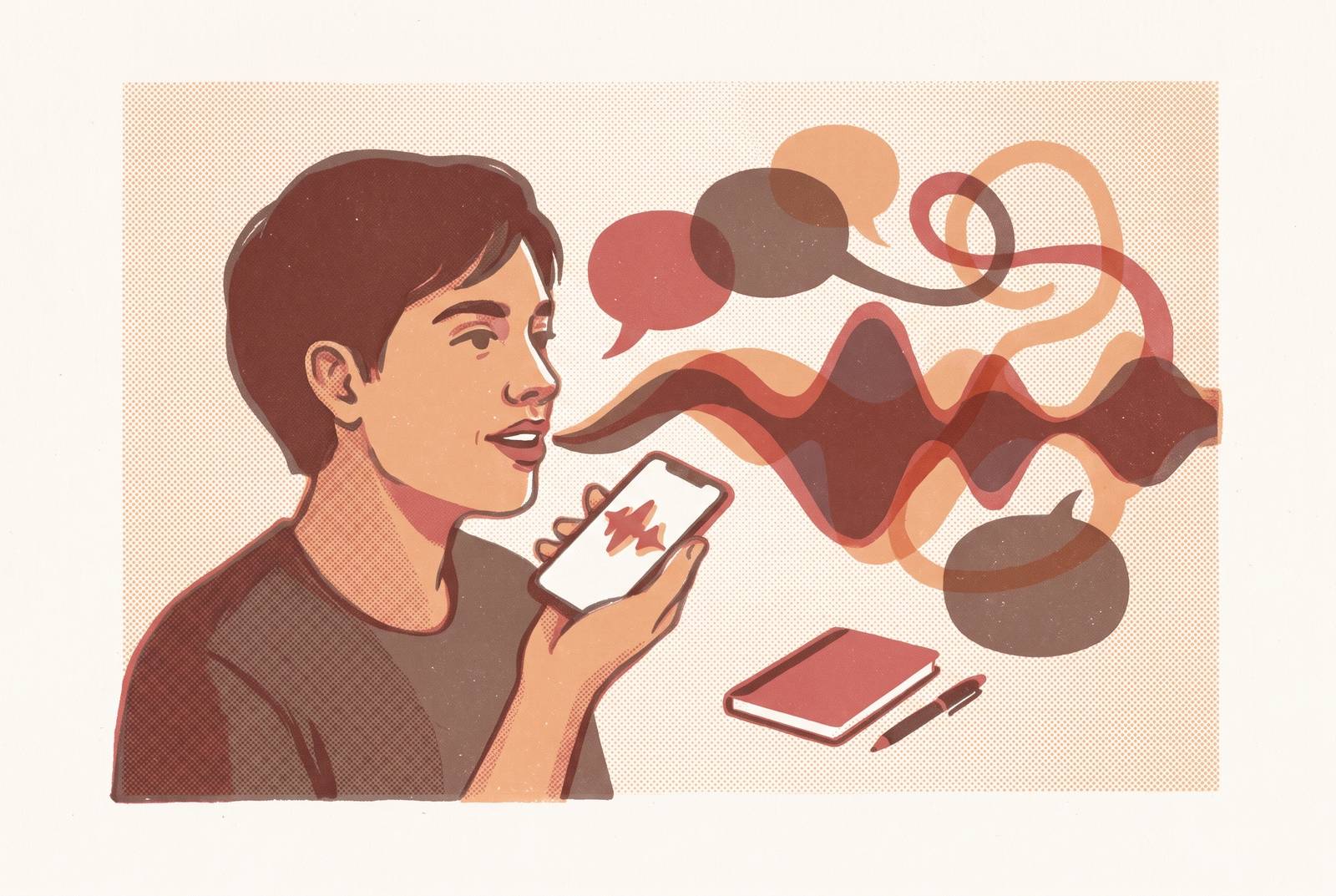
Voice journaling is a way for people who think better out loud to record and work through their thoughts without typing them. For twentysomethings who already process through conversations and voice memos, its main advantage is a better fit. Speaking removes the format mismatch that can make written journaling difficult to sustain.
Why out-loud processors already journal — they just don't call it that
You send a voice memo about a hard day and work out what upset you halfway through recording it. Or you talk something through with a friend and reach a conclusion you did not have when the conversation began. The talking is doing some of the thinking. For this kind of processor, words do not simply report a finished thought. They help assemble it.
That distinction separates people who have never wanted to journal from those who have repeatedly tried and quit. The second group already wants space to think things through. A blank page gives them that space in a form that may obstruct their usual way of reaching clarity. Their abandoned journals need not be evidence of weak commitment. They may be evidence that the wrong tool kept getting assigned the job.
What voice journaling actually is, separated from the hype around it
Voice journaling means recording yourself as you talk about your day, feelings, challenges, and things you notice, as a way to work through emotional processing and build self-awareness. Instead of composing a written entry, you speak and let thoughts arrive before deciding whether they sound polished. The recording becomes the journal entry. It does not need an audience, and it does not need to read like an essay afterward.
A daily check-in recounts what happened, while emotional processing stays with an experience that still feels active. Gratitude reflections name what you appreciate, and morning intentions describe what you want from the day ahead. Stream-of-consciousness entries can be about whatever comes to mind.
Recording a difficult feeling is not therapy, and describing a mood is more open-ended than logging it in a tracker. AI analysis is optional. The common feature is a shorter path from experience to expression.
Why written journaling keeps failing the people who most need it
Writing about an emotion asks for several things at once. You have to feel it, find words for it, organize those words, and keep typing or moving a pen. Those demands arrive on top of the distress that prompted the entry.
The empty page adds its own performance standard. It seems to ask for something coherent and meaningful before the writer knows what the experience means. Someone who understands a feeling only after talking through it is being asked to present the conclusion before doing the work.
For people with ADHD, the parallel demands can be especially costly. Spelling, grammar, formatting, and sentence structure compete with the emotional processing the exercise is meant to support. Speaking removes much of that written production work, though it does not remove every difficulty with attention or consistency. In that context, quitting a written journal can be a reasonable response to an ill-fitting format.
What the brain does differently when you speak versus when you type
Speech combines language production with movement and hearing. Broca's area contributes to speech production, while auditory systems process the words as they are spoken. That combination creates an external feedback loop. Instead of holding an unfinished thought entirely in your head, you can hear what you have just said and respond to it.
The sequence is important because silent thinking can circle. Spoken words unfold in time, giving ideas an order even when the speaker starts without one. A thought becomes something you can hear, question, or qualify. This helps explain why talking can produce clarity that silent rehearsal has not.
Prosody adds another layer, including tone, pace, hesitation, and changes in the voice. A transcript preserves the words but not necessarily the tremor around a difficult memory or the acceleration of excitement. The Voice, Emotion and Speech Neuroscience Lab studies self-voice processing and how emotions in a voice shape what people perceive. That work supports treating the voice as more than a delivery system for text, without establishing that every spoken journal entry is more useful than a written one.
How affect labeling — naming emotions aloud — actually reduces their intensity
Naming an emotion changes the task from experiencing it to representing it in words. That process is called affect labeling. Anxiety becomes something identifiable rather than an undifferentiated sense that everything is wrong. The label can change the response to the feeling itself.
Lieberman et al. (2007) found that affect labeling increased activity in the right ventrolateral prefrontal cortex, a region linked to inhibitory and symbolic emotional processing. The study also found that activity there and in the amygdala were inversely correlated. The amygdala helps detect threats. This offers a mechanism for why putting a feeling into words can modulate it.
However, evidence for affect labeling is not proof that speaking always outperforms writing. Voice journaling provides an accessible way to do the naming, particularly for someone who struggles to get an entry started. It also gives repetitive internal language an audible sequence. The useful shift is from being caught in the feeling to identifying and examining it.
What Pennebaker's expressive disclosure research says about speaking versus writing
James Pennebaker's expressive disclosure research showed that putting difficult experiences into words can help reduce anxiety, improve immune function, and lead to better emotional regulation. Writing is the best-known form of that work. Yet the early research also included spoken disclosure, with participants talking about traumatic experiences into a tape recorder.
Those who spoke benefited much as those who wrote did. The finding changes the question from whether a journal must be written to what the act of articulation accomplishes. Researchers at the University of Texas at Austin, building on Pennebaker's work, also found that benefits of emotional disclosure were not confined to writing. Spoken disclosure could help with emotional regulation and lower stress.
Neither way works better for everyone, and this research does not show that a given journaling app will bring those results. Writing may suit someone who needs more time to think through an experience. For someone who keeps avoiding the page, though, speech makes it easier to put an experience into words, an act the research supports.
The difference between processing out loud and venting, and why it matters for whether journaling actually helps
Talking can repeat a grievance without changing the speaker's understanding of it, just as internal rumination can revisit the same distress. More expression is not automatically more processing. The distinction is whether the entry opens up the experience or merely rehearses the existing account.
Stella Labs provides a concrete hinge with its question about what meaning the speaker is assigning to an event. That separates what happened from the interpretation attached to it. An entry can then move from recounting events to examining their significance and considering what is needed next. The next step might be an action, a conversation, or an acknowledgment that no decision is required yet.
This need not turn an informal recording into an interrogation. Tangents and contradictions can remain, provided there is some movement toward understanding. Structure, even a small amount, is what separates intentional voice journaling from simply talking to yourself.
Voice journaling's practical advantages for people who are busy, mobile, and easily distracted
That light structure is easier to use when the format fits into an ordinary day. A spoken entry can happen on a walk, during a commute, in a waiting room, or lying in bed, where privacy allows. It requires no desk or good lighting. For someone easily distracted, speaking also avoids the delay in which a new thought can disappear while the previous one is still being typed.
What does such an entry actually sound like? Often it contains repetitions, pauses, incomplete sentences, and a claim the speaker revises halfway through. Working through a contradiction aloud can help the speaker understand it, while changes in pace or tone keep signs of how they feel that polished prose might leave out.
A few prompts can supply direction without demanding composition. Recounting what actually happened today invites a sequence, after which feelings may become easier to name. Asking what meaning you are assigning to events separates interpretation from fact. Asking what you need next lets you end an entry without having to come up with a solution.
The storage format serves a different purpose from the speaking. Raw audio preserves prosody and suits expression, while transcripts make entries easier to retrieve, review, and compare over time. Keeping both accommodates those different uses. For someone just starting, though, feeling awkward may get in the way more than storage does. Treating early entries as throwaways and speaking as if to a trusted friend can make an unfamiliar voice feel less like an audition.
The privacy question every voice journaler needs to answer before going deep
If a journaler thinks someone else might hear or analyze an entry, that doubt can lead them to hold back what they say. Privacy therefore affects the practice itself. It is not merely a preference about an app's settings.
Voice journaling tools vary in where they store entries and who can get to them. Some offer end-to-end encryption, while others store entries on cloud servers with standard encryption that could, in theory, let employees access them. Some use entries to train AI models. Understanding these architectures and policies requires more than a reassuring interface.
The lesson for a prospective user is to examine those arrangements before recording deeply personal material. Stella Labs says to check storage settings to establish whether a recording is private or gone. That check should cover three things: the encryption method, the data retention policy, and whether entries are used for AI training. Those questions apply to tools that just record as well as those that offer detailed emotional analysis.
What's the best journaling app if you hate writing but love talking through your thoughts?
The best match depends on what should happen after you press record. Raw-capture-first users want speed and little interruption, while prompt-guided users want help examining an experience. Others want to work through their thoughts in a conversation. A tool that transcribes speech should not automatically be treated as one that guides a dialogue.
Speakwise and Google Recorder are in the raw-audio-with-auto-transcription category for those who want to capture thoughts as fast as possible without prompts to guide them. That approach suits someone who already knows how to talk through a day and mainly needs a record that can be reviewed later. It keeps the emphasis on capture. It is not the same use case as wanting a framework for self-examination.
Know Your Ethos is an option for philosophical or structured self-examination. Entries serves users who want emotional analysis and AI tagging, using OpenAI's Whisper for transcription and GPT-4 for emotional analysis. It is designed for people who prefer speaking over typing and is iOS-only as of mid-2026. Those differences provide a more useful basis for choosing than a universal ranking, with the privacy questions above remaining a condition for every option.
Why voice journaling sticks when writing didn't — and what that says about habit design
The habit-design advantage is that the behavior is already familiar. Someone who routinely talks through a day does not have to learn an entirely new way of reflecting. Voice journaling redirects that behavior toward a private, intentional record. The change is smaller than becoming a person who enjoys sitting down to write.
Reducing friction also changes when the practice is possible. Working through thoughts no longer has to wait for the combination of a suitable place, available materials, and enough willingness to compose. Removing those obstacles can make it easier for someone to understand their life, though consistency remains uncertain.
For twentysomethings who think better out loud, the useful comparison is therefore not voice against writing in the abstract. It is a spoken practice that fits against a written practice that repeatedly stalls. The best journal is the one still being used in three months because getting a thought into it does not require thinking like someone else.