Loneliness After a Major Life Transition
The loneliness that follows major life changes is structural, not emotional, and it has a fix.
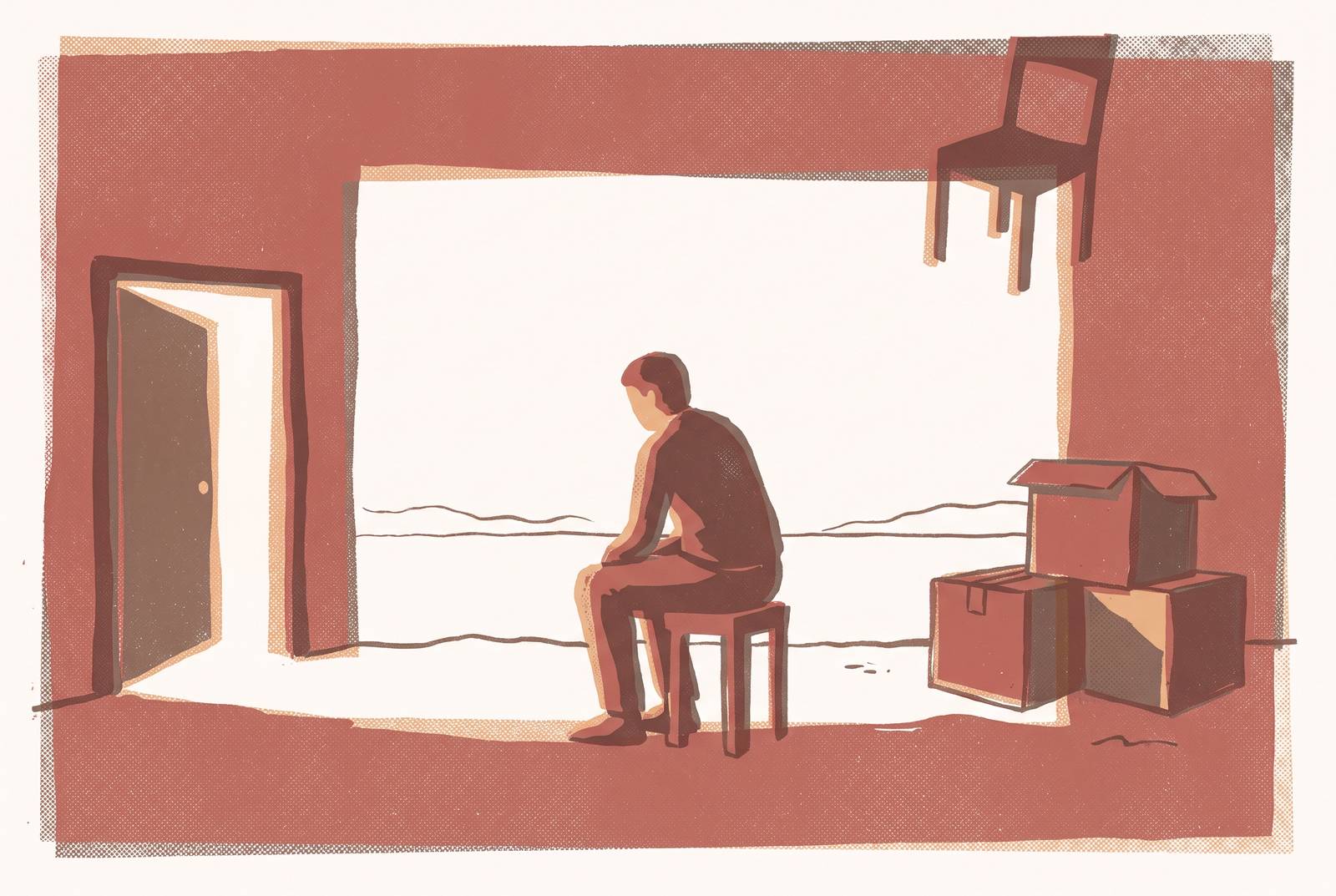
Major life transitions produce loneliness on a schedule you can almost set a clock to, and the mechanism behind it has nothing to do with how well the transition goes. Someone can land the promotion, move to the better city, have the healthy baby, and still find themselves sitting alone in a new kitchen at 9 p.m. wondering why none of it feels like it was supposed to feel. This piece is about that gap: why it opens up, what it looks like across the transitions that produce it most reliably, what it does to the brain if it's left alone too long, and what a person can actually do about it besides waiting for it to pass.
Why major life transitions produce loneliness
Adult friendship runs on shared context far more than most people give it credit for. The coworker who knows your coffee order, the neighbor who waves at the same time every morning, the friend from the old apartment building who used to just show up, none of those relationships exist because of some deep, portable bond. They exist because a context built the conditions for them and then kept supplying the occasions to maintain them. Pulling the context away leaves the relationship behind; it does not pack its bags and follow. It stays behind, the way a plant left in an old house keeps growing for whoever moves in next.
Dr. Gillian Sandstrom, an associate professor at the University of Sussex and director of the Sussex Centre for Research on Kindness, frames the mechanism in a way that reframes the entire problem: life transitions reduce both the opportunities to engage in social interaction and the number of interaction partners who are readily available. Read that twice, because it's doing more work than it looks like. It means the collapse is infrastructural. The roads out of the neighborhood get torn up, not the traveler's legs.
Three things keep a relationship feeling alive, and transitions tend to knock out all three at once. Shared context goes first, since a new job or city or role removes the backdrop that made bumping into people easy. Mutual history stalls next, because the people who knew the old version of a life are no longer there to reference it, and the people in the new life have no memory to draw on yet. And the small rituals, the Tuesday lunch, the Sunday call, the walk around the block at the same hour, lose their scaffolding when the schedule that supported them disappears. One of these breaking would be inconvenient. All three breaking at once is closer to a structural failure than an emotional one.
That's also what makes transition loneliness so disorienting: it tends to arrive exactly when the culture says someone should be celebrating. A new city is supposed to feel like an adventure. A promotion is supposed to feel like arrival. A new baby is supposed to feel like the fullest a life has ever been. When the internal experience doesn't match that script, the mismatch itself becomes a second problem, separate from the loneliness. People start to wonder what's wrong with them for feeling isolated inside a moment that was supposed to be a triumph, and that wondering, that private sense of ingratitude, is often more corrosive than the loneliness that triggered it.
The specific forms transition loneliness takes across common life changes
The structural story stays the same across transitions. The texture changes completely depending on which kind of context collapses.
Geographic relocation is the cleanest version, almost a controlled experiment in social infrastructure loss. Moving to a new city resets the social ledger to zero. There's no barista who already knows the order, no neighbor two doors down who waves on the way to the mailbox, no acquaintance from the gym who always asks how the week is going. Weak-tie networks, the ones that took years of small, repeated contact to build, vanish overnight, and they don't come back just because a person is friendly and shows up to things. They have to be rebuilt one encounter at a time, which is slow, and slow is not what a lonely person wants to hear.
New parenthood produces a stranger paradox: a person is rarely alone in the literal sense, and yet the isolation can be some of the most acute of any transition on this list. The old social world, built around spontaneity, late dinners, last-minute plans, doesn't bend to fit a newborn's schedule. Spontaneity is often the first casualty, and without it, the friendships that depended on casual, low-effort contact start to go quiet. Identity reorganizes itself around the new role faster than most people expect, and the friends who haven't had a child yet often can't follow that reorganization even when they want to. This loneliness takes a specific form: surrounded by one tiny, demanding person around the clock, and disconnected from every adult who used to be easy to reach.
Career change and retirement expose something that's easy to underestimate until it's gone: a job is never just a paycheck. It supplies identity, daily structure, and a dense, recurring web of social contact, all bundled into one role. When that role ends or shifts, the whole bundle goes with it, not just the income. A study tracking individuals across 24 countries found that behaviors, socioeconomic factors, and civil society participation all shape whether someone transitions into loneliness: the risk sits in structural circumstances, not in some personal failure to adapt. Retirement doesn't make someone lonely because they didn't try hard enough to stay social. It makes them lonely because the infrastructure that used to generate social contact automatically, five days a week, simply stopped running.
What ties all three of these together is a category of loss that rarely gets named: passive contact. These are the brief, low-stakes interactions with people who aren't close friends but who form a kind of ambient social texture, the dog walkers, the regulars at the coffee shop, the person at the front desk who always says good morning. Nobody notices how much weight these interactions were carrying until they're gone, and then a person feels the hole without being able to say what's missing. It's the hundred small, nameless people who made the world feel populated, not the absent best friend.
What loneliness does to the brain
Loneliness doesn't sit quietly waiting to be addressed. It actively changes how the brain processes social information, and left alone, that change tends to deepen the loneliness.
The mechanism works like a feedback loop with no off switch. Feeling disconnected raises the brain's alertness to social threat, so ordinary interactions start to feel riskier than they are. A text left unanswered for a day starts to read as rejection. A new coworker's neutral tone starts to read as dislike. That heightened threat-detection makes staying home feel safer than risking another small social wound, so a person withdraws, and that withdrawal deepens the disconnection that triggered the alertness. Each pass through the loop reinforces the next one, so loneliness that might have resolved on its own in a few weeks can instead settle in and start to feel permanent.
The body keeps score too. Research reviewed in the International Journal of Environmental Research and Public Health links loneliness to a 50% increase in the risk of developing dementia, along with worse cardiovascular health and elevated mortality. Isolation raises dementia and cardiovascular risk over time, not only mood, as it appears in the heart and the brain. Rokach and Berman describe the subjective experience with particular precision: lonely people report feeling unimportant, unnoticed, and uncared for, even when they're surrounded by people who do care about them. That detail matters, because it means loneliness is a measure of felt invisibility rather than how many people are nearby, and it can exist in a crowded house exactly as easily as an empty apartment.
One might argue that loneliness tied to a specific event should fade once the event is behind someone. Often it does. But transitions are precisely the moments when reactive loneliness, the kind triggered by a single identifiable change, risks becoming woven into how a person experiences the world more generally. That shift from situational to characterological is the real stakes of letting the feedback loop run unchecked. Waiting it out is a choice with a cost, because a brain already primed toward social threat works against the very reconnection that would resolve the loneliness.
This is where writing earns its place as more than a coping cliché. Naming an emotion measurably reduces its intensity, a process researchers call affect labeling, and the shift from raw sensation to something examined on a page moves the brain from threat response toward analysis. Loneliness, left unexamined, tends to feel shapeless and endless. Writing imposes a structure on it almost by accident: a beginning, a middle, and an implied direction forward. There's a real difference, neurologically speaking, between a person thinking "I am lonely" and a person thinking "I am experiencing loneliness right now, for identifiable reasons." The first is an identity. The second is a data point.
The Pennebaker expressive writing protocol, which involves writing about a stressful or emotional experience across a set number of sessions, has been linked to measurable improvements in physical and psychological health. The VA's Whole Health Library documents it as the most widely used and researched method of its kind in clinical practice, which is a fairly remarkable endorsement for something that requires nothing more than a notebook and twenty minutes. Applied to a transition specifically, the method looks almost deceptively simple: a handful of short sessions spent writing about the transition itself, not in the abstract, but about the deepest thoughts and feelings it has actually produced, without editing for how it sounds.
Brains differ in how they process this, so matching the method to the person changes whether the practice actually sticks. Someone who's noticed a specific distorted thought on repeat, something like "no one here will ever want to know me" or "I've missed my best years for making friends," is often better served by a structured thought record: write the thought down, question what evidence actually supports it, and build a more measured response in its place. Someone who processes by exploring rather than analyzing may do better with stream-of-consciousness free-writing, which maps the emotional terrain of a transition without forcing a conclusion before one is ready. Forcing a rigid log on a free-associative thinker, or unstructured free-writing on someone who wants data and a clear next step, tends to produce the same outcome either way: the notebook closes after three days and doesn't reopen.
Prompts that translate the signal of loneliness into specific, actionable insight
The most useful prompts don't ask a person to feel better. They ask a person to get specific, because specificity is what turns a diffuse, oppressive feeling into a problem that can actually be worked on. The first move is naming the flavor of the loneliness rather than just its presence: is this boredom, grief for the life left behind, the sting of feeling unseen in a new setting, or a loss of identity that hasn't found its footing yet? Each of those points toward a different response, and lumping them together under one label called "loneliness" makes the problem feel bigger and vaguer than it has to be.
From there, it helps to locate the actual need underneath the feeling by finishing one honest sentence: "I am craving ___." That single fill-in-the-blank often does more than any generic loneliness-fighting advice, because it forces the vague ache into something nameable, whether that's being known, being touched, being asked a real question, or just being around noise that isn't a screen. Once the need has a name, a two-bridge approach keeps the response proportional to where someone actually is in a transition: one small social bridge, a text, a call, a single invitation, and one solo bridge, a walk, a ritual, a return to a familiar place that still feels like home. Both bridges are deliberately small, since the first weeks of a transition punish ambition and reward anything that's realistic enough to actually happen.
As the initial rawness settles, the prompts can go deeper without tipping into rumination. Loneliness has sometimes helped surface something important about who a person is becoming, since the feeling isn't always purely destructive. What feels frightening about sitting fully with the loneliness instead of rushing to fix it matters, since the urge to fix is sometimes itself a form of avoidance. The transition has revealed something about the kind of relationships someone actually wants to build going forward, since old friendship patterns don't automatically deserve to be rebuilt exactly as they were. And being around people has sometimes been mistaken for genuine connection, since proximity and intimacy are not the same currency even though they often get spent as if they were.
A seven-day rhythm gives this enough shape to prevent spiraling without boxing out discovery: the first two days for naming what's actually being felt, the next two for understanding the need underneath it, and the final three for identifying small bridges back outward. Sandstrom's students at the University of Sussex developed a three-tier framework: work on strangers, weak ties, and strong ties in parallel, rather than waiting for one tier to feel resolved before touching the next. With strangers, the goal isn't depth but repeated exposure, since most people overestimate how badly a conversation with someone new will go and underestimate how much better it tends to land than expected; a weekly coffee run or the same bench in the same park at the same hour each day does more work than it looks like it should. With weak ties, self-disclosure is the actual mechanism that upgrades an acquaintance into something closer to a friend, and it doesn't need to be heavy, just honest, since most people wish for deeper conversation more than they ever initiate one. With strong ties, old friends tend to be happier to hear from someone after a long silence than that person expects, and the effort it takes to send one overdue message is reliably smaller than the psychological cost of letting the friendship keep drifting.
The 24-country longitudinal data offers one more piece worth building a life around: civil society participation, being embedded in some community or organization beyond work and family, is tied to meaningfully shorter stretches of loneliness. The specific activity seems to matter less than the fact of recurring structure itself. The choir, the recreational soccer league, the volunteer shift, and the book club are all functionally doing the same job. They are manufacturing the thing a transition just took away: a reason to show up, on a schedule, with the same people, until showing up stops feeling like an assignment and starts feeling like a life.
Sources
- Avoiding loneliness during life transitions
- Transitions of loneliness and lonely life expectancy: A longitudinal study across 24 countries - PubMed
- Loneliness: An Existential and Public Health Issue
- MAPPING THE FACTORS OF LONELINESS IN OLDER ADULTS: THE ROLE OF EMPLOYMENT AND WORK ACTIVITY – A SCOPING REVIEW