Friendship Recession Among Young Men
Young men are losing close friendships three times faster than other demographic groups.
The friendship recession is not hitting everyone equally. Young men are losing close friends faster than any other demographic group, and the pattern is sharp enough to qualify as a generational collapse rather than a personal failing. Understanding why requires looking past the headlines about loneliness and into the specific structural and behavioral forces at work.
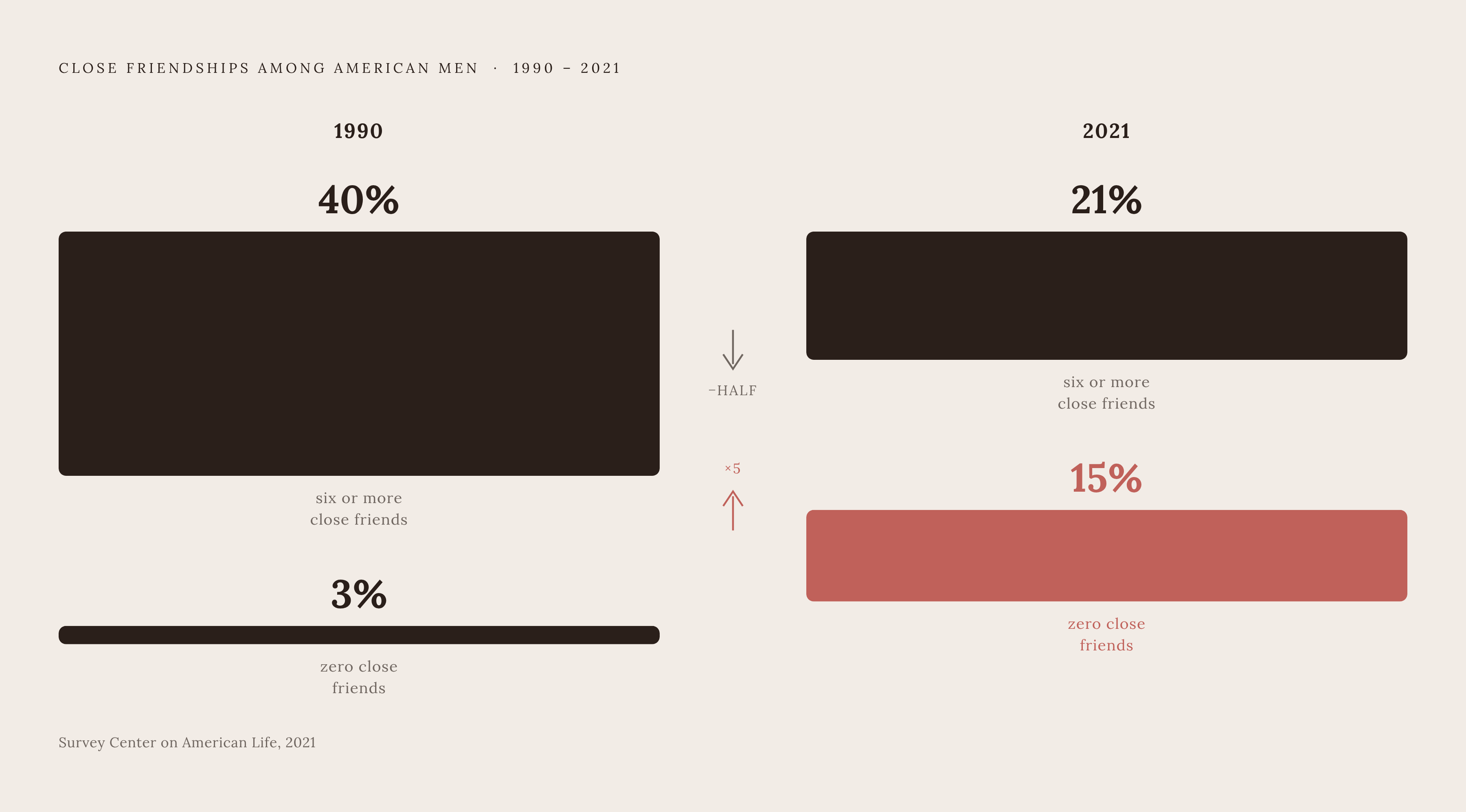
The numbers are stark. The share of American men with six or more close friends fell by roughly half between 1990 and 2021, according to Survey Center on American Life data. Over the same period, the share of men with zero close friends rose fivefold. This is not a gentle drift downward. It is a cliff, and the people falling off first are the youngest.
Gallup's 2025 data puts a finer point on it. Among U.S. men aged 15 to 34, 25 percent reported feeling lonely much of the previous day. That figure is significantly higher than the national average of 18 percent, and higher than the rate for young women, which sits at the same 18 percent. Young American men are now among the loneliest young male cohorts in the Western world. The OECD median for loneliness among younger men is 15 percent, meaning the United States stands apart from its wealthy-nation peers by a full ten points.
The decline is steeper for men than for any other demographic group tracked in the same dataset. That specificity matters. This is not a story about everyone getting lonelier at the same rate. It is a story about a particular group, at a particular life stage, losing a particular kind of relationship at a pace that demands explanation.
How adult life quietly dismantles the conditions friendship needs to form
Friendship is not a feeling that happens to people. It is an outcome of specific conditions, and those conditions have been systematically removed from adult life. Communication researcher Jeffrey Hall at the University of Kansas has established that friendship formation requires accumulated hours of freely chosen time. The key phrase is "freely chosen." Hours spent working side by side count far less than hours spent hanging out. Proximity alone does not build friendship. It takes sustained, voluntary shared time to move from acquaintance to close friend, and the average adult schedule simply does not contain that time anymore.
The American Time Use Survey, analyzed by Bryce Ward, shows that weekly time spent with friends dropped sharply between 2014 and 2019, before the pandemic. Think about the sequence there. The decline was already underway years before the pandemic began. The pandemic accelerated existing trends, but it did not start them. Routines that quietly sustained casual friendships broke during lockdowns, and many never reassembled.
Remote work has weakened the workplace as a friendship pipeline even as it remains the top venue where adults meet friends. The logic is uncomfortable. The place where adults most often form friendships is becoming a place where they interact less and less in person. Physical venues are contracting too: youth clubs, affordable community spaces, nightlife. Sociologists identify the engine of friendship formation as "repeated, unplanned interaction in a shared context." Each of those elements is under pressure. Repeated interaction requires time. Unplanned requires proximity. Shared context requires physical spaces. Adult life is dismantling all three.
Americans also move frequently across their lifetimes, resetting social networks each time. School used to provide automatic structure for rebuilding. Adulthood offers no equivalent. You arrive in a new city, you get a job, you commute, and the people you see each day are colleagues whose time together does not count as hanging out. The friendship pipeline narrows to almost nothing.
How masculine norms turn structural disadvantage into a behavioral trap
Structural forces make friendship harder for everyone. Masculine norms make it harder specifically for men to respond. Men typically form friendships through shared activity rather than direct emotional disclosure. The classic formulation holds that men bond side by side, not face to face. This has real consequences. When the shared context disappears, when the job changes or the team dissolves or the routine breaks, the friendship rarely survives the transition. The bond was always tied to the activity, and when the activity goes, so does the connection.
Traditional masculine norms emphasizing self-reliance, emotional stoicism, and independence increase vulnerability to loneliness and reduce willingness to seek social or emotional support. That finding comes from Mokhwelepa and Sumbane, published in the American Journal of Men's Health in 2025. The norms do not just reflect male loneliness. They actively generate it by rewarding the behaviors that let friendships lapse.
But there is a critical wrinkle, and it is the sharpest insight in this entire subject. An unpublished manuscript by Matavelli, summarized on a World Bank blog in 2025, found that most young men overestimate how stoic their peers actually are. The barrier to reaching out is partly built on a misperception of norms, not on the norms themselves. Men do not reach out because they believe reaching out would be unusual. In fact, their peers would welcome it.
This means the behavioral trap is partly self-reinforcing. A man assumes his friends are handling things fine, so he does not call. His friends assume the same about him. Everyone waits. No one reaches out. The friendship fades not because anyone wanted it to, but because everyone incorrectly believed that wanting to reach out was the unusual feeling in the room.
Why men's friendships look fine from the outside while quietly hollowing out
Here is the problem with diagnosing this issue: by most self-reported measures, men and women look roughly the same. Men and women report feeling lonely at roughly equal rates. The clearest difference is not in the feeling but in the response. Women are more likely to turn to friends, family, and mental health professionals for emotional support. Men are far less likely to reach out at all.
A 2025 systematic review found that men are less likely to report loneliness or discuss mental health with others, possibly due to social stigma and entrenched gender roles. The word "possibly" belongs there. What matters is the outcome. A man can be deeply isolated and still check the box that says he has friends, because most adults define "friend" loosely enough to include people they have not spoken to in a year. Surveys that ask specifically about close friends, people you would call at 2 a.m., produce much lower counts.
The dominant male coping pattern is reliance on a partner rather than a friend network. Men and women are equally likely to turn to a spouse or partner for emotional help, Pew Research Center found in 2025, but men reach out to friends far less often than women do. This looks stable from the outside. A man with a partner has someone to talk to. But the arrangement is fragile in a specific way. It concentrates emotional risk in a single relationship.
After divorce, bereavement, or retirement, that single relationship disappears or changes, and the man discovers he has no network underneath it. The friendships that looked fine from a distance turn out to have been scaffolding around one central relationship. When that relationship shifts, the whole structure has nothing holding it up.
What happens when social isolation goes unaddressed — and what is filling the vacuum
The stakes are not metaphorical. The U.S. Surgeon General's 2023 advisory documented that chronic social disconnection carries mortality risk comparable to smoking, alongside elevated risks of heart disease and stroke. Loneliness is not just unpleasant. It is physiologically corrosive.
Men make up the large majority of U.S. suicides, and social isolation is a documented contributing factor. In England and Wales, men's suicide rate remains roughly three times higher than women's, according to national statistics in 2024. The connection between isolation and suicide is not simple or automatic, but the pattern is consistent enough to take seriously.
And now there is a new variable. AI companionship is emerging rapidly. A large majority of U.S. teens have used AI companions at least once, and more than half use them at least a few times a month, according to Common Sense Media in 2025. Girls are slightly more likely than boys to use AI companions, which complicates the straightforward gendered story. In the UK, nearly half of 16-to-24-year-olds have used AI instead of speaking to a person about their mental health, according to the British Association for Counselling and Psychotherapy's 2026 survey.
The concern with AI companionship is not the technology itself. A tool that offers validation and a listening ear is not inherently harmful. The concern is the feedback loop. Constant validation may gradually reorient users' social preferences away from human interaction. Human relationships are difficult in specific ways: they involve friction, unpredictability, the other person's needs. An AI companion offers none of that friction. The risk is that it makes real friendship feel worse by comparison, compounding the very isolation it appears to address.
A necessary complication: the "epidemic" framing is partly wrong, and why that matters
At this point, a careful reader might object. Are we sure there is an epidemic of male loneliness? The answer, based on the best evidence, is no. And that is important to say clearly.
A 2026 systematic review in Frontiers in Public Health found that a widespread epidemic of male loneliness is absent. What the data supports instead is something more specific and more actionable: a sharp increase concentrated in younger men, ages 18 to 29, while older men, ages 60 and up, show more stable patterns. The crisis is not evenly distributed across all men. It is concentrated in one generation.
This matters for two reasons. First, precision helps. "Young men are the hardest-hit group within a real and ongoing decline" is both more accurate and more useful than "all men are in a loneliness epidemic." The accurate version points to where intervention is actually needed. The inflated version spreads the problem so thin that no targeted response makes sense.
Second, the framing has political implications. A La Trobe University discussion paper by Mwatsiya, Ison, Vrankovich, and Hooker argues that framings which present men as lonely because society has neglected them, or because they simply lack emotional vocabulary, flatten the causes. These framings distort the implications and depoliticise a deeply structural and gendered phenomenon. Saying "men need to talk more" puts the burden on individuals while ignoring the structures that removed the conditions for friendship in the first place.
The misperception-of-norms finding becomes relevant here again. If much of the behavioral trap is based on a false belief about what peers think, then some portion of the problem is correctable without structural redesign. Peer communication alone may shift behavior. That is genuinely good news. It means the problem is not monolithic, and neither are the solutions.
What actually rebuilds male friendship — and the structural principle behind what works
The friendships that survive and grow in adult male life share a common feature. They replace the automatic social architecture that adulthood removes with a deliberate, recurring substitute. Consider two examples. The Professional Black Men's Friends Group in Phoenix was founded by Quincy Winston, then 38 and formerly military, in March 2022. It started with seven men at Pappadeaux's restaurant. By 2024 it had grown to approximately 130 members meeting about once a week. What Winston did was not complicated. He created a regular gathering with a clear purpose.
Men's Sheds, a national nonprofit originating in Australia in the 1990s and now operating 27 U.S. locations, operates on a similar principle but with a different mechanism. Men show up to do something tangible, project-based work of some kind. Friendship is the byproduct. Phil Johnson, 74, helped start several chapters around Minneapolis. The point is not that men need workshops to process emotions. The point is that giving men something concrete to do together creates the conditions under which friendship forms naturally.
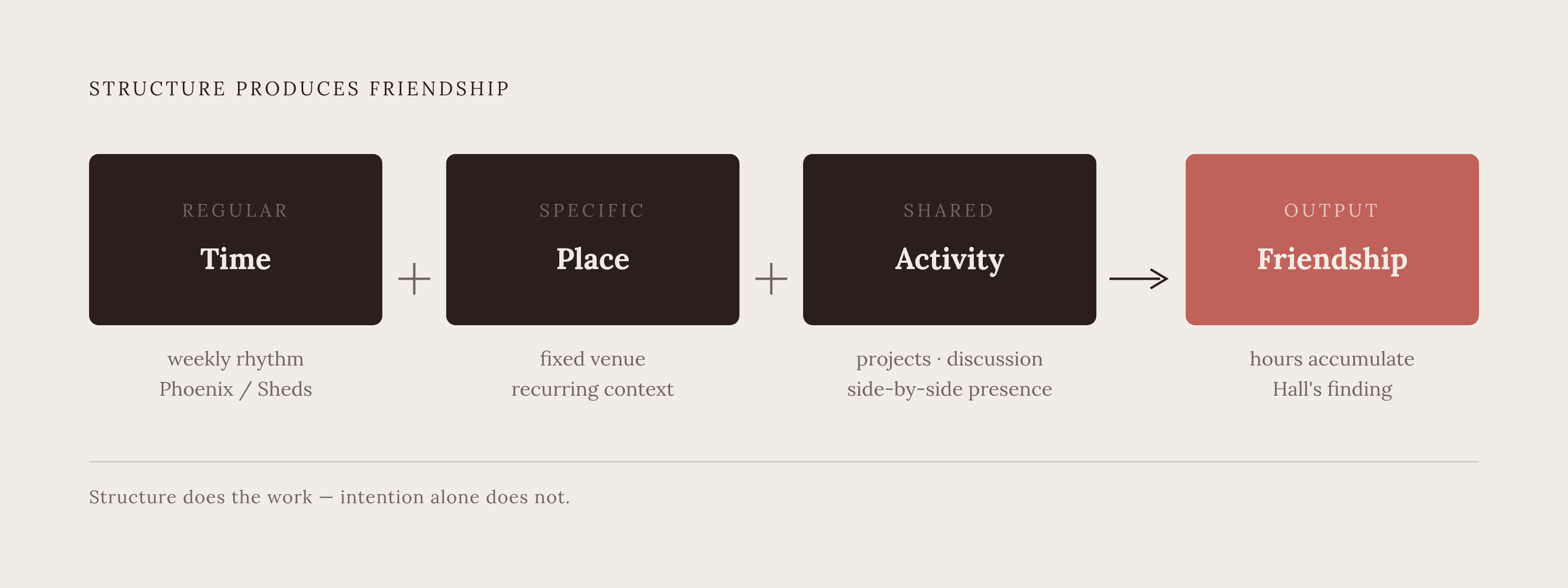
Both models share the same operating principle: a regular time, a specific place, and an activity. This removes the logistics burden that causes "let's hang sometime" to go nowhere. The structure does the work. Jeffrey Hall's research explains why. Hours of freely chosen shared activity accumulate toward close friendship far faster than incidental contact. The structure creates the conditions, not the intention. You do not need men to want friendship. You need to give them a reason to spend time together.
At the policy level, recognition is growing. A 2026 paper in Policy Insights from the Behavioral and Brain Sciences by Krems and Kaufman argues for integrating friendship skills into school curricula and embedding friendship into eldercare infrastructure. Governors including Utah's Spencer Cox, California's Gavin Newsom, and Maryland's Wes Moore have made the wellbeing of boys and men a policy priority, including social connection, mental health, education, and employment.
The OECD's 2025 report on social connections found the sharpest falls in daily in-person friend contact among the young across 21 European countries. The structural causes are not uniquely American. The problem is showing up across wealthy nations, which suggests the forces at work are broad and systemic rather than local and cultural.
Before anyone can rebuild a friendship practice, they need an honest picture of what has quietly slipped. The misperception-of-norms finding matters practically here. A man who believes his peers are more stoic than they actually are will not reach out. A structured reflective practice can surface that assumption and test it.
The specific questions worth working through are direct. Who have you let drift? What shared activity used to hold a friendship together that no longer exists? What would a recurring, structured time with one person actually look like in your current schedule? These are not therapy questions. They are logistics questions. And logistics, it turns out, is where friendship lives or dies.
Sources
- Younger Men in the U.S. Among the Loneliest in West
- Why a growing number of American men say they are in a 'friendship recession'
- Frontiersin
- Rethinking masculinity to build healthier outcomes
- American Men Suffer a Friendship Recession
- Men’s Mental Health Matters: The Impact of Traditional Masculinity Norms on Men’s Willingness to Seek Mental Health Support; a Systematic Review of Literature
- Male loneliness and isolation: What the data shows - American Institute for Boys and Men