Loneliness as a Public Health Condition in Under-35s
Young adults face widespread loneliness driven by structural changes, not personal failure.
Loneliness in under-35s is a public health condition. The evidence points to a problem shaped by the conditions of young adulthood, with effects that reach beyond mood into the brain and body. Understanding that pattern changes the response it calls for, from asking people to try harder socially to making meaningful connection easier to build and sustain.
Why loneliness is classified as a public health condition, not a personal failing
In 2023, the U.S. Surgeon General issued an 82-page advisory, Our Epidemic of Loneliness and Isolation, marking the first time the office treated social disconnection as a national public health crisis. The advisory placed connection within the same field of concern as other influences on health and premature death. Its framing was explicit that poor social connection carries a health risk comparable to smoking. That comparison was not a claim that loneliness and smoking act on the body in identical ways.
The World Health Organization declared loneliness a global public health concern that same year and launched a Commission on Social Connection. The WHO Commission’s later reporting linked the lack of social connection to hundreds of thousands of deaths per year. A feeling can be subjective and still have real effects on health. Public health is concerned with those consequences and with the conditions that expose people to them.
Loneliness is the gap between the social connections a person has and those they desire. Solitude, therefore, is not sufficient evidence of loneliness, and company is not proof of its absence. Someone can feel lonely in a crowd, with a full inbox or a large follower count.
Why the data consistently point to young adults, not older people, as the loneliest group
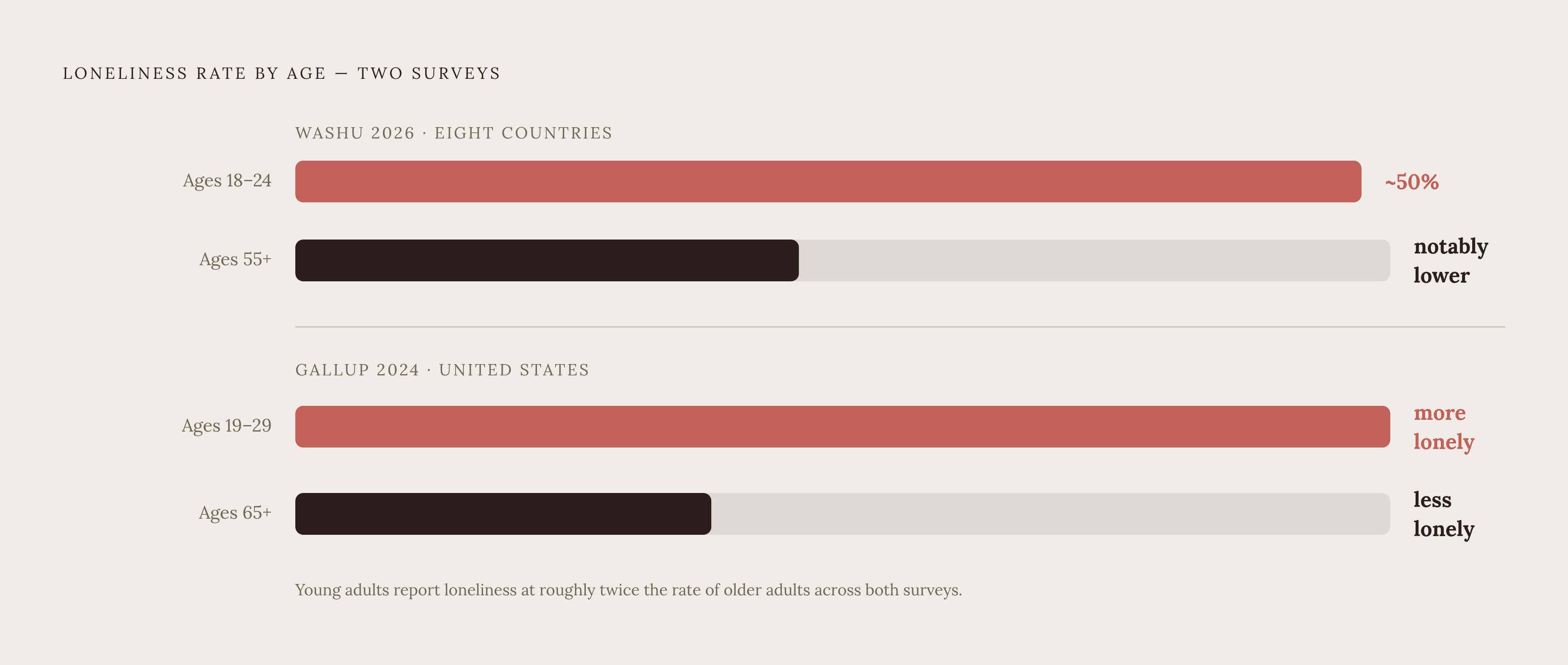
The familiar image of loneliness is an older person living in isolation. Survey data from multiple countries and methods complicate that picture, with young adults aged 18 to 34 reporting the highest loneliness of any age group. Age alone is a poor guide to where the greatest concentration of reported loneliness lies. The demographic pattern turns the familiar assumption on its head before any explanation of it begins.
The WashU 2026 study, covering eight countries, found that nearly one in two people aged 18 to 24 reported feeling lonely. Adults 55 and older reported loneliness at a notably lower rate. Gallup 2024 U.S. polling likewise found that adults aged 19 to 29 were more likely to feel lonely than adults 65 and older. The age brackets differ, so these are not interchangeable estimates of one precisely defined population.
The WashU study covered Brazil, France, India, Indonesia, Nigeria, the Philippines, Turkey, and the United States. Its breadth makes the pattern difficult to dismiss as a peculiarity of one culture or economy. The study also found that the association between loneliness and depression and anxiety held across all eight countries after accounting for demographic differences and prior diagnoses. That consistency establishes a wider concern without proving that every country has the same causes or needs the same response.
What is driving loneliness in young adulthood — structural forces, not character flaws
Social connection depends on people meeting casually, in person, again and again, and several changes in how people live have left fewer chances for this. Families are smaller, people marry later, and more people live in single-person households, so people have less company as part of daily life at home. Geographic mobility also disrupts community ties, with young adults moving more frequently and living farther from the networks they grew up in. These changes reduce the social infrastructure a person can inherit without having to assemble it from scratch.
Outside the home, fewer people take part in civic organizations, faith communities, and community groups, leaving fewer chances to see the same people often. Robert Putnam’s Bowling Alone tracked how people pulled away from these shared institutions. Such institutions supplied more than activities, because they brought people back into contact with one another repeatedly. Urban and suburban design can further narrow those opportunities when places offer few walkable, public gathering points. Without those settings, incidental encounters have fewer chances to accumulate into familiarity.
Work and the pandemic added further disruption at a particularly unsettled stage of life. Remote and hybrid work removed much of the incidental social contact of workplaces, disproportionately affecting young adults entering the workforce for the first time. Pandemic disruptions also broke social routines that, for many young adults, were still forming.
Digital contact sits within this larger picture. Young adults are the most digitally connected generation in history, yet that connectivity does not necessarily translate into felt closeness. This is the paradox of “digital density plus relational poverty”, in which a busy feed can coexist with an unmet need for connection. Social media’s presentation of curated lives can also intensify the gap between expectation and experience. Baylor University’s 2024 study in Personality and Social Psychology Bulletin found that both passive use, such as scrolling, and active use, such as posting and commenting, were associated with growing loneliness over time. That finding challenges the idea that simply doing more online is a reliable answer.
What loneliness does to the young adult brain and body over time
These conditions matter medically because chronic loneliness can keep the body’s stress response activated. This raises stress hormones and inflammation, which keep the cardiovascular system and the immune system under strain.
John Cacioppo and colleagues showed that lonely people have changes in gene expression that affect inflammatory pathways. Their research described immune systems maintained in a higher state of alert, a pattern associated with chronic disease risk. The Surgeon General’s advisory documents elevated risks of heart disease and stroke, as well as a substantially increased risk of dementia among older adults. The dementia finding in older adults does not show a dementia risk in the under-35 population. Its relevance here is the time horizon, because the effects of chronic exposure can begin accumulating long before later-life illness becomes apparent.
Mental health adds a more immediate, self-reinforcing pathway. The WashU 2026 study found that people reporting loneliness had almost three times the odds of meeting screening criteria for depression and nearly four times the odds of meeting screening criteria for generalized anxiety. These links with screening results do not prove that loneliness alone caused either condition. The relationship runs in both directions, as loneliness heightens stress, disrupts sleep, and reduces social support, while depression and anxiety can produce withdrawal and negative expectations about relationships. The resulting feedback loop can deepen the very disconnection from which it began.
That loop is particularly consequential in young adulthood because this is a period of building social foundations. Close friendships, romantic partnerships, and professional networks can protect against isolation in later decades. Loneliness can therefore be most disruptive when those ties are least established and the work of forming them is still under way. Sustained exposure can accumulate during the same years in which protective relationships are supposed to take root.
Why the public health system is starting to screen for loneliness in routine care
Some healthcare systems are beginning to screen patients for loneliness during routine visits. Screening brings social disconnection into the clinical conversation before it is left entirely to the patient to raise. It also reflects the evidence that loneliness can be connected to both physical and mental health.
Screening becomes useful when a positive result connects to something actionable. Integrated care models are designed to make that connection through referrals to behavioral health support, community programs, peer support networks, or social prescribing initiatives. These pathways give the finding somewhere to go. Where they are absent, screening can identify a need without supplying the means to address it, which is an important limit on claims of progress.
Government attention to this issue also predates the recent health advisories. The UK appointed a Minister for Loneliness in 2018, becoming the first government to treat social disconnection as a policy portfolio. That move recognized that the causes extend beyond what a consultation can change. Housing costs, workplace design, civic decline, and urban form are not conditions an individual can simply overcome by being more outgoing. Advice to “put themselves out there” places the burden on the person while leaving those conditions intact.
The Surgeon General’s advisory sets out six pillars to help people build social connection, with changes to community infrastructure, public policy, and workplace design. It also calls for changes in community life, healthcare, and technology to happen together. Healthcare can recognize loneliness and connect people with support, but it cannot by itself rebuild every setting in which relationships grow. A referral pathway and a place worth being referred to are different parts of the same response.
What individuals can do within that structural reality — and why the approach matters
A structural explanation changes what personal action can reasonably be expected to achieve. Individual practices are supportive tools within a larger problem. The research favors the quality and consistency of connection over the sheer quantity of social activity. That distinction matters because an overcrowded calendar is not the opposite of loneliness. The goal is felt closeness.
Small, real interactions that happen often do more to protect against loneliness than large social events held now and then. A few genuinely close relationships also predict better health outcomes than a large, shallow network. Shared activities, including classes, groups, and standing commitments, create repeated contact with the same people. They are more reliable than waiting for motivation to initiate a succession of one-off events.
The form of contact matters as well as its frequency. Voice and in-person interaction tend to relieve loneliness more effectively than passive scrolling or text-based interaction because tone and presence carry warmth that text cannot. More messages and more meaningful contact are not necessarily the same outcome.
UCLA neuroimaging research found that affect labeling, or putting feelings into words, activates the prefrontal cortex while dampening amygdala activity. The research involved labeling emotions on photographs, so its findings apply to that task and should not be treated as a direct test of journaling for loneliness. It does illuminate the regulation mechanism captured by “name it to tame it”. Expressive writing and journaling have a role in processing feelings, but they do not replace connection itself.
Emotional regulation can help with the experience of loneliness, while recurring, meaningful contact addresses the unmet need at its center. Institutions, in turn, help shape how easy or hard it is for people to find that contact.