Identity Diffusion vs. Identity Moratorium in the Twenties
Two identity statuses look the same from outside but run on entirely different engines.
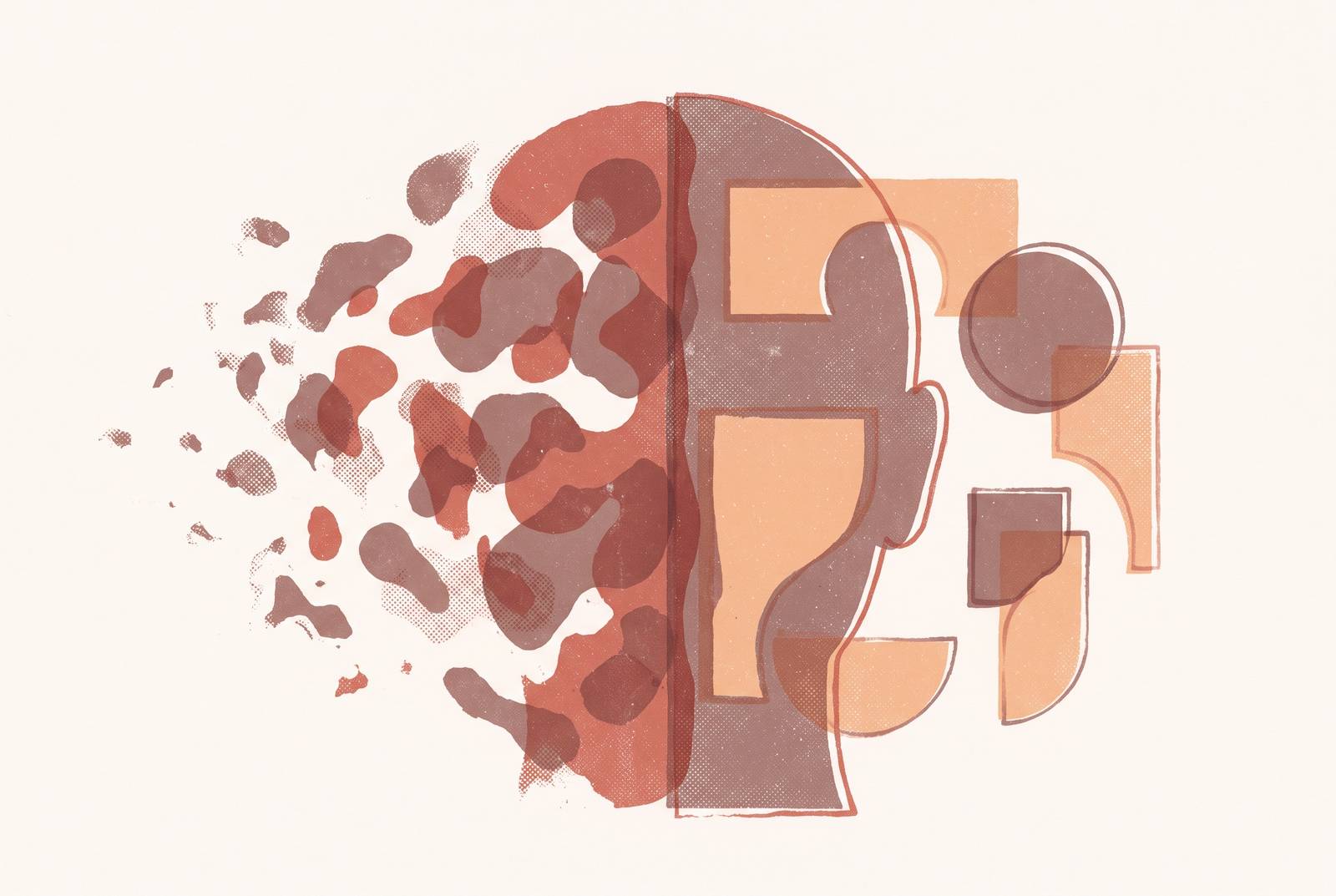
The twenties feel psychologically crowded for a specific structural reason: two developmental stages from a well-known stage theory, which were designed to run in sequence, end up overlapping and pulling against each other at once. Identity formation (the "who am I?" work of adolescence) and intimacy versus isolation (the "who do I let in?" work that follows) do not politely wait their turn. They show up together, and each one complicates the other, because committing to another person is hard to do honestly while the terms of the self are still being drafted.
This collision is built into the developmental timeline, not a sign that someone is behind schedule. Erikson originally framed identity work as adolescent business, something largely settled before a person reached their twenties. Later research revised that picture considerably: most identity formation actually happens during young adulthood, not before it. That reframing matters because it means the twenties are not a delayed cleanup of teenage loose ends. They are the main event, the decade where the actual labor of answering "who am I?" takes place, often at the exact moment a person is also trying to figure out who gets access to that still-unfinished self.
Marcia's Four Identity Statuses
Psychologist James Marcia took Erikson's broad idea of an "identity crisis" and gave it measurable coordinates. Marcia's model runs on two axes: exploration (whether a person is actively questioning and testing options) and commitment (whether a person has settled on answers). Crossing those two axes produces four statuses, and each one describes a genuinely different psychological position rather than a rung on a ladder from immature to mature.
Low exploration paired with low commitment defines identity diffusion. Identity foreclosure holds commitment without the exploration that would normally precede it, often because a role was simply inherited. Identity moratorium holds exploration without commitment, the active searching that hasn't yet resolved into an answer. Identity achievement is commitment that arrives after exploration has run its course.
Picture the two axes as a simple grid: commitment present or absent on one side, exploration present or absent on the other. Diffusion and moratorium both land in the "commitment absent" column, and that shared column is exactly where the confusion starts. From outside the grid, both statuses look like a person without settled answers, shrugging through quarter-life decisions with no fixed position. The difference between them has nothing to do with what's visible from outside. It lives entirely in whether real exploration is happening underneath that shared appearance of unsettledness.
Identity Diffusion
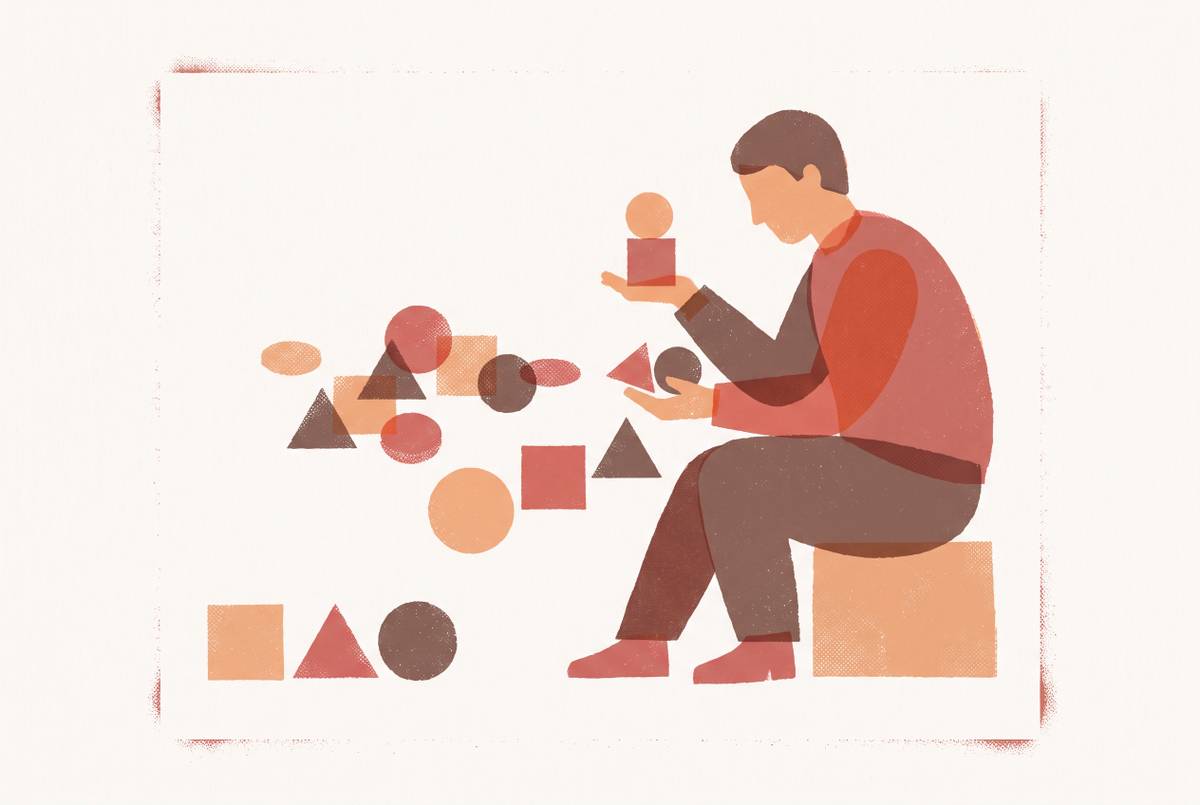
Identity diffusion gets mistaken for a holding pattern, a neutral pause before the real searching starts. The research treats it differently: diffusion is the absence of searching itself, not a prelude to it. Low exploration and low commitment occur together: the person isn't questioning options, testing roles, or building toward any particular choice. That absence of forward motion is precisely what makes diffusion the least developmentally adaptive of Marcia's four statuses.
The deceptive part is how diffusion can present. Someone in a diffuse identity status can hold down a full class schedule, maintain an active social calendar, and look entirely functional to everyone around them, while still carrying no real sense of personal direction. The scattering happens internally, invisible to a roommate or a parent checking in over the phone. A useful image from the research literature: diffusion looks like someone trying on outfit after outfit without ever actually choosing one to wear out the door. Friend groups, majors, hobbies, belief systems get sampled and dropped in turn, none of it sticking long enough to become part of an actual identity, leaving the person feeling scattered or quietly disconnected from their own life.
That drift carries weight beyond the twenties themselves. People who persist in diffusion risk continuing to drift with little sense of purpose and weak connection to the people around them, which is less a moral failing than a developmental stall that tends to compound the longer it goes unaddressed.
The two faces of diffusion, carefree versus troubled
Diffusion isn't one experience wearing two names. Research distinguishes two versions of the same low-exploration, low-commitment position, and they feel almost nothing alike from the inside. Troubled diffusion comes packaged with high ruminative exploration: the person circles the same identity questions over and over, can't convert that circling into any proactive step, and lives with a steady undercurrent of worry and indecision. Carefree diffusion looks almost like its opposite. People in this status aren't bothered by their own lack of proactive identity work, and because nothing feels urgently wrong, they also don't ruminate about it.
Carefree diffusion can be genuinely difficult to spot, in oneself or in anyone else, despite the name suggesting otherwise. It doesn't read as paralysis. It can read as ease, even a kind of confidence, which is part of why it tends to persist unchallenged. Both versions of diffusion still register as the least adaptive statuses in Marcia's framework, and in one large study, people in both carefree and troubled diffusion statuses tended to be the youngest participants in the sample, suggesting these positions cluster especially early in emerging adulthood.
The practical fork matters for anyone trying to figure out what kind of help, if any, is useful. A person in troubled diffusion already knows something is off and is suffering over it, so the task is converting that distress into direction. A person in carefree diffusion feels no such urgency, so the task looks more like noticing the absence. Both are stuck in the same place on Marcia's grid, but a prompt that would jolt one of them into motion might not even register with the other.
What identity moratorium is, and why discomfort is its most reliable sign
Moratorium is the status most easily confused with diffusion from a distance and the most different from it up close. It's defined by high exploration paired with low commitment: active questioning of values, genuine trial runs of different roles, real exposure to competing beliefs, none of it yet resolved into a settled answer. The research literature describes this as an anxious, emotionally tense period, and that description shouldn't be softened. People in moratorium carry more negative emotion on average than those in achieved or foreclosed statuses, and the many questions genuinely outnumber the available answers for a while.
That tension is the cost of admission for the work moratorium actually involves. Diffusion avoids this discomfort by avoiding the searching that produces it; moratorium pays the emotional price precisely because the searching is happening. Moratorium scores high across exploration in breadth, exploration in depth, and ruminative exploration simultaneously, while commitment stays low to moderate, signaling someone working several fronts at once.
None of that makes moratorium pleasant, and it shouldn't be romanticized as some enlightened state the diffuse person is simply failing to reach. It's uncomfortable because it's effortful, and effort toward an unresolved question tends to feel worse in the moment than giving up on the question. The discomfort has a direction, though, which is the part diffusion's drift doesn't share.
The single clearest test that separates the two states
The test that actually separates moratorium from diffusion isn't "do you have answers yet?" Both statuses will produce a "no" to that question. That is exactly why it fails as a diagnostic. The real question is whether genuine searching is underway, because moratorium includes active exploration and diffusion includes little to none of it, even though both can look like uncertainty from the outside.
Concrete markers of moratorium: trying out a new friend group and noticing what shifts, changing direction in a major after an internship reveals something unexpected, actively comparing two career paths against specific criteria, debating a value with someone and meaning it. That's restlessness pointed somewhere. Concrete markers of diffusion look different: going along with whatever option requires the least friction, sidestepping decisions rather than making them, echoing whatever opinion a parent or a peer group already holds instead of forming one independently, feeling scattered with no real pull toward resolving it.
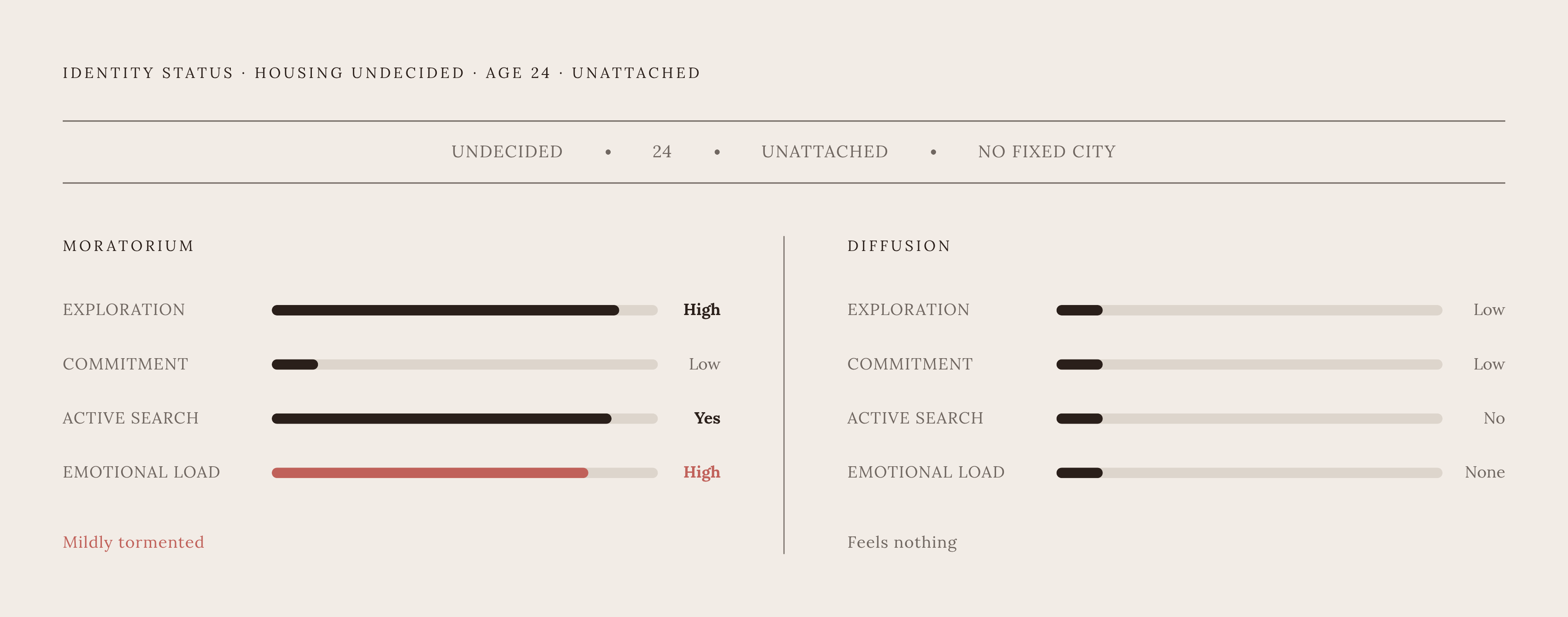
Picture two people, both 24, both unattached, both undecided about where to live next year. One has spent the last six months test-driving two different cities through actual visits, comparing cost of living against specific values about family proximity, and feels mildly tormented by the decision. The other has simply stayed where they landed after college because moving sounded like a hassle, hasn't weighed alternatives, and doesn't feel much of anything about it either way. Housing status: identical. Internal status: opposites.
One thing complicates any clean self-diagnosis: a person can occupy different statuses in different domains at the same time. Someone might be achieved in career direction, diffuse in relationship values, in moratorium about geography, and foreclosed on religious identity, all simultaneously. The test has to be run domain by domain. Running it once, globally, and expecting a single verdict misreads how identity actually fragments across a life.
The collision between identity formation and intimacy needs described earlier generates real psychological intensity, and that intensity often pushes people to externalize the thinking. Speaking competing pulls out loud surfaces clarity that silent introspection misses. Apps like Joice, built around letting someone talk through a decision and then listen back for patterns across conversations, turn that externalizing impulse into something closer to a habit than a one-off.
How gender, age, and context shape which status people end up in
A large-scale study of 7,906 Flemish individuals, ages 14 to 30, found that who lands in which status is not evenly distributed across the population. Women were overrepresented in moratorium, the high-exploration status. Men clustered more heavily in foreclosure and carefree diffusion, both lower-exploration positions, though foreclosure still carries strong identity commitments alongside that lower exploration.
Educational and employment context mattered just as much as gender. High school students were overrepresented in the diffusion statuses, while college students clustered mostly in achievement and moratorium, the two highest-exploration positions in the model. That pattern suggests the college environment itself, with its rotating exposure to new people, ideas, and optional paths, actively manufactures the conditions moratorium requires. Employment status showed a parallel split: employed individuals were overrepresented in foreclosure, while unemployed individuals clustered mainly in troubled diffusion. The structure (or absence) of a job shapes identity status in a way that operates somewhat independently of age.
One might argue this lets individuals off the hook entirely, as though status were purely assigned by circumstance. That overstates the finding. Context shapes the odds without fixing the outcome, and a person stuck in diffusion might need something more structural than a pep talk, enrollment in something, a job with actual stakes, any environment that gives exploration somewhere concrete to happen, rather than another resolution to think harder about who they are.
How social media structurally promotes diffusion over moratorium
Social media's interference with identity work isn't a matter of distraction in the casual sense, phone-as-time-waster. It functions more like a structural competitor for the exact attentional resources moratorium requires. Research has found consistent associations between problematic social media engagement and depressive symptoms, anxiety, loneliness, disrupted sleep, and body image difficulties, the same psychological conditions that make active exploration harder and tip the balance toward carefree or troubled diffusion instead.
Why would a feed designed to be scrolled, rather than closed, have this effect specifically on identity formation? Because moratorium is slow by nature: it requires sitting with an unresolved question long enough for something to shift, trying a belief on and testing whether it holds under pressure, tolerating the discomfort of not yet knowing. Social media products are engineered to maximize engagement in the opposite direction, rewarding the next scroll over the pause. Set those two processes side by side and the quiet, uncomfortable internal work of moratorium loses almost every time, because one system is built for friction and the other is built against it. Diffusion becomes the path of least resistance in an environment engineered to minimize resistance everywhere.
The absence of searching that defines diffusion is internal, easy to miss from the inside as much as from the outside. Naming it carries weight for exactly that reason. Diagnosing one's own position comes down to what happens in private, unobserved moments: actively wrestling with competing options, or sampling them without any real probing underneath. Voice journaling can help draw that line more clearly: talking something out loud surfaces whether a person is circling the same unresolved question or genuinely turning over new material, a distinction that's much harder to catch in passing thought alone.
Why ruminative exploration in diffusion is not the same as moratorium's productive searching
Anyone in troubled diffusion reading this far has a fair objection queued up: "but I think about who I am constantly, so how can that count as an absence of exploration?" The answer turns on what ruminative exploration actually does versus what it merely resembles. Continuously circling the same identity questions, revisiting them without resolution, arrives bundled with worry, indecision, and real distress, and research suggests it may actively hinder identity development. Thinking about the question a great deal is not the same as making progress on it.
The directional difference is the whole distinction. Moratorium's exploration moves outward: trying a role, testing a belief against actual friction, exposing oneself to an alternative and seeing what happens on contact. Troubled diffusion's rumination moves inward on a loop, revisiting the identical unresolved question without generating any new information and without inching toward a commitment. One accumulates data. The other consumes itself, turning the same material over without ever metabolizing it into something new.
What converts rumination into the kind of exploration moratorium is built from is structure, something that interrupts the loop and turns it into a narrative with an actual beginning and direction. Troubled diffusion's rumination often feels isolating precisely because the struggle stays invisible to everyone else, hidden behind whatever face a person wears at work or in class. A space to say the repetitive loop out loud, to hear oneself name the same hesitation for the third or fourth time and actually register the repetition, can be the first real step toward treating the loop as the problem. That's the specific use of conversational journaling tools like Joice: not resolving the underlying question for someone, but giving the pattern enough shape, spoken and heard back, that it stops running invisibly in the background and starts looking like something a person can actually work on.
Sources
- Identity Statuses throughout Adolescence and Emerging Adulthood: A Large-Scale Study into Gender, Age, and Contextual Differences
- Life on hold: Staying in identity diffusion in the late twenties - ScienceDirect
- Erikson: Identity vs. Role Confusion
- Identity Statuses throughout Adolescence and Emerging Adulthood: A Large-Scale Study into Gender, Age, and Contextual Differences
- Daily Identity Processes and Emotions in Young Adulthood: a Five-Day Daily-Diary Method - PMC
- 15.2: James Marcia