Emerging Adulthood as a Distinct Developmental Stage
Arnett's theory explains why the late teens and twenties feel distinctly different.

Emerging adulthood is now a formally recognized developmental stage, not a polite term for adults who are behind schedule. Developmental scientist Jeffrey Jensen Arnett coined it in a 2000 paper in American Psychologist, arguing that the years between roughly 18 and 29 operate under their own psychological rules, distinct from both adolescence and settled adulthood. The claim that matters here isn't about slowness. It's about structure: this period has a set of identifiable features, a measurable neurological signature, and consequences for mental health that appear in the data whether or not anyone's paying attention to them.
Before Arnett, the dominant model, developed by an earlier psychologist, treated "early adulthood" as one long stretch running from about 17 to 45. Under that framework, a 19-year-old figuring out a major and a 40-year-old renegotiating a mortgage were, developmentally speaking, doing the same job. Arnett's argument was that this collapses something real. The late teens and twenties, he said, deserve their own category, one defined less by what a person has accomplished and more by what remains unsettled. His description of the period is "a time of life when many different directions remain possible, when little about the future is decided for certain."" The openness isn't a side effect. It's the thing itself.
The idea has since picked up institutional weight that theories built on vibes alone rarely get. The Society for the Study of Emerging Adulthood exists as a dedicated research body, and the American Psychological Association partnered with it to launch Applied Studies in Emerging Adulthood, a journal aimed squarely at the 18-to-29 range. Arnett's own book, Emerging Adulthood: The Winding Road from the Late Teens Through the Twenties, has gone through three editions (2004, 2015, and 2024), with the most recent update reckoning with cultural variation and how much technology has reshaped the terrain since the first printing. The core age range is usually given as 18 to 25, though the Society itself now extends it to 29, which tells you something about how elastic the boundary is even among the people who study it for a living.
The demographic shift that made this stage possible
None of this happens in a vacuum. Emerging adulthood exists because the mid-20th-century schedule for adult life quietly fell apart. Arnett points out that people used to marry and start families in their early twenties as a matter of course; by the turn of the 21st century, in industrialized societies, both of those milestones had drifted toward 30. That's not a small shift. That's an entire decade opening up in the middle of life where almost nothing used to be.
A few forces drove it since 1960: longer stretches of education, later marriage, later parenthood, expanding options for women outside the home, and a cultural loosening around premarital relationships. Stack those together and the result is a stretch of years where jobs get changed often (and not always for the better), school keeps going, and the traditional finish lines of adulthood sit years off in the distance. The road didn't get harder to walk. It got longer.
Interestingly, when Arnett asked Americans what actually makes someone an adult, marriage and parenthood barely registered. The answers that rose to the top centered on internal states: accepting responsibility for yourself, making independent decisions, and achieving financial independence. Notice what those have in common: none of them are events you can put on a calendar. They're internal states, not milestones, which is part of why so many people in this age range struggle to say definitively whether they've arrived. In Arnett's research, 60% of 18-to-25-year-olds said they felt like adults in some ways and not in others. That in-between feeling isn't confusion. It's an accurate read of a genuinely ambiguous situation.
The framework took early criticism for describing, essentially, upper-middle-class college kids in one wealthy nation, a demographic with the financial cushion to explore and delay in the first place. That critique doesn't sink the theory, but it does mean the "extended adolescence with better vocabulary" version of this stage was never universal, even at the start.
The five features Arnett identified as defining this period
Arnett laid out five features that, together, distinguish this stage from anything before or after it. Each one explains a different piece of why this decade feels the way it does.
Identity exploration: one influential psychologist, back in 1950, located the identity crisis in adolescence. Arnett's contribution was to argue that most of the real identity work, career, relationships, worldview, values, cultural and sexual identity, now happens later, in the late teens and twenties. This isn't passive drifting. It's active trial and error: people try a major, drop it, try a relationship, end it, try a belief system, revise it, all in service of figuring out who they're actually going to be before committing to it.
Instability: exploration doesn't come free. Exploration generates uncertainty, and that uncertainty produces more job changes, more moves, and more relationship turnover than any other age group experiences. It's tempting to read this as flakiness. Arnett's read is closer to the opposite: instability is what possibility looks like from the inside. You can't try five different paths without some of them ending badly.
Self-focus differs from self-centeredness, which Arnett associates more with adolescent development. Emerging adults, in his research, remain considerate of other people's feelings, including their parents', whom they increasingly see as full people rather than authority figures standing between them and the car keys. Self-focus here means something narrower: fewer obligations to others, and an awareness that this might be the one window in life where decisions can be made without checking them against a spouse, a child, or a mortgage.
Feeling in-between: ask an 18-to-25-year-old if they feel like an adult, and "yes and no" comes up more often than a clean yes or no, more than it does for teenagers or for adults over 25 (Arnett, 2001). That answer isn't wishy-washy. It's structurally correct: puberty's over, high school's done, but school might still be running, rent might still come from a parent, and full responsibility hasn't landed yet. That 60% figure isn't a coincidence. The same ambivalence appears in multiple lines of research, from different angles.
The age of possibilities is the optimistic one, and arguably the reason emerging adulthood gets marketed (fairly or not) as the fun stage. More people in this range believe they'll eventually get where they want to go than in almost any other age bracket. Arnett's explanation is almost mechanical: dreams haven't been tested against reality yet, and it's a lot easier to believe in a plan before it's failed once or twice. There's a real upside buried in this too. For anyone whose childhood was rough, this stretch offers a genuine first shot at redesigning a trajectory, moving out, starting over, building something that wasn't handed down.
What the brain is doing during this decade
The behavior described above isn't just personality. It tracks a measurable biological process. The prefrontal cortex, the region responsible for executive function, planning, and impulse control, is the last part of the brain to finish developing, continuing into the mid-20s, with newer research pushing that ceiling into the early 30s. So when a 22-year-old makes a decision that looks impulsive from the outside, the hardware for fully weighing long-term consequences against short-term reward is, quite literally, still being installed.
Researchers describe this as a "frontolimbic fine-tuning" process: the prefrontal cortex gradually strengthens its regulation over the limbic system (the brain's emotional and reward-processing machinery), and a new balance forms between prefrontal subregions that handle approach versus avoidance. Adult-level self-regulation isn't inherited the moment someone turns 18. It gets built, slowly, across a span of years that extends well into adulthood.
Research has flagged two domains as especially relevant to this window: reward sensitivity (how strongly someone weighs a payoff when deciding whether to chase it) and tolerance of ambiguity (the capacity to sit with an unresolved situation without forcing a premature decision). Both shift gradually across adolescence and into early adulthood; neither flips like a switch. Research shows the usual young-adult gains in emotional stability, agreeableness, and conscientiousness are somewhat less pronounced specifically during emerging adulthood, which lines up neatly with a brain that's still mid-renovation.
That overlap, a brain still finishing construction during exactly the years when identity, instability, and possibility are all peaking at once, sets up the next problem directly.
Why mental health risk peaks during a period framed as opportunity
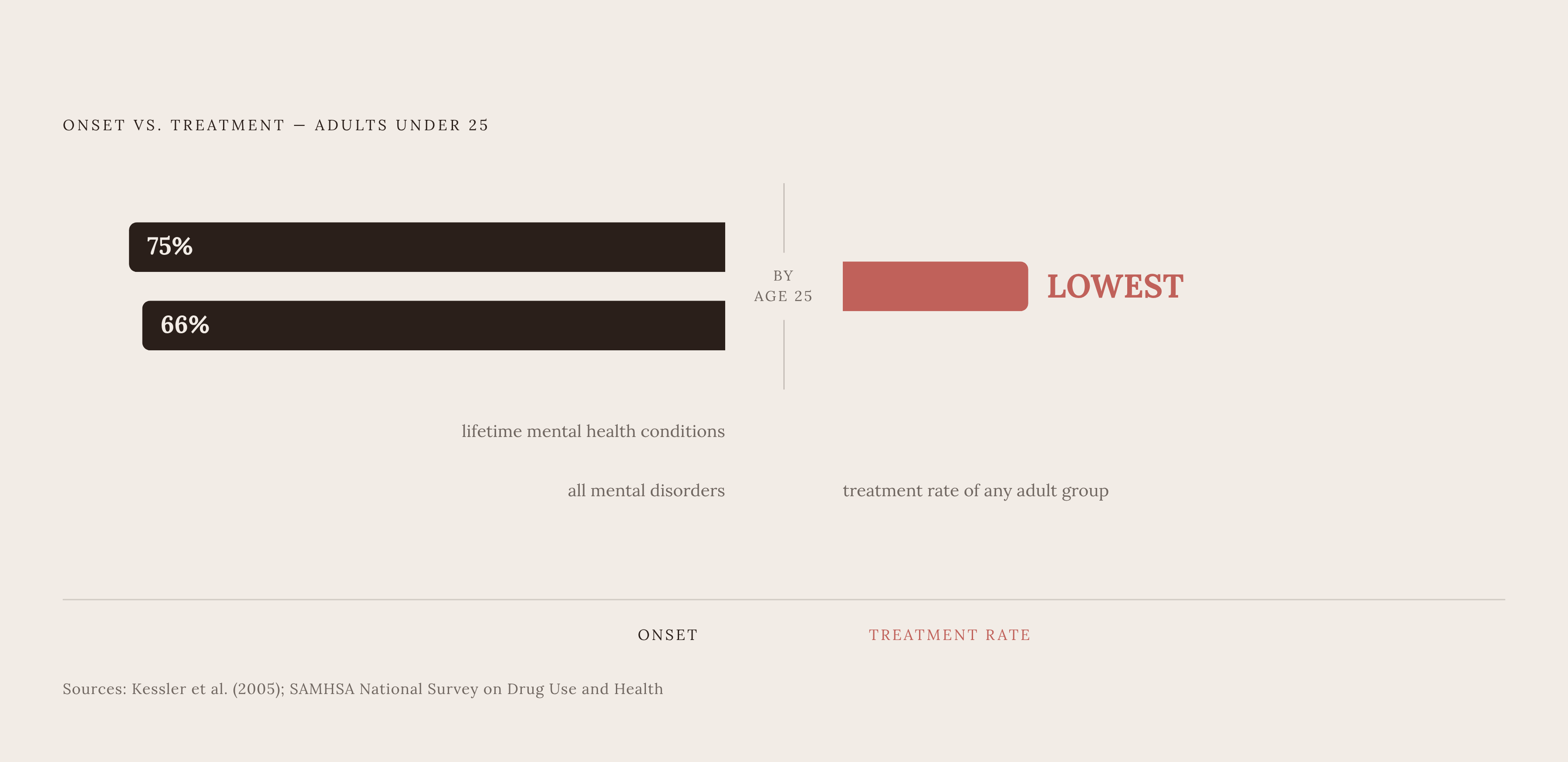
Roughly 75% of all lifetime mental health conditions emerge by age 24, and separate epidemiological work puts onset for about two-thirds of all mental disorders before age 25. That's not a footnote. That's the single most consequential fact about this entire developmental window, and it sits uncomfortably next to a stage that gets marketed, culturally, as the fun one. Meanwhile, this same age group receives the lowest rate of mental health treatment of any adult population. The gap between how often distress occurs and how rarely it gets treated is, functionally, a structural failure, not a coincidence of timing.
Why would that be? Identity development itself seems to run in both directions with mental health outcomes. A systematic review found evidence of bidirectional relationships between identity synthesis (or confusion) and depression, anxiety, and eating disorder symptoms, drawing on 20 studies covering 13,787 participants, with a majority of female participants. The meta-analytic piece of that same review didn't find significant associations for anxiety or depression specifically, and study quality was mixed (55% rated "fair," 45% rated "poor"). So the evidence points somewhere real, but study quality was mixed and it shouldn't be inflated past what it actually shows.
What that leaves is a fairly recognizable set of presenting problems: decision paralysis brought on by an overwhelming menu of life choices, generalized anxiety and depression, and the low hum of social pressure that comes from navigating relationships and expectations without a fixed script to follow. Culturally, the spotlight stays fixed on academic and professional milestones, grades, internships, first jobs, while a quieter identity crisis caused by that same narrow focus goes largely unaddressed. This isn't a case of emerging adulthood causing mental illness. It's a case of developmental demands and neurological immaturity converging at the exact moment the support systems built to catch it are looking somewhere else.
How economic and structural conditions have complicated the original theory
Arnett's original model assumed a level of economic slack that allowed delay to be a choice rather than a trap. That assumption is exactly where the earlier critique, that the theory described mostly college-attending, upper-middle-class Americans, comes back around with new evidence attached.
Living arrangements make the shift concrete. In 2023, 18% of 24-to-35-year-olds were living with a parent, up from 11% in 2005 (Pew Research Center / U.S. Census Bureau). And it's not just housing: 47% of Americans aged 18 to 29 received financial help from someone outside their household for at least one basic expense, rent, general costs, a car payment, a phone bill, according to Federal Reserve data. Nearly half. That's not "some young adults leaning on family." That's approaching a coin flip.
A 2026 paper in Frontiers in Public Health frames the current moment as a "polycrisis": climate change, geopolitical conflict, forced migration, economic volatility, and digital saturation, all converging on the same 18-to-29 population at once. The paper's phrase for what this does to Arnett's original picture is sharp: the "volitional exploration" he described (choosing your own path because you can afford to) is increasingly replaced by "forced navigation" through terrain nobody chose. Layer onto that an informational crisis, uncertainty not just about what will happen but about what's even true or trustworthy, shaped by algorithmically curated feeds, and the exploration Arnett described starts to look less like a buffet and more like a maze with the lights half off.
There's also a geographic asymmetry. In the Global North, this polycrisis often reads as biographical disruption, a "status anxiety" born from losing a postwar stability that used to be assumed. In much of the Global South, and among marginalized populations everywhere, precarity was never the exception to begin with; it's the baseline it's always operated from. Arnett's optimism-and-possibility framing was never going to fit every life equally, and that unevenness isn't a flaw in the theory so much as a boundary on where it applies cleanly. None of this means the category collapses. It means the conditions inside the category have shifted, and the framework has to stretch to keep up.
How the theory holds up across cultures and what recent research is adding
The main tool for testing emerging adulthood across cultures is the IDEA, the Inventory of the Dimensions of Emerging Adulthood. The complication is that its factor structure doesn't hold steady from country to country, which makes clean cross-cultural comparison genuinely difficult. Ethnic-specific versions have been built in the Netherlands, and independent analyses in Greece, Spain, Mexico, Chile, and Russia have turned up mixed results rather than a tidy confirmation.
A 2025 study (Jankowiak and colleagues, published in a SAGE journal) took a different approach: 129 students across Spain, Portugal, Japan, Korea, Poland, and one additional country. wrote reflective essays about what adulthood meant to them personally. Analysis of those essays identified developmental tasks that an earlier researcher's original framework never accounted for: social solidarity and openness to diversity, lifelong learning, active development of thinking and knowledge, and building mental resilience. The more provocative finding was comparative: across the sample, tasks characteristic of adolescence appeared more often than tasks characteristic of adulthood. That suggests the subjective experience of "feeling grown" may be lagging behind the calendar age that's supposed to mark it.
There's also a push to split the category further. Columbia University's Karen J. Gilmore and Pamela Meersand, writing for the American Psychiatric Association, argue for treating ages 18 to 23 (early emerging adulthood, or late adolescence) as distinct from ages 24 to 30 (emerging adulthood proper), on the grounds that the developmental tasks and capacities genuinely differ between the two windows. A single 12-year bucket, in other words, might already be too coarse.
Separately, a 2025 review out of Arizona State University, published in Behavioral Sciences, looked at how emerging adults perceive their future selves and the continuity linking their past, present, and future identities. That sense of continuity, it turns out, predicts self-regulatory behavior and outcomes ranging from psychological well-being to academic performance. Notably, the review found gender and socioeconomic status made little difference in moderating those relationships, which cuts against any assumption that this experience splits cleanly along demographic lines. The field, in short, isn't standing still: the 2024 edition of Arnett's book added a chapter on cultural variation, the Society for the Study of Emerging Adulthood keeps nudging the upper age boundary toward 29, and applied journals keep working to close the distance between the research and the people actually living through it.
What understanding these five features changes for someone living through this period
Knowing the five features doesn't make the twenties less turbulent. What it does is change what the turbulence means. Instability, under Arnett's framework, isn't evidence of falling behind; it's the expected output of a period built for exploration rather than commitment. Self-focus isn't selfishness; it's what a genuinely low-obligation window looks like from the inside, and it's temporary by design. Feeling caught between adolescence and adulthood isn't a personal failure to "figure it out." It's an accurate read of a stage where the biological and social markers of adulthood simply haven't lined up yet.
That reframe matters most against the backdrop of everything the later sections lay out: a brain still finishing its executive-function wiring, mental health risk peaking at the exact moment support systems are thinnest, and economic conditions that have made "forced navigation" a more accurate description than "open exploration" for a growing share of this population. None of that erases the five features. It just means the environment surrounding them has gotten harder, which raises a real question: does a framework built on possibility still hold when possibility itself becomes harder to access? Arnett's answer, updated across three editions, is that the category survives because the underlying developmental logic, identity work, instability, self-focus, in-betweenness, and possibility, still describes something real, even when the economic floor underneath it has shifted. The five features were never a promise that this decade would be easy. They were an explanation for why it was never going to be simple.
Sources
- Emerging Adulthood & Cognition – Human Development – Revision
- Building Bridges Between Arnett’s and Havighurst’s Theories: New Developmental Tasks in Emerging Adulthood Across Six Countries - Barbara Jankowiak, Emilia Soroko, Karolina Kuryś-Szyncel, Sylwia Jaskulska, Charles T. Hill, Takafumi Sawaumi, Belén Sanz-Barbero, Carmen Vives-Cases, Sofia Neves, Tsutomu Inagaki, Joo Lee, Yayoi Watanabe, 2025
- frontiersin.org
- apa.org
- pubmed.ncbi.nlm.nih.gov