Career Identity Disruption After a Layoff or Pivot
Writing forces the identity work that speed and positivity shortcuts skip.

A layoff ends a paycheck, but what it actually dismantles is identity. This piece argues that recovery depends less on how fast someone gets re-employed and more on the deliberate work of separating self-worth from job title, and that structured writing is the mechanism that makes this reconstruction possible.
A layoff as a loss of self, not just a loss of income
The meeting carries a vague title on the calendar, maybe a name from HR, maybe nothing else. The call lasts fifteen minutes. There is a script, a severance packet, a line about the role being eliminated for reasons that have nothing to do with performance. Then the laptop gets collected or the badge stops working, and whatever happens next, happens alone. The financial hit is real and most people see it coming: the budget spreadsheet, the insurance math, the countdown on savings. What blindsides people is everything else that walked out the door in that same fifteen minutes. A job supplies daily structure, a community of people who know your name and your coffee order, a sense of status, a reason to get up, and for most adults, a working answer to the question of who they are. When the job disappears, all of those functions disappear at once. Research published in BMC Psychology in 2024 found that an employee's affiliation with an organization forms a meaningful part of identity itself, and that losing that affiliation contributes directly to identity disruption and grief symptoms. That overlap is the clinical starting point for understanding why a layoff can feel less like a setback and more like a death in the family, where the family happens to be a job title.
What over-identifying with a job title costs
The wound is sharper for some people than others, depending on how much of the self got loaded onto the job before the layoff happened. Work-based identity is a predictable outcome of how most professional cultures are built, and it comes with real rewards while the job lasts: a strong sense of purpose, belonging to a professional community, high engagement, sustained commitment to getting better at the craft. None of that gets questioned during good times, because why would it? The system is working. The trouble becomes visible under stress, when the same fusion that produced engagement produces something closer to compulsion, driving excessive hours, burnout, and the pattern sometimes labeled workaholism, where a person keeps working past the point of diminishing returns for health or relationships. When career disruption eventually hits someone who has built their entire sense of self around a title, the financial crisis and the identity crisis arrive together, and even voluntary exits like retirement can destabilize a person whose answer to "who are you" has only ever been a job function. David Blustein, a counseling psychology professor at Boston College and author of "The Importance of Work in an Age of Uncertainty," has described how the belief that hard work insulates a person from being laid off becomes, after the layoff, nearly impossible to unwind: the same work ethic that produced years of success turns into the engine of self-blame, because if hard work was supposed to protect you and it didn't, the mind looks for someone to hold responsible, and lands on you.
The instinct to move fast and stay positive makes recovery harder
The standard advice after a layoff arrives almost immediately and almost always says the same three things: update the resume, start networking, stay positive. Each instruction assumes that recovery is a logistics problem, solvable through speed. But what if speed is exactly the wrong variable to optimize? Grief does not move on a schedule, and it certainly does not move on the schedule of a job search. Some people feel relief first and devastation weeks later. Others go numb for a month before the weight of what happened actually lands. Forcing productivity into that window does not skip the disorientation, it compounds it, layering the pressure to perform on top of a nervous system that is still absorbing the hit. There is also a harder, more practical problem hiding inside the cheerful advice: clinical research shows that high depressive symptoms after job loss significantly reduce the likelihood of reemployment over time. Untreated psychological disruption does not sit quietly in the background while the job search proceeds. It interferes with it directly, making emotional processing a strategic necessity for finding the next job. The pressure to project resilience carries its own cost, too, generating shame around grief itself. Workers start to feel they should be "over it" before they have done any of the work required to actually get over it, and that shame pushes the emotion underground. If rapid re-employment is not the mechanism of recovery, then what is?
Identity Reconstruction: Narrative Repair and the Multidimensional Self
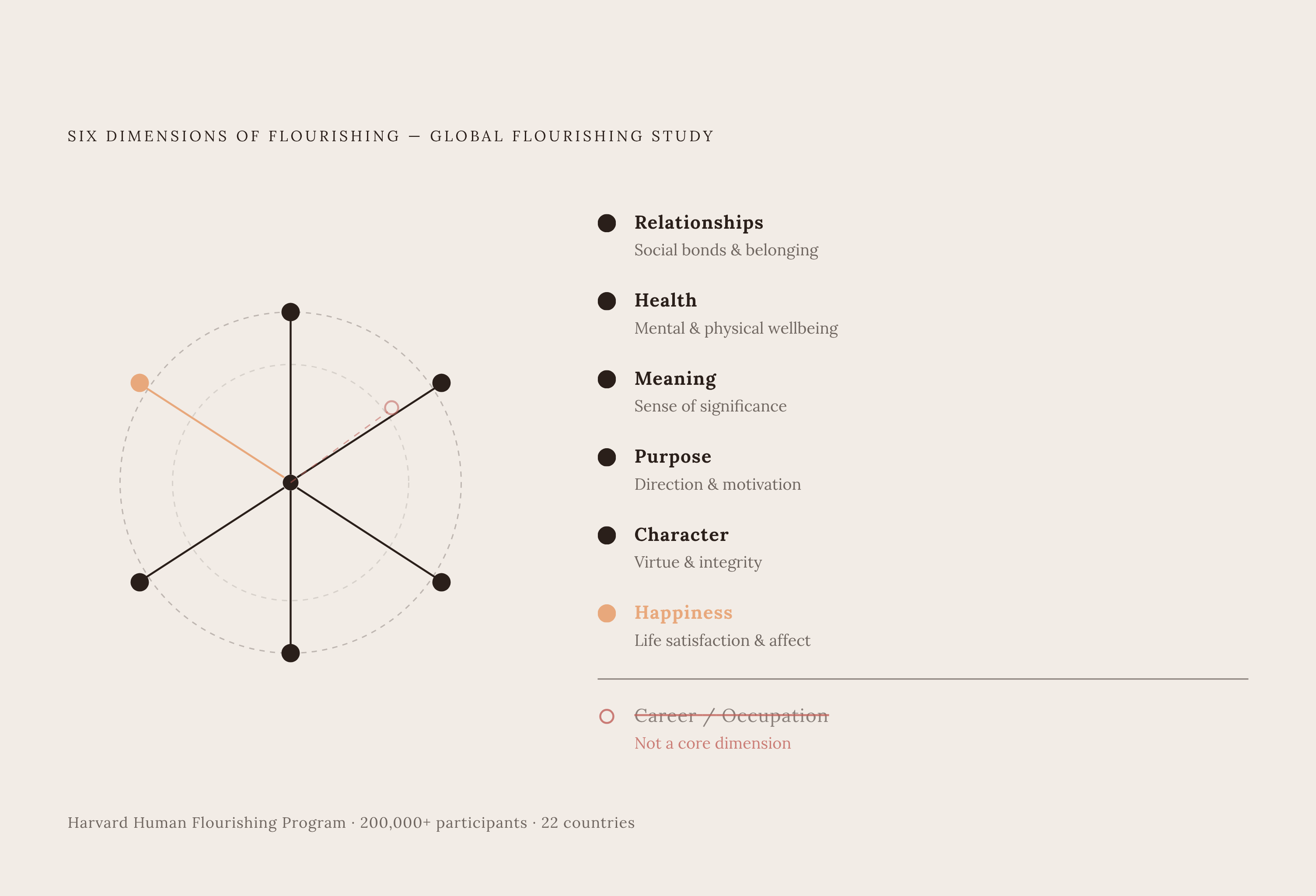
Recovery is closer to an inventory and reassembly project than an invention of a new self from nothing, because most people already hold a "narrative repertoire," a set of roles, values, and relationships that a layoff obscures without erasing. The job title gets removed from the equation, but the parent, the neighbor, the volunteer coach, the person who reads mystery novels at 11 p.m., none of that disappears. The Global Flourishing Study, which follows more than 200,000 participants across 22 countries through the Harvard Human Flourishing Program, reinforces exactly this point: career does not even appear directly among the six critical dimensions of human flourishing. Relationships, health, meaning, and purpose carry more structural weight than occupation does, which suggests that a person's flourishing was never supposed to rest on a job title. A layoff also forces a reckoning that people who leave jobs voluntarily rarely face. Someone who chooses to leave carries their existing frameworks with them into the next thing, largely intact. Someone whose choice gets removed has to ask harder questions: what did that job actually provide, and what did it simply make tolerable? Identity reconstruction, in this frame, is structural work. It means identifying which threads of the self survived the layoff intact, and which new threads need to be woven in, not manufacturing a replacement identity out of thin air.
Why writing works for this kind of reconstruction
Writing is mechanistically suited to this particular task: separating reactive emotion from reflective understanding, which is precisely what identity reconstruction requires. An experience that stays only in the body, as a knot of anxiety or a vague sense of dread, is hard to examine because there is nothing to look at. Putting it into language forces a structure onto it: a beginning, a sequence, a cause. James Pennebaker's expressive writing research spans decades and a large body of studies, showing that even short sessions of reflective writing improve mental and physical health outcomes. Pennebaker's protocol was tested specifically on laid-off workers, and the results showed faster re-employment among those who wrote, not just better mood. Earlier studies using the same protocol on college students found reduced health center visits and improved immune function, suggesting the effect is not confined to feeling better in the moment but extends to measurable physiological change. None of this requires treating writing as therapy in a clinical sense. It requires treating it as a specific, testable mechanism for converting an undifferentiated mess of a layoff into something a person can actually examine, question, and eventually revise.
Processing what happened before planning what comes next
Before any forward-looking plan is useful, the disruption itself needs to be written through, and that means confronting the self-blame, the grief, and an honest account of what the job actually provided. Pennebaker's protocol calls for brief daily sessions of expressive writing over several days, focused on the difficult experience itself rather than on solutions, and this is the phase most people skip entirely in their rush toward the next job posting. One entry point asks a person to write the harshest thing they have said to themselves since the layoff, then write what they would say to a friend who confessed the same self-judgment. The gap between those two responses is usually enormous, and that gap is the whole point: it creates distance between the self-critical voice and the reflective self, which is the first real step in separating self-worth from job title. A second entry point asks what the job provided beyond a paycheck, broken out specifically: identity, structure, purpose, community, and whatever else belongs on that list. Writing about each one individually turns an undifferentiated catastrophe into a specific inventory of losses, and specific losses can actually be grieved, where a vague sense of "everything is gone" cannot. William Bridges' Transition Model calls this stage "Endings," marked by loss, disorientation, and identity instability, and the model's usefulness lies in matching the prompt to the phase. Writing about exploration and new possibility before the Endings work is finished tends to produce forced optimism rather than genuine movement, because the grief hasn't been metabolized yet, it has just been covered over.
Frameworks for the middle phase, when the old identity is gone but the new one hasn't arrived
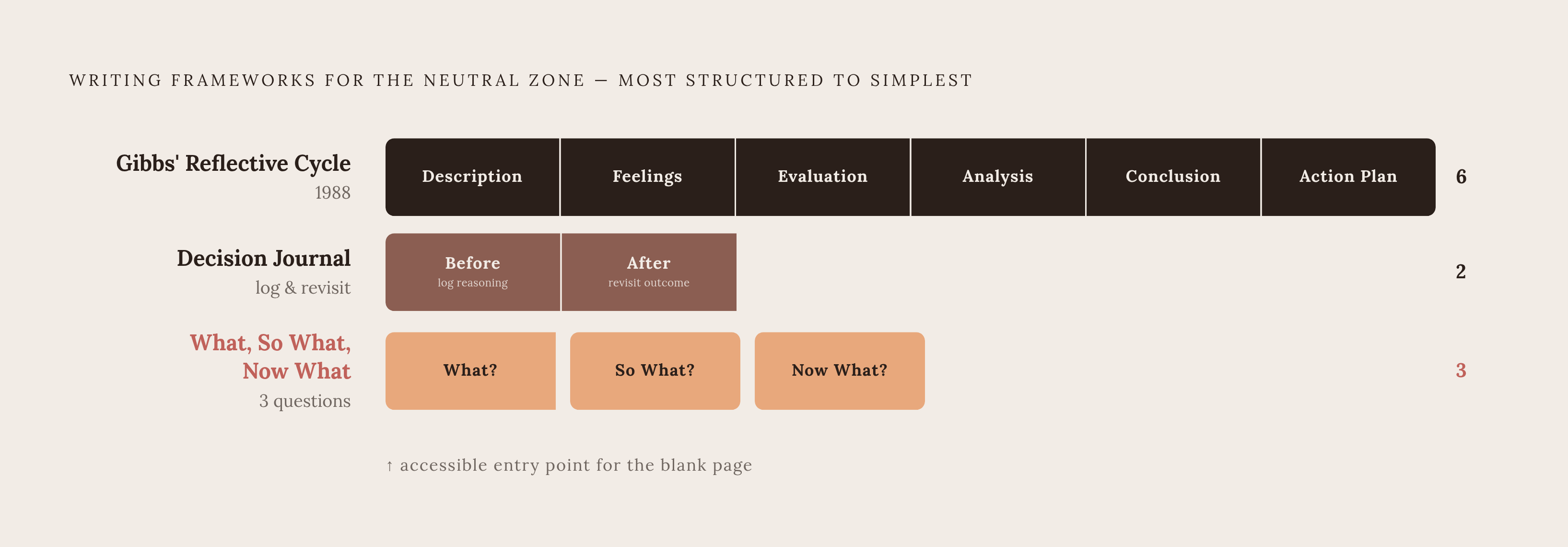
Bridges calls this stretch the Neutral Zone, a state of chaos and creative restlessness where the old identity has been dismantled and the new one has not yet arrived, and it is here, in that uncomfortable middle, that identity reconstruction actually happens. The prompts that suit this phase look different from the grief work of Endings: less about loss, more about exploration and possibility, and different frameworks end up suiting different personalities. Someone who thinks analytically and wants structure before they feel safe exploring anything might prefer Gibbs' Reflective Cycle, a six-step format from 1988 that moves through Description, Feelings, Evaluation, Analysis, Conclusion, and Action Plan, which works well as a post-event debrief for auditing what the last role actually was and wasn't. Someone who wants the simplest possible entry point, without six stages to track, can use the "What, So What, Now What" framework: three questions, asking what happened, why it matters, and what to do differently next time, that keep a session focused and produce a small, usable piece of output. For career pivots specifically, a Decision Journal offers something the other formats don't: a written record of the reasoning behind a choice, logged before the outcome is known, to be revisited later and checked against what actually happened. That return visit builds the kind of self-knowledge that keeps the next career decision from quietly repeating the patterns of the last one. One exploration prompt asks directly what parts of the last job quietly drained energy, the parts that had stopped registering as a problem because they had just become "the job," since those are the signals to screen for in whatever comes next. And for people who find a blank page paralyzing rather than freeing, directed journaling offers a workable alternative. It means responding to a set prompt in a timed, stream-of-consciousness burst. Forbes career contributor Rebecca Fraser-Thill recommends 20-minute timed sessions built around prompts like "What does it mean to you to live a full life?" and "What are the last five compliments you received about your work?", questions specific enough to generate movement without requiring a blank page to summon it from nothing.
Sources
- Identity Reconstruction During Involuntary Mid-Life Career Change: A Phenomenological Study: Journal of Constructivist Psychology: Vol 0, No 0 - Get Access
- Navigating Involuntary Career Changes: Emotional Dynamics During Work-Related Identity Loss and Recovery - Caroline Éliane Brazier, Michaël Parmentier, Jonas Masdonati, 2025
- Effects of Reappraisal and Self-Compassion Expressive Writing on Emotion Regulation - Teresa Jacques, Rui A. Alves, 2025
- Career Transition and Professional Identity: Dynamic Processes, Multiple Selves, and Nonlinear Trajectories