Gig Economy Work and Chronic Stress Accumulation
How four overlapping stressors trap gig workers in unrelenting anxiety cycles.
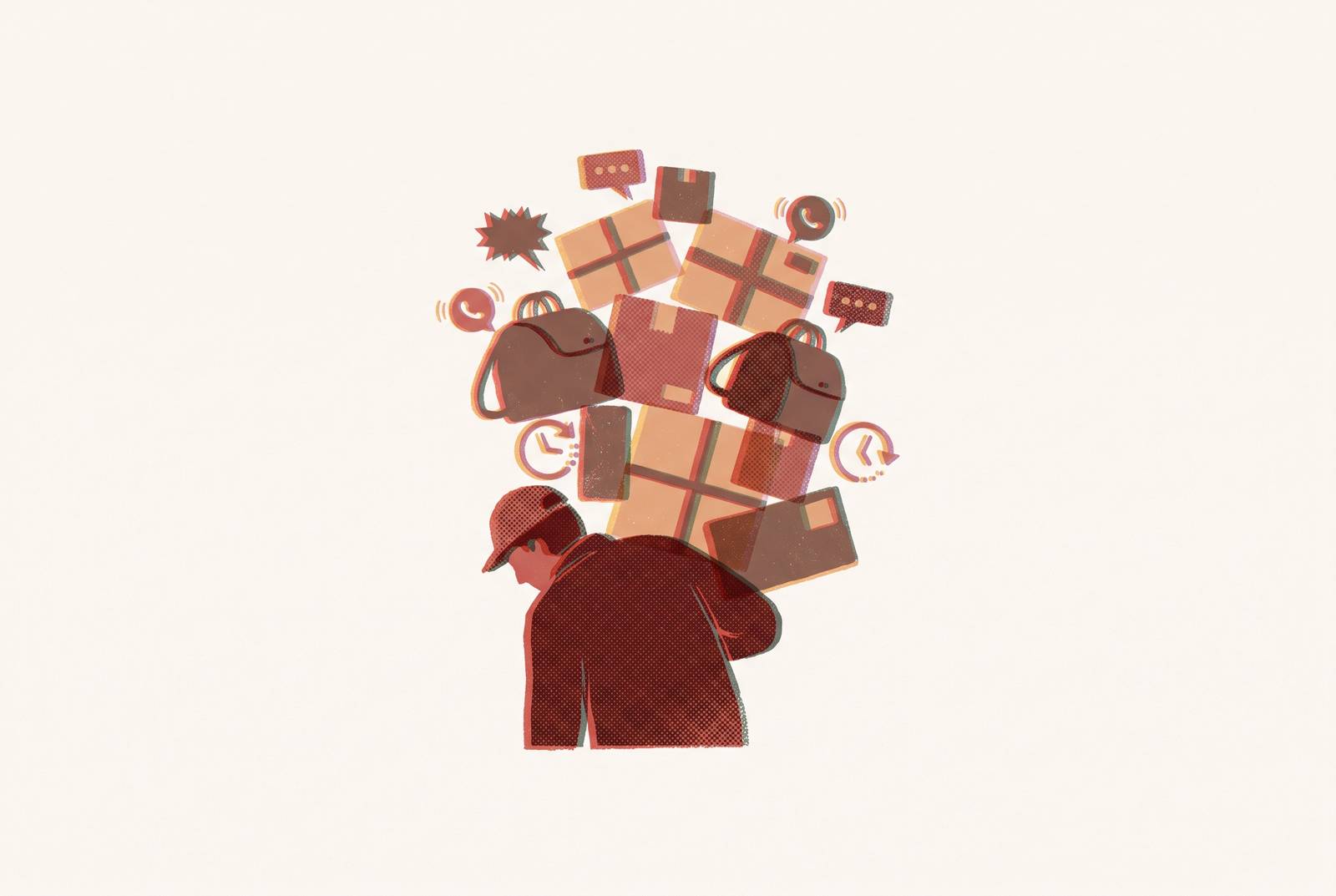
Rideshare driving is taxing on the body and the mind at once, and it is lonely in a way that most jobs are not. That combination, physical wear paired with mental fatigue paired with isolation, is the starting point for this piece, because gig work does not simply pile more stress onto workers than a normal job would. It changes the kind of stress they carry. Gig workers lack a fixed edge to a bad shift, a manager to appeal to, and often any coworker to serve as practical support or social anchor.
Researchers call this mechanism the Double Destabilization Model. Income variability and occupational identity erosion do not simply stack on top of each other. Identity instability dismantles the psychological buffer that would otherwise let a person tolerate financial uncertainty, so each stressor amplifies the other rather than sitting beside it. That is the argument this piece traces across every section that follows: income volatility, algorithmic control, isolation, and identity erosion interact rather than merely coexist, and the interaction is what produces a stress cycle that ordinary employment rarely generates.
Traditional workplace stress tends to be episodic. A bad quarter ends. A difficult manager gets replaced or moved to another department, or the employee moves on. The stress has a shape, a beginning and an end, something a nervous system can process and file away. Gig work removes that shape entirely, because the four conditions generating the stress (unpredictable pay, an opaque algorithm, no coworkers, no stable occupational identity) do not fluctuate with circumstance. They are the job's permanent architecture. What follows is an attempt to take that architecture apart piece by piece, then show how the pieces feed back into each other.
O|Income unpredictability as a permanent cognitive condition
Money problems are supposed to resolve, at least in theory. A salaried worker gets a paycheck, knows roughly what it will be, and can stop thinking about it until the next one arrives. Gig income offers no such closure, since pay depends on platform algorithms, surge pricing, and customer tips rather than contracted hours, and a worker cannot mentally file the question away the way a person on a fixed salary can. The worker is left with a kind of ambient math problem that never gets solved, just deferred to the next shift.
Writer Sarah Anne Lloyd's Postmates delivery has become something of a case study in this dynamic: nearly an hour of work for four dollars. That gap between what a job promises and what it actually pays does more than demoralize. It forces the worker to keep running the numbers before, during, and after every gig, recalculating whether the next delivery is worth the gas, the time, or the risk at all. That recalculation is a recurring tax on attention, paid every single time a new job pings the app.
That constant recalculation eats into working memory and executive function, the same mental resources needed for planning, decision-making, and staying alert on the road or at a customer's door. Chronic cortisol elevation, the kind produced by sustained financial uncertainty, has been linked to impaired performance on memory tasks tied to the hippocampus and to disruption of executive control and processing speed. Occupational health researchers have a name for the underlying structure: the effort-reward imbalance framework, developed in that field and cited in Imperial College London's public health literature, holds that failed reciprocity between effort and reward is itself a stressor, independent of how much money is actually lost. Gig work structurally maximizes that imbalance, because the output demanded of a worker is relentless while the reward attached to it stays unpredictable.
Financial worry ranks among the most commonly reported causes of anxiety, and poverty is an independent risk factor for mental illness on its own. The inability to predict next week's income compounds financial worry and poverty's independent risk to mental illness, leaving a gig worker in a state of ongoing cognitive vigilance. No single good paycheck resolves it, because the uncertainty returns the moment the next shift begins.
O|Algorithmic management as a second layer of unresolvable stress
Financial unpredictability alone would be enough to strain most people. Gig work adds a second, structurally separate layer on top of it: algorithmic management, which evaluates and disciplines workers through systems they cannot see, question, or appeal. Ride-hailing and delivery drivers work under continual GPS tracking, live customer ratings, automated performance alerts, and dynamic pricing, all of which assign reward and penalty without ever explaining the logic behind the decision.
A driver whose rating drops has no manager to ask why. There is no meeting, no warning conversation, no appeal process that resembles what a traditional employee would expect. Workers must maintain a minimum rating to keep working at all, managing two audiences simultaneously, the customer sitting in the back seat and the algorithm evaluating the trip in the background, while also driving a car or carrying a bag of food up three flights of stairs. A systematic review in Frontiers in Sociology, covering more than a hundred studies on algorithmic management published between 2010 and 2025, found that algorithmic management has become a defining feature of platform work and that it often reproduces and intensifies the very managerial control gig platforms are marketed as replacing, raising real questions about autonomy, fairness, and worker wellbeing.
The accountability gap this creates is not abstract. Human Rights Watch's report "The Gig Trap" documented algorithmic, wage, and labor exploitation across seven major U.S. platform companies. When Human Rights Watch wrote to each company that March asking for comment, Lyft responded that app-based work provides uniquely flexible opportunities. Most of the other companies did not respond at all, though Amazon met with the organization and offered some written clarification. One organization asked seven companies a direct question, and got one substantive answer and one polite deflection. That asymmetry is the accountability gap in miniature: a system built to evaluate millions of workers in real time, with almost no reciprocal obligation to explain itself to the people asking on their behalf.
Stress researchers distinguish between controllable and uncontrollable stressors for good reason. A controllable stressor, even an unpleasant one, can be managed, negotiated, or planned around. An uncontrollable one cannot, and algorithmic management takes what used to be a human relationship (a boss, a shift lead, someone who could explain a decision or be talked out of one) and replaces it with an automated verdict that offers no such door.
O|Isolation and identity erosion strip away stress buffers
Financial volatility and algorithmic control both generate stress on their own. What makes the stress compound rather than merely add up is what happens to the resources a worker would normally use to absorb it. Isolation and occupational identity erosion do not introduce a new pressure so much as remove the shock absorbers. Traditional jobs come with a built-in social structure: coworkers, shared routines, a professional identity tied to an employer or an industry. Gig workers largely lack all three, working alone without coworkers to serve as either practical backup or a place to vent.
A 2026 paper in the Journal of Business Ethics traced this to a broader shift in how low-wage work is organized: gig platforms and efficiency-monitoring technology have squeezed the ordinary socializing that used to happen during a shift out of the workday entirely, contributing to what researchers describe as the desocialization of work. A separate piece published in Science that June reached a related conclusion about remote work more broadly, finding that it has meaningfully increased social isolation with measurable mental health consequences. Gig work, done from inside a car or on a bike with one earbud in, is remote work's more physically demanding cousin. It shares the isolation without sharing the home-office comforts.
Identity erosion runs alongside this and deepens it. A person who drives for Uber is, formally, a "driver." There is no career ladder attached to that title, no institutional membership, no sense of professional progression the way a nurse or an electrician might describe one. That thinner identity leaves a weaker emotional anchor exactly when it is needed most, at the moment an algorithmic penalty lands or a slow week drains the bank account. The Double Destabilization Model names this directly: without a stable occupational identity, the psychological buffer against financial uncertainty simply is not there, so the kind of income swing a salaried worker might shrug off becomes destabilizing for someone doing gig work. Isolation and identity erosion, in other words, do not need to be the worst stressor on the list to matter most. They determine whether the other two ever get absorbed or just keep accumulating.
O|A self-reinforcing physiological cycle
Everything described so far, income swings, algorithmic opacity, isolation, a thin professional identity, sounds like a list of separate problems. Biologically, they behave more like stages in a single loop. Acute stress is a short-term adaptive response, visible in a spike of cortisol or adrenaline, while allostatic load is the cumulative wear that builds up when that acute-stress system stays switched on for months or years rather than resetting.
Sleep sits at the center of the loop. A 2025 review in Frontiers in Psychology, synthesizing a large body of research, found that sleep and cognitive deficits function simultaneously as causes, consequences, and maintaining factors of chronic stress. For gig workers, whose hours often shift day to day to chase surge pricing or peak demand, irregular schedules disrupt circadian rhythms, and the resulting sleep disturbance further degrades cognitive performance, leaving less capacity to handle whatever stressor arrives next. That is the loop closing on itself: bad sleep produces worse stress tolerance, worse stress tolerance produces worse sleep.
A 2025 study in Psychoneuroendocrinology, drawing on longitudinal data from the English Longitudinal Study of Ageing, found that chronic cortisol excess may precede the buildup of allostatic load, and that the level of work stress a person experiences shapes that relationship. Earlier research has separately connected higher effort-reward imbalance to higher total allostatic load, and gig work, as established earlier, structurally maximizes that imbalance. These two findings together establish a documented biological pathway from gig work's daily conditions to cumulative physical harm. It becomes a documented, if still developing, line of evidence.
Downstream, a stress system that never fully stands down produces gastrointestinal problems, chronic fatigue, anxiety, depression, and elevated cardiovascular risk as its physical residue. Women carry an added dimension the general allostatic load literature does not always capture: irregular work hours can affect hormonal and reproductive health specifically, adding a biological pathway layered on top of the one that applies more broadly.
E|Why the stress burden is not uniform
None of this lands evenly, and treating gig work as one undifferentiated mass of stress would actually weaken the argument rather than strengthen it. McKinsey's own taxonomy, cited in the Imperial College London public health literature, sorts gig workers into four groups: free agents, who choose gig work and rely on it as primary income; casual earners, who take it on as supplemental income by choice; reluctants, who depend on it as primary income but would prefer traditional employment; and the financially strapped, who take gig work out of necessity to supplement other income.
Autonomy matters here, and the research backing that up deserves to be taken seriously rather than waved off. Some studies do find that workers who chose gig work and use it to supplement other income report higher job satisfaction and lower stress than workers in traditional jobs. That finding does not contradict the structural argument. It sharpens it, because it tells us where the stress concentrates: not evenly across all gig workers, but specifically among reluctants and the financially strapped, the people for whom gig work is not a choice so much as the only option left.
Gender complicates the picture further. Longitudinal research has found that moving into gig work is associated with better mental health than remaining unemployed, but only for men. Women who make the same transition do not see the same benefit, which suggests autonomy and flexibility do not function the same way across genders. A study by Wang, Li, and Wang, published in SSM: Population Health and drawing on longitudinal data from 2019 to 2024 on a nationally representative sample of British workers, found that high-dependence gig work correlates with meaningfully elevated psychological distress in men with chronic illness compared with regular employment. Dependence, not gig work as an abstract category, is what moves the needle. And dependence on gig income as a primary source, rather than a side hustle, is precisely the segment of the workforce that keeps growing as platforms expand into more sectors and more workers lose access to traditional jobs. The heterogeneity in outcomes does not undercut the thesis. It tells us exactly where to look.
E|Why institutional responses remain structurally insufficient
Governments and international bodies have started responding, and the responses so far treat symptoms rather than the structure generating them. Karnataka, India passed gig worker legislation in 2025 establishing a welfare fund, transparency requirements, and a grievance redressal mechanism, giving this category of worker in the state its first formal channel for dispute resolution and marking a genuine institutional innovation. That is a genuine institutional innovation. The law stops short of granting collective bargaining rights or recognizing gig workers as employees, so the algorithmic control, the effort-reward imbalance, and the identity ambiguity driving the stress cycle all remain fully intact under the law, making it a partial measure by its own text.
International movement exists too. The International Labour Organization circulated a draft Convention and Recommendation called "Decent Work in the Platform Economy" in August 2025, ahead of the 114th International Labour Conference held the following June, a signal that binding international norms might eventually take shape. A draft convention describes a process underway, not a protection currently in force, and its eventual scope and enforceability are still undetermined.
Healthcare access compounds the problem rather than offsetting it. In the United States, employer-sponsored healthcare is tied to full-time employment status, so gig workers face real barriers to coverage. ACA Marketplace plans and Medicaid exist as alternatives, but both tend to be less affordable and harder to navigate than employer coverage. The healthcare gap becomes one more structural feature making the stress cycle harder to interrupt from the inside. Every intervention described here, the welfare fund, the grievance process, the draft convention, addresses one slice of the problem while leaving the interlocking machinery, income volatility, algorithmic opacity, isolation, identity erosion, running exactly as before. Every intervention addresses one slice of the problem while the interlocking machinery keeps running, which makes this a structural condition rather than a set of individually fixable complaints, and partial fixes, however well-intentioned, cannot close the gap on their own.
O|What gig workers can do at the individual level
None of the four structural drivers traced through this piece, income volatility, algorithmic control, isolation, and identity erosion, are things an individual worker can fix through better habits or a more positive outlook. Stating that first matters before any individual-level suggestion gets made, because pretending otherwise would undercut everything argued above. Individual practices can treat the residue the cycle leaves behind, the accumulated cognitive fatigue, the loneliness, and the low-grade financial anxiety that never fully resolves.
Isolation, at least, admits a partial workaround. Building community deliberately, joining driver forums, local meetups, or informal co-working arrangements with other gig workers, restores some of the social buffering that platform work removes by design. It will not replace a coworker who happens to be sitting at the next desk, but it recreates a version of that function on purpose rather than leaving it to chance.
On the financial side, converting unpredictable income into something that feels more predictable, through income averaging or automatically routing a percentage of every payment into savings the moment it lands, reduces the background cognitive noise of constant recalculation without requiring the income itself to become any more stable. Sleep is one of the more tractable targets available, since irregular schedules do not have to mean irregular sleep and wake times; anchoring those two points, even while work hours swing around them, helps stabilize the circadian rhythm the earlier section identified as central to the physiological loop.
The emotional and cognitive residue that builds up between shifts, the friction of an unexplained rating drop, the math of a four-dollar delivery, the low hum of never quite knowing what next week's income will look like, tends to go unprocessed simply because there is no built-in moment in a gig worker's day to process it. A short daily habit of naming what happened and how it landed, even informally, gives that residue somewhere to go rather than letting it stack silently toward the allostatic load described earlier. None of this closes the structural gap. It gives a worker something to do with what the structure leaves behind, while the fixes that would actually shrink that gap, predictable income, contestable algorithms, real social infrastructure, affordable healthcare, remain squarely outside any one person's control.
Sources
- A Plea for the Need to Investigate the Health Effects of Gig-Economy
- Gig work and mental health during the Covid-19 pandemic: A gendered examination of comparisons with regular employment and unemployment - ScienceDirect
- Gig work dependence and psychological distress in chronic illness - PMC
- Frontiers | Psychological wellbeing in informal workers within the gig economy: the roles of social support, work–life balance, workload, and time pressure
- Frontiers | Algorithmic management in the global gig economy: an interdisciplinary systematic literature review and critical discourse analysis
- Dependence and Precarity in the Gig Economy: A Longitudinal Analysis of Platform Work and Mental Distress - Guo - 2025 - The British Journal of Sociology - Wiley Online Library
- Frontiers | A Plea for the Need to Investigate the Health Effects of Gig-Economy