Burnout in Entry-Level Knowledge Work
Entry-level workers face burnout at nearly double the rate of C-suite leaders.
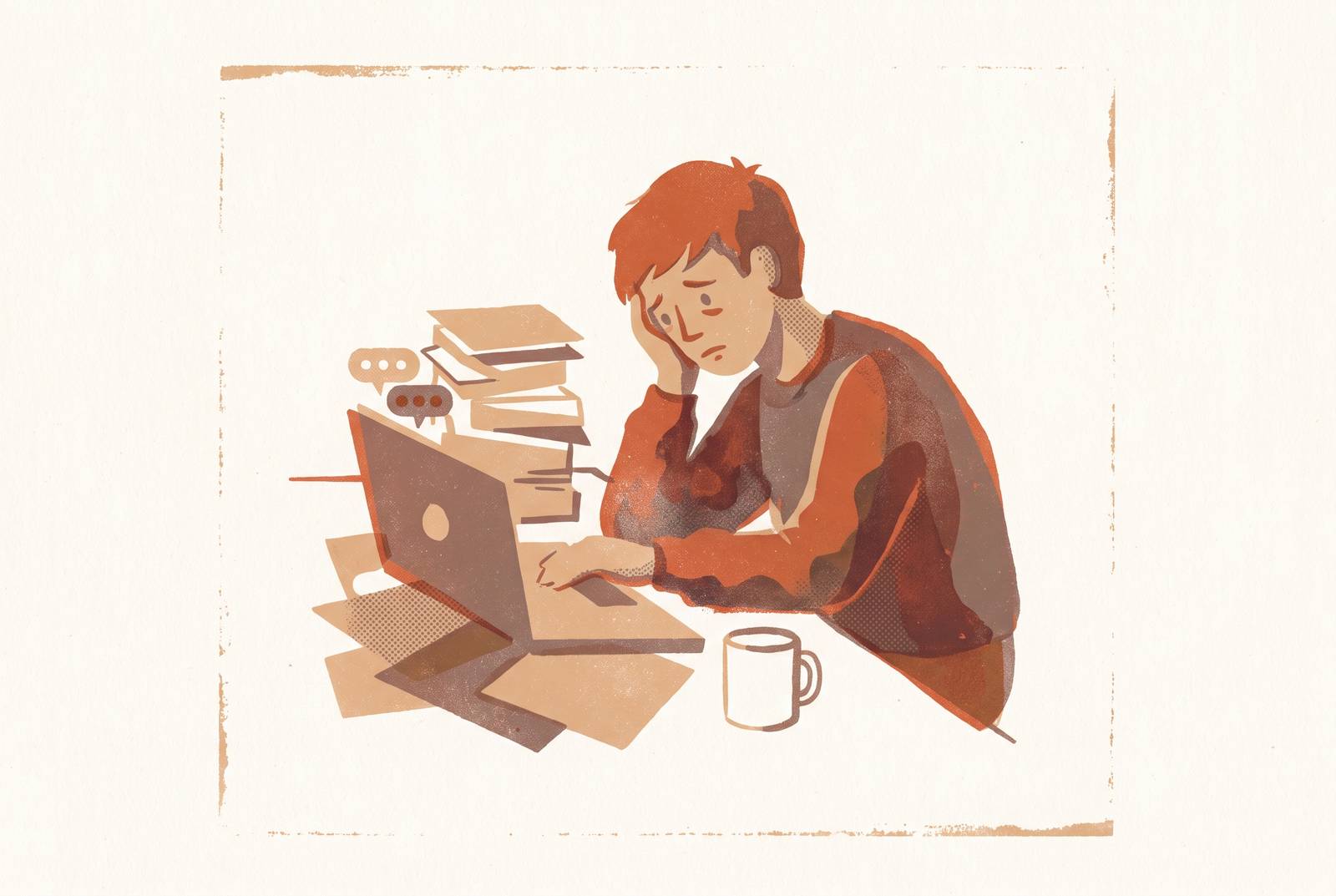
Entry-level knowledge work has a burnout pattern that looks nothing like burnout at the top. The data on white-collar fatigue tends to get reported as a single number, as if a first-year analyst and a managing director are wearing down under the same conditions. They are not, and the gap between them is the actual story here.
Entry-level knowledge workers' structurally different burnout problem
Across a survey of white-collar knowledge workers in North America, Europe, and Asia, 83% reported at least some burnout, barely moved from 82% the year prior. A number that flat looks almost boring, until you break it apart by seniority and find it is hiding a much sharper story.
Associates and entry-level employees report reduced engagement from burnout at rates of 62% and 61%, respectively. C-suite leaders are at 38%. That is not a small gap. That is a structural fault line running straight through the org chart, and it exists because entry-level roles combine three conditions that almost never stack up at senior levels at the same time.
The first is cognitive load. New employees are absorbing unfamiliar domains, steep learning curves, and tooling nobody bothered to explain properly, all without a mental schema to hang any of it on. The second is autonomy, or the lack of it: tasks arrive assigned rather than chosen, and there is little say over pace or method. The third, and probably the most corrosive, is the absence of coping scaffolding. No accumulated strategies built over a decade of trial and error, no peer network to vent to that actually understands the stakes, no institutional capital to spend when the pressure spikes. A senior VP under stress can call in a favor, delegate sideways, or lean on a reputation earned over fifteen years. A 23-year-old six months into a job has none of that in the bank.
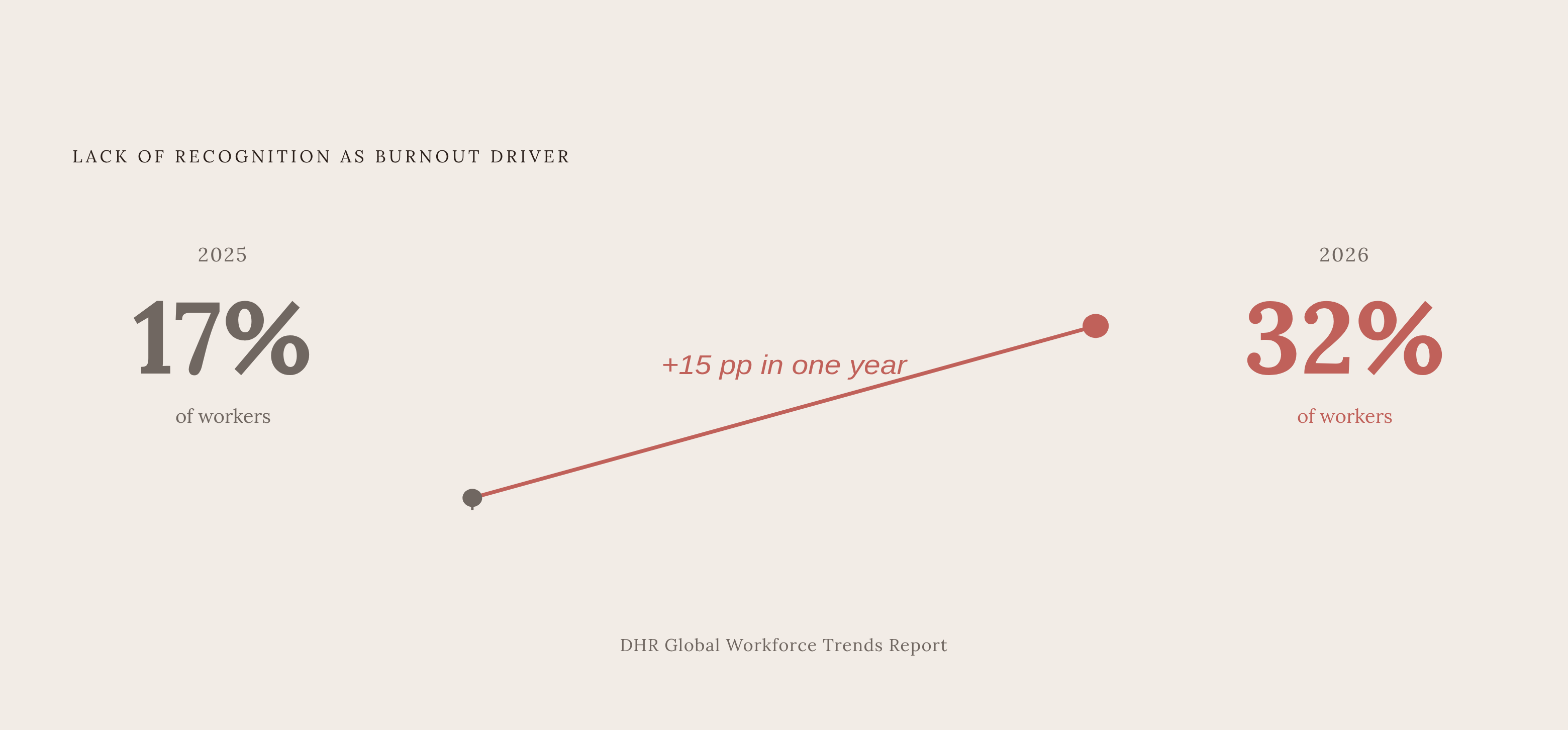
Layer onto this a rising recognition problem. The share of workers citing lack of reward or recognition as a burnout driver nearly doubled in a single year, from 17% in 2025 to 32% in 2026. That jump does not land evenly. It concentrates at the bottom of the hierarchy, where recognition was already the scarcest resource in the building.
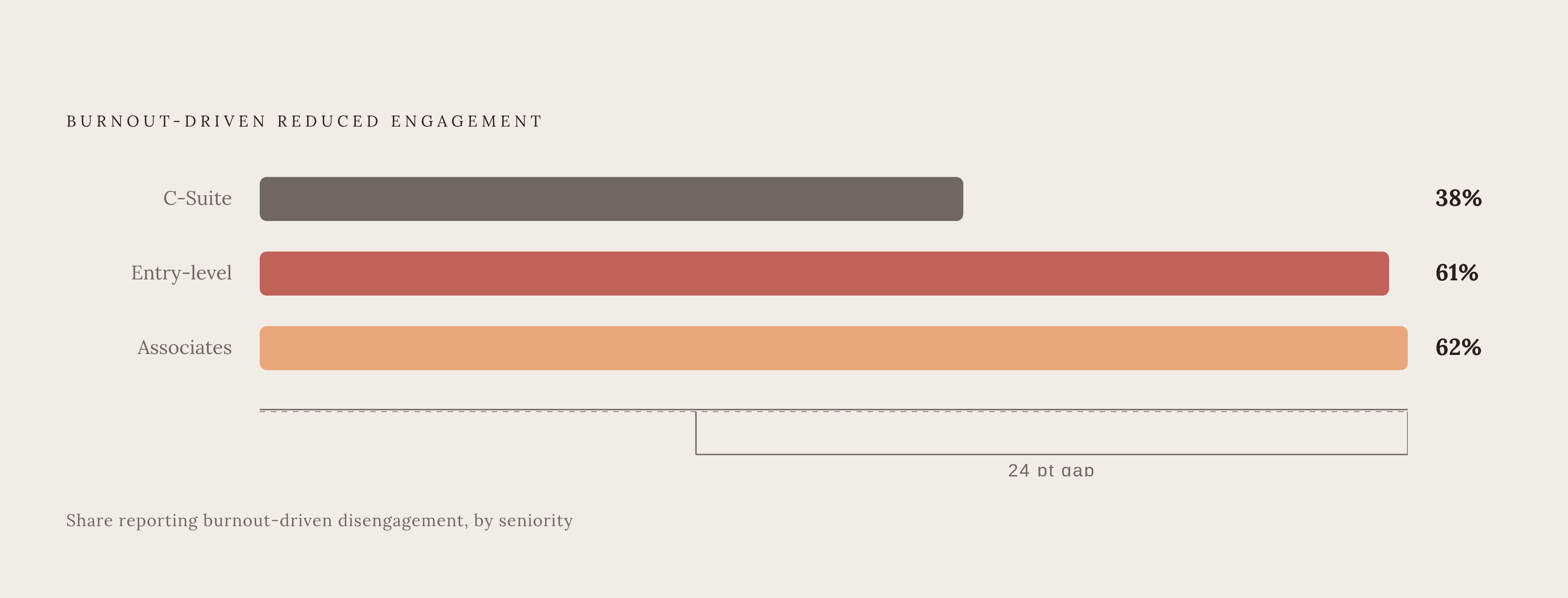
How fast burnout damage compounds by seniority
Gen Z is the loudest signal in the data, and arguably the most alarming one, since it suggests the depletion starts before the first paycheck even clears. Seventy-four percent of Gen Z employees report moderate to severe burnout, and nearly 40% of 18-to-24-year-olds have already taken time off specifically for stress-related mental health reasons. The generation walking into knowledge work right now is arriving pre-exhausted, which raises an uncomfortable question about what "entry-level" even means anymore if entry itself requires recovery time.
A survey found that 52% of workers now say burnout is dragging their engagement down, up from 34% the year before. That is an 18-point jump in twelve months, which is the kind of move that should make an HR department nervous rather than mildly concerned.
The gender split deserves its own paragraph rather than a bullet buried in a list. Forty-six percent of women report burnout compared to 37% of men, a meaningful gap that widens further among those in leadership roles. Entry-level women are absorbing workplace pressure on top of a caregiving load that, structurally, has not gotten any lighter. Two systems stack on the same person at the same time, and only one of them appears on a performance review.
Then there is where all this concentrates by industry. Burnout in the tech sector alone runs at 58%, and the problem concentrates in industries that, not coincidentally, are also where a huge share of young knowledge workers land their first real job. The picture that emerges is a young, disproportionately female, tech-and-healthcare-and-retail-adjacent workforce, absorbing a kind of pressure the data says is intensifying rather than leveling off. It is a young, disproportionately female, tech-and-healthcare-and-retail-adjacent workforce, absorbing a kind of pressure the data says is intensifying rather than leveling off.
Drivers of burnout at the start of a knowledge career
Workload tops the list by a wide margin: 48% of workers name overwhelming workload as the primary cause. For someone new to a role, that number understates the real problem, because workload is not just volume, it is volume multiplied by inexperience. Every task takes longer when there is no established pattern for doing it, so the same ten items on a to-do list represent a much heavier cognitive tax for a first-year employee than for someone five years in.
Long hours follow close behind at 40%, and the two drivers feed each other in a fairly predictable way. Entry-level staff, eager to prove themselves, tend to mistake hours logged for value delivered, and working past capacity gets read internally as ambition rather than as a warning sign. Nobody hands out a badge for staying until 9 p.m., but plenty of new hires act as though one exists.
13% of employees cite anxiety about AI's effect on their role as a contributor to burnout. That number sounds small until you consider who is most exposed to it. Someone who has not yet built a professional identity, a specialization, a track record that feels distinct from what a language model could plausibly automate, is going to feel that anxiety more acutely than a twenty-year veteran with a client book and a reputation. The fear is concrete for them. It is aimed directly at the thing they have not built yet.
The recognition deficit, though, might be the sneakiest driver of the group, because it does not just make people feel bad, it removes information they need to function. Entry-level work tends to disappear into a team product. The deck gets presented by the manager, the code ships under the team's name, and the individual contribution goes uncredited by design, not malice. That near-doubling of recognition-related burnout, from 17% in 2025 to 32% in 2026 according to the DHR Global Workforce Trends Report, is not just a mood problem. For someone still figuring out whether they are good at this job, silence is not neutral. It is the absence of the calibration data they need to know whether to push harder, change direction, or ask for help. Learning to shoot free throws with the scoreboard turned off makes the same problem visible. You would keep shooting, sure, but you would have no idea if you were improving.
Burnout's hold on the brain and its effect on recovery
Why does an unfinished task feel so physically heavy, even when it is objectively small? The brain treats open loops, unfinished work, unresolved worry, as active processes that occupy working memory until they are closed out. For an entry-level worker facing a high volume of unfamiliar demands, that queue rarely clears. It just accumulates, one unresolved thread stacked on the next, until mental processing capacity is full and nothing new can load properly.
Chronic stress compounds this by keeping the amygdala, the brain's alarm system, in a persistently elevated state. That matters specifically for knowledge work because an activated amygdala pulls bandwidth away from the prefrontal cortex, the region responsible for reasoning, planning, and emotional regulation. Precisely the machinery that writing a report, debugging code, or making a judgment call under ambiguity requires most.
What does that actually look like day to day? Difficulty prioritizing, since everything registers as equally urgent when the alarm system is running the show. Reduced creativity and problem-solving capacity, because the brain in survival mode is optimized for threat detection, not novel synthesis. Emotional reactivity to ordinary friction, the kind where a mildly terse message from a manager on a workplace messaging tool suddenly feels like a personal indictment. And a strange sense of motion without progress: busy in the sense of constantly doing something, unproductive in the sense that none of it moves anywhere.
There is a specific mechanism that offers a way out of this loop, rooted in neuroscience research on emotion labeling. Studies on affect labeling have found that naming an emotion, actually putting words to it, can measurably reduce the brain's stress response. The shorthand for this is "name it to tame it," and it is worth taking that phrase literally rather than as a wellness slogan. The act of articulating a feeling in words is a neurological intervention. Which raises the obvious next question: if naming an emotion out loud does this, what happens when you write it down instead?
Why reflective writing works as an intervention for burnout
Research on expressive writing offers a fairly clean answer. Research on expressive writing suggests that putting anxiety into words before a high-stakes task can free up working memory that had been tied up maintaining that anxiety, making that freed capacity available for the task itself. The anxiety did not vanish. It just stopped occupying cognitive real estate it had no business occupying.
Multiple meta-analyses on structured expressive writing back this up at a broader scale, showing measurable reductions in emotional exhaustion and improvements in psychological well-being, with effects appearing relatively quickly rather than requiring months of practice. That is a fast return for a fairly low-tech intervention, which should make anyone skeptical of journaling as therapy-lite pause and reconsider.
Three mechanisms appear to be doing the work simultaneously. Externalization gets a thought out of the head and onto a page, which lowers the cognitive cost of maintaining it internally, similar to closing a browser tab that had been running in the background the whole time. Pattern recognition emerges from the written record itself: a recurring trigger, a specific relationship that drains more than it gives, a task category that eats disproportionate energy relative to its actual importance, patterns that are nearly invisible from inside the day-to-day but obvious once they are laid out on a page in sequence. And a cognitive mode shift occurs simply by the act of writing, which activates analytical processing and moves the brain away from reactive stress response toward something closer to reflective problem-solving.
The most rigorously tested version of this is the Pennebaker method: sustained writing about the deepest emotions and thoughts tied to a specific emotional challenge. It is among the most studied approaches in the clinical and organizational literature on expressive writing, and even brief sessions using this format have been linked to measurable improvements in psychological well-being. Twenty minutes. That is shorter than most standup meetings, which is either an indictment of standup meetings or a decent argument for trying this instead of one.
Journaling methods matched to the specific problems early-career burnout creates
Not every method suits every problem, and treating them as interchangeable defeats the purpose. The right approach depends on which specific failure mode a person recognizes in themselves from the sections above.
For working memory overload, the daily fog of unfinished thoughts piling up before the workday even starts, Morning Pages fits best. It is a free-writing, stream-of-consciousness method with one goal: clear the mental clutter before the day adds more to the pile. This lowers what amounts to a maintenance load, the background cost of holding unresolved thoughts in mind, and it is particularly useful for entry-level workers whose mornings already start anxious before the first email even loads.
For emotional exhaustion, for processing something specific and hard rather than the general daily grind, the Expressive Writing method described by Pennebaker is the better fit. Twenty minutes, deepest emotions, tied to one particular challenge. It is built for the aftermath of a genuinely bad week, a rough conversation with a manager, or a moment that felt like failure and needs to be metabolized rather than just logged.
For the anxious, catastrophizing thinking that tends to appear in the first year of any career, CBT Thought Records offer a more structured, almost clinical process. Catch the self-defeating thought, question whether it is actually true, find evidence against it, then reframe it. Grounded in cognitive behavioral therapy, this method is particularly suited to the specific flavor of dread that sounds like "I don't belong here" or "everyone else already knows how to do this." Thoughts that feel like facts but are, on inspection, closer to guesses dressed up in certainty.
Prompts that work for burnout at different stages of recovery
The reflection someone needs while still depleted is not the reflection that helps once they are stabilizing. Prompts should map to a stage of recovery rather than get applied uniformly.
At the stage of simply recognizing what is happening, the goal is observation. A prompt like "what does my energy level feel like right now, as a weather pattern" works because it gives permission to describe a state rather than judge it. Nobody fails at describing rain.
Once someone is ready to process what actually happened, sharper prompts start to earn their keep. "What am I pretending not to know?" surfaces the exact thing someone has been quietly avoiding for weeks. "What would I do if no one was watching?" separates real motivation from performance anxiety, from doing things because they look good rather than because they matter. These prompts tend to generate resistance almost immediately, a flinch, a blank page, an urge to write something safer instead. That resistance is usually the exact spot where the most useful reflection is sitting, half-buried, waiting to be dug out. It is usually the exact spot where the most useful reflection is sitting, half-buried, waiting to be dug out.
Rebuilding calls for a different register. "What does a good day look like for me?" re-establishes a reference point after burnout has flattened everything into the same gray tone, where a great day and an average day start to feel indistinguishable. This is also where gratitude journaling earns a legitimate place, as active noticing of what survived the burnout intact. Small, specific, and honest, rather than performative.
Analog versus digital: choosing a journaling medium that will hold
The format matters less than whether the format survives contact with an actual bad week, which is the exact week it needs to hold up during. A paper notebook asks nothing of a phone battery and creates zero temptation to check a notification mid-sentence, but it also cannot search past entries for a recurring theme, and it is genuinely easy to lose in a desk drawer or a move.
A digital format offers searchability, the ability to look back across months and spot a pattern (that recurring dread every Sunday night, that one recurring name attached to half the frustrated entries), and it travels on a device already in hand. The tradeoff is obvious too: a phone is also the delivery vehicle for the very notifications and doomscrolling that contributed to the burnout in the first place, so opening a journaling app can become one more tap away from an inbox.
Neither format is inherently superior, and the research on expressive writing does not appear to hinge on the medium; it hinges on whether the writing actually happens with any consistency. The honest test is not which method sounds more sophisticated on paper (or on screen). It is which one a burned-out, time-poor, already-depleted person will actually reach for at 11 p.m. when the alternative is scrolling until the eyes give out. Pick the version that survives the worst week, not the best one, because the best week was never the one that needed the intervention.