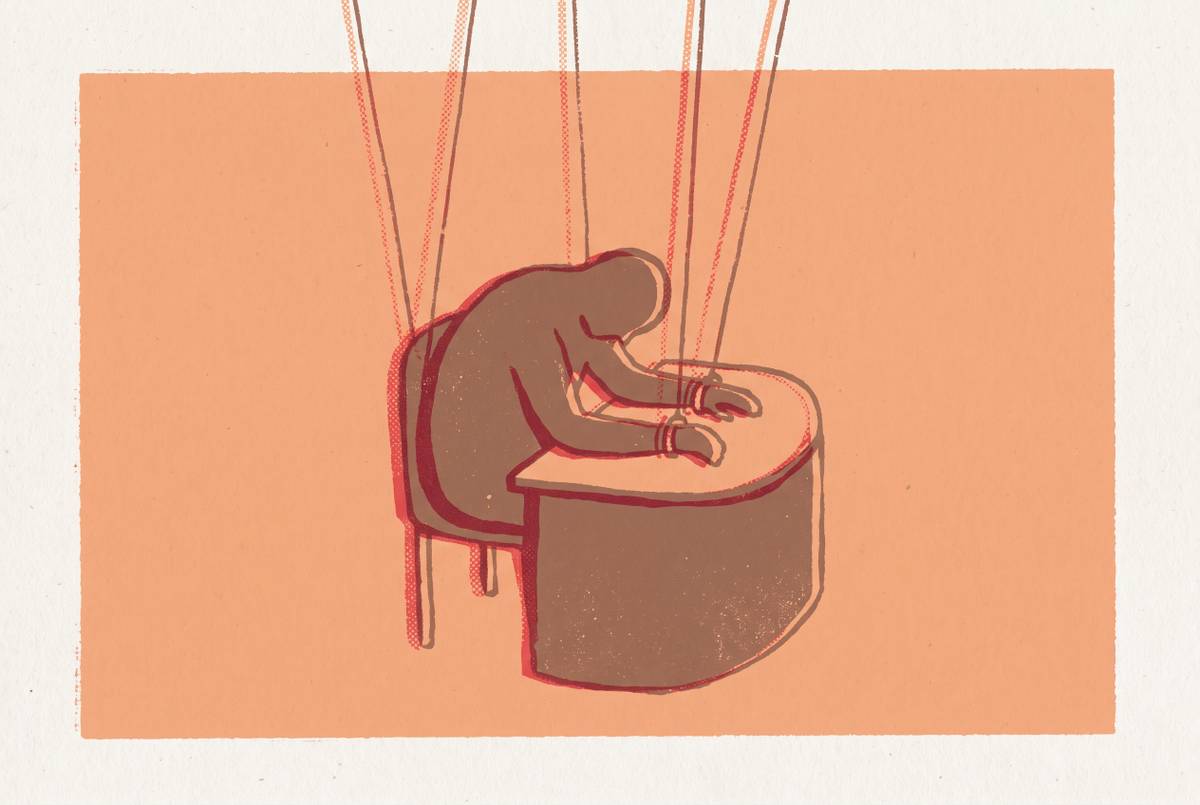
Setting Work Limits When Your Job Punishes It
Writing about work pressure helps your brain process limits you're afraid to enforce.
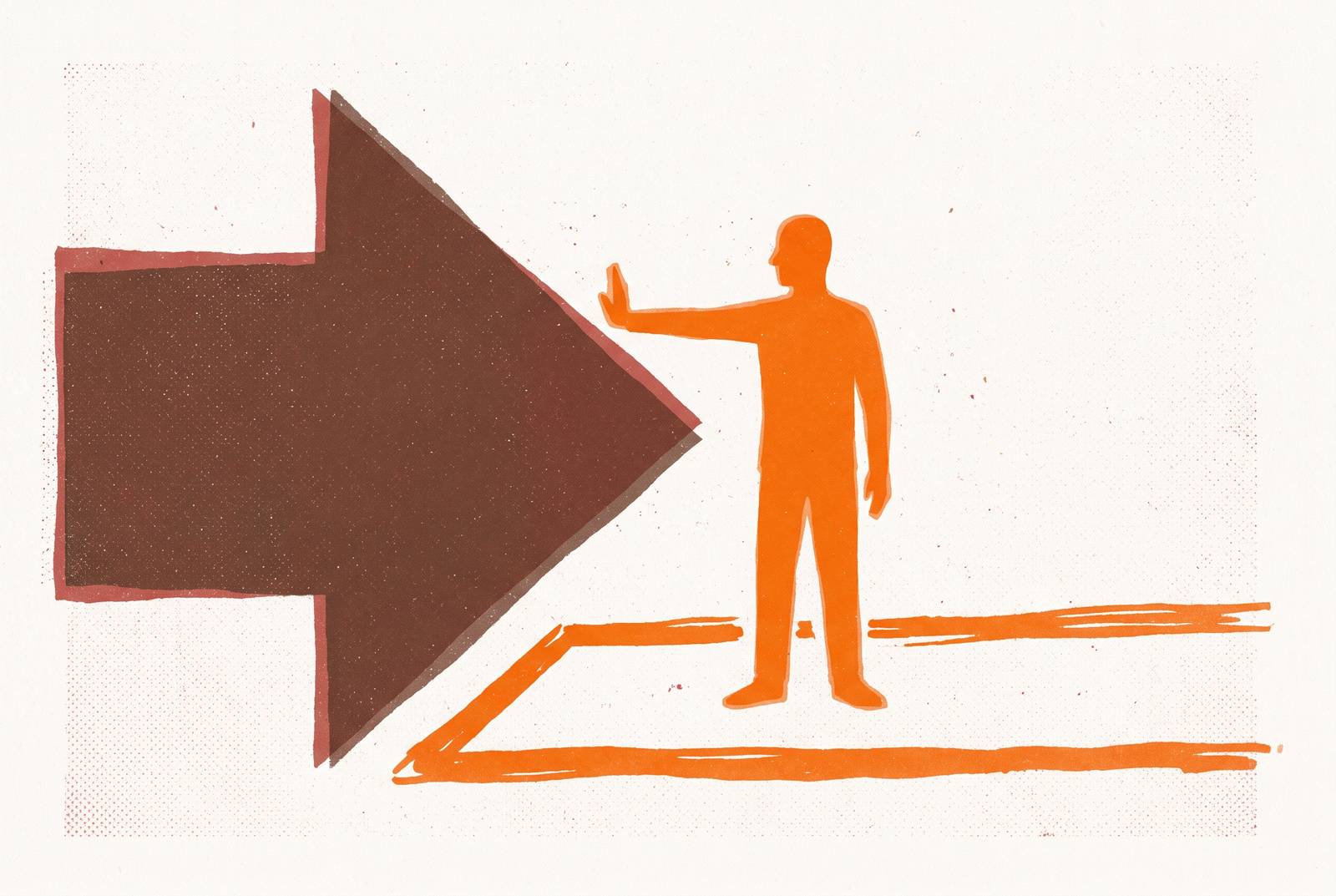
Availability has become the new overtime. Somewhere between the rise of workplace messaging apps, the death of the commute, and the general cultural agreement that rest is suspicious, a lot of workplaces started treating responsiveness as a personality trait rather than a job requirement. This piece looks at what it actually takes to set limits in a job that reads those limits as a red flag, and why the answer starts privately, on a page, before it ever gets said out loud in a meeting.
The scale of this is not anecdotal. Roughly 85% of employees get work messages outside standard hours at least a few times a month, and 60% get them a few times a week or more, according to workplace communication surveys on the subject; only 6% report never hearing from work after hours at all. Among remote workers specifically, 81% check email outside their contracted hours, including 63% who do it on weekends and, somewhat heroically, 34% who do it on vacation. Ask a broad sample of workers. workers whether there's a real line between their job and their personal life, and 60 will tell you no, not really. The commute used to do this work for free. It was dead time, but it also functioned as a boundary, with the car, the train, or the walk between the office door and the front door acting as a buffer that quietly ended the workday whether anyone announced it or not. Remote and hybrid work deleted that buffer. The erosion of limits didn't happen because people got worse at saying no. It happened because the physical infrastructure that used to say no on their behalf disappeared.
What makes this environment different from simply having a demanding job
A demanding job asks a lot of your output. A punishing one asks a lot of your presence, and treats the two as interchangeable even when they aren't. That distinction matters because the fixes for each are completely different: one is a workload conversation, the other is a culture problem wearing a workload costume.
The tell is in what gets rewarded publicly. In a merely demanding job, someone who answers an email at 11 p.m. might get a quiet thank you. In a punishing one, that same email gets held up as an example, in a team meeting or a group chat channel, of what commitment looks like, which quietly instructs everyone watching that this is now the baseline. Once responsiveness becomes the performance metric, declining extra work gets read as a character reference rather than treated as a scheduling question. Scope creep, meeting overload, and after-hours pings accumulate the same way sediment does. Nobody decides it. Nobody decides it; it just settles.
The risk of setting a limit is not distributed evenly across a workforce. Who gets called "difficult" for saying no and who's simply expected to absorb everything without comment tends to track along lines of race, gender, age, and seniority. Women report burnout at notably higher rates than men, at 46% compared to 37%. Gen Z, meanwhile, hits peak burnout at age 25, a full 17 years earlier than the average American, which is either a damning indictment of modern work or the single fastest coming-of-age story in labor history. Possibly both.
Why most boundary-setting advice fails in environments that penalize it
Most boundary advice out there was built for offices that are indifferent to limits, not ones actively hostile to them. Scripts, templates, the "just say no" energy of a professional-networking-site carousel: all of it assumes the hard part is finding the right words. The hard part is not finding the right words. The hard part is knowing, with any confidence, what you're even trying to protect.
Communication tactics operate on the assumption that a person already knows their limit and already believes it's reasonable to hold it, and that's the gap: punishing environments erode exactly those two things, continuo... Communication tactics operate on the assumption that a person already knows their limit and already believes it's reasonable to hold it. Punishing environments erode exactly those two things, continuously, in the background, without anyone having to say a mean word to you directly. Constant exposure to the idea that availability equals commitment doesn't just pressure people into overworking, it makes them doubt whether their own limits are legitimate in the first place. And chronic stress isn't just unpleasant, it has a measurable cognitive cost: it degrades the prefrontal cortex's capacity for the kind of clear reasoning needed to evaluate what's acceptable and what isn't. The mental bandwidth required just to keep functioning under pressure is bandwidth that isn't available for figuring out where the line should be.
That problem has a mechanical version. Cognitive psychology research on the subject shows that working memory holds somewhere around 4 to 7 items at a time. An unresolved worry, a half-finished task, a dreaded conversation you're putting off: the brain treats all of these as open loops that need active maintenance, occupying a working-memory slot the same way an open tab occupies a device's memory. Load enough of those in, and there's nothing left to run the process of actually deciding what your limit is. So people don't discover their limit through reflection. They discover it by blowing past it, at which point they're reacting, usually badly, usually too late to look composed about it. They're reacting, usually badly, usually too late to look composed about it.
What happens in the brain when you write about pressure rather than just carrying it
The fix here is not a vibe but a documented mechanism. Expressive writing appears to create a pathway between emotional experience and reasoned thinking. Writing about a stressor doesn't just get it out of your head. It creates a pathway for processing that purely mental rumination doesn't.
The specific effect has a name: affect labeling, sometimes summarized as "name it to tame it." Putting a precise word on an emotional state lowers its intensity and sharpens the thinking around it; leaving it unnamed keeps it running as background noise, a low hum of activation that never fully resolves. UCLA's Dr. Dan Siegel put it directly: "If you can name it, you can tame it."
In 2011, researchers Ramirez and Beilock at the University of Chicago had students spend 10 minutes writing about their anxiety before a high-stakes exam. In 2011, researchers Ramirez and Beilock at the University of Chicago had students spend 10 minutes writing about their anxiety before a high-stakes exam. The group that wrote performed significantly better than the group that didn't. The mechanism wasn't motivational, it wasn't a pep talk effect. The act of writing about the anxiety appears to have reduced its interference with performance.
Translate that to a job that treats your inbox as a character test. Unprocessed resentment about a boundary that got ignored, uncertainty about whether your limit is even reasonable, quiet fear about what happens if you enforce it anyway: these are not background feelings. They're active cognitive loads, sitting in the same limited working-memory space that a person needs to think clearly about anything else. Writing them down is closing browser tabs. It's closing browser tabs.
Building the private system: what to track before you communicate anything outward
Before any conversation with a manager, the material worth having is a private record, and it serves three separate jobs at once: documenting what's actually happening, processing the emotional charge of it, and clarifying what you actually want to hold onto going forward.
Three categories deserve regular tracking. First, incidents and patterns: when a limit got crossed, what was actually asked, what the unspoken pressure behind the ask was, how the response went, and what it cost afterward. A single instance rarely looks like much. A month of them, read back together, usually does. Second, personal signals: exceeding a limit produces physical, cognitive, and emotional markers, whether that's a sleep pattern, a short temper, or a specific kind of exhaustion that doesn't match the actual hours worked. Third, and probably the real destination of this whole exercise, values clarification: sorting out what's genuinely worth keeping versus what's simply being absorbed out of fear of the label.
A handful of formats do this work well, and none of them require much setup.
A brain dump, unstructured, just getting everything out of the head and onto the page, works well on the days when there's no bandwidth left for anything more organized.
Structured prompts help surface patterns instead of single incidents: something like "Which habits or routines consistently supported well-being, even on hard days? Were there any that hindered it?" pulls attention toward the shape of things over time, over the worst moment of the week.
A well-known expressive-writing method asks for a short period of continuous, unedited writing about the emotional dimension of a specific situation. Not a description of what happened. What it felt like.
CBT-adjacent thought records go a step further, capturing the situation itself, the automatic thought attached to it ("if I say no, I'll be seen as uncommitted"), the evidence for and against that thought, and a more balanced version of it. This one is particularly useful for interrogating the assumptions a punishing environment has quietly installed.
None of these need to be long or polished to work. Research on expressive writing generally suggests that consistency matters more than session length or polish. Regular shorter sessions tend to produce better outcomes than sporadic longer ones, much as a short daily jog beats one heroic marathon attempt a year.
Using what you've written to decide what you want to hold
The actual shift this practice produces is specific: moving from "I feel overwhelmed," which is a feeling, to "I will not respond to messages after 7 p.m. on weekdays," which is a decision. The second version is the only one that can be communicated to another person and held over time. Nobody can negotiate against a feeling. A decision, on the other hand, has edges.
It helps to separate limits into distinct categories, because collapsing them tends to produce a boundary that misses the actual target. Time and availability limits cover when someone is reachable and when they're not. Workload limits cover what can realistically get delivered, and at what quality, given everything already on a plate. Emotional labor limits cover what someone is willing to absorb that was never actually part of the job description, the unpaid therapist role that creeps into a lot of team dynamics. Communication style limits cover how someone is willing to be spoken to, tone included.
Reading back through what's been written is its own distinct step, separate from the writing itself, and arguably the more useful one. This is where the pattern actually surfaces: which situations keep repeating (the scope creep, the after-hours ping, the meeting that could've been an email, the volunteering that was never actually volunteered), which signals cluster together (fatigue, sloppy errors, and irritability spiking in the same week is rarely a coincidence), and which past responses actually held versus which ones quietly eroded under pressure.
How to communicate limits in environments where the stakes feel real
Framing changes how a limit lands, even when the substance is identical. "I need to protect my output quality" and "I need to leave by 6 p.m." can describe the exact same boundary, but one gets heard as a professional standard and the other gets heard as a personal ask. In an environment where availability reads as commitment, that difference in framing is not cosmetic. It's the entire negotiation.
A workable structure holds up across most high-stakes conversations. Start by affirming the shared goal, so the limit doesn't read as opposition to the work itself. Name the actual constraint, whether that's time, scope, or bandwidth, without over-explaining it. Offer a visible trade-off or option, so the other person has a real choice rather than a wall. Then confirm whatever gets decided, briefly, in writing, so it doesn't quietly dissolve by Thursday.
In practice, that sounds like: "Sure, I can take this on. To deliver it well by Friday, I'll need to pause Project X or move Task Y to next week. Which deliverable should shift?" Or, when there's simply no room left: "I'm at full capacity this week. The earliest I can start this is Tuesday, with a draft by Thursday." For after-hours contact specifically: "I'm offline after 6 p.m. If something comes in during the evening, I'll respond the next business day. If it's urgent, please call and leave a voicemail with the deadline and impact."
None of this erases the equity concerns raised earlier, and pretending otherwise would be dishonest. The exact same sentence, delivered by two different people in the same company, can register as calm professionalism from one and as aggression from the other, depending entirely on who's saying it and where they sit in the org chart. That's a reason the private reflection step, all the writing and pattern-spotting covered above, matters even more for the people who carry higher risk in saying it out loud. It's a reason the private reflection step, all the writing and pattern-spotting covered above, matters even more for the people who carry higher risk in saying it out loud. Going into that conversation already clear on the limit, already able to name it precisely, is armor that people with less institutional safety net can't really afford to skip.
Building the reflection habit when the environment creates resistance to it
The system that survives is the one that's easy enough to actually keep. A daily practice that demands 30 uninterrupted minutes will get dropped the first time a deadline actually matters, which, in a punishing environment, is basically every week. The best version of this habit is the one built to run on the worst day.
So the starting point can be small enough to feel almost silly: one honest sentence a day is a legitimate place to begin. Five minutes done consistently builds more real momentum than a 30-minute session that happens twice and then quietly stops happening. Given everything covered here, from the working-memory research to the affect-labeling concept to the actual mechanics of a boundary conversation, the throughline is the same one running under the whole piece: clarity is not something that appears on demand in a tense meeting. It gets built beforehand, in private, in small and unglamorous increments, by someone willing to sit with the pressure long enough to write down what it's actually asking of them.