WHO Burnout Definition and What It Actually Covers
The WHO's 2019 definition classifies burnout as an occupational phenomenon, not a medical disease.
The WHO definition of burnout gets quoted constantly and understood rarely. Most people who cite it have never read past the first sentence, which is a shame, because the second half of the text does all the interesting work: it tells you what burnout is not, and where it does not apply.
WHO's exact 2019 language on burnout
Burn-out is a syndrome conceptualized as resulting from chronic workplace stress that has not been successfully managed. It is characterized by three dimensions: feelings of energy depletion or exhaustion; increased mental distance from one's job, or feelings of negativism or cynicism related to one's job; and reduced professional efficacy. Burn-out refers specifically to phenomena in the occupational context and should not be applied to describe experiences in other areas of life."
That text lives inside ICD-11, in a chapter titled "Factors influencing health status or contact with health services." It is not filed under diseases. It sits under code QD85, in a section for problems tied to employment or unemployment. The classification was adopted in 2019 and became formally active on January 1, 2022, so this has been the operative definition for years now, not a fresh proposal still finding its feet.
Compare that to what came before. ICD-10 filed burnout under Z73, "Problems related to life-management difficulty," with its own subcode Z73.0, and described it in four words: "a state of vital exhaustion." Dr. Frank Drummond, chief medical officer of behavioral health services at HCA Healthcare, frames the shift as moving burnout from a symptom associated with poor life management into a syndrome tied specifically to unmanaged workplace stress. The non-disease status never changed. The architecture underneath it changed, and that changed architecture produces the entire shift being described here.
Sit with the language for a second before reaching for interpretation. Two phrases are doing the heaviest lifting in that paragraph, and neither one gets much attention in casual conversation about burnout.
The two words most readers miss: "occupational phenomenon, not a medical condition"
"Occupational phenomenon" is not throat-clearing. In ICD-11's own logic, it means burnout is real enough to justify a doctor's visit, but it is filed in the chapter reserved for non-illness reasons people show up at a clinic, not the chapters that hold diseases, disorders, or diagnosable conditions. A medical condition, by contrast, would sit in a disease chapter, get coded as a primary diagnosis, and be treated as an illness in its own right. Burnout does neither.
That stands as a firm statement. It is the operating instruction for the entire framework.
What does that mean for someone sitting across from a clinician? Before burnout becomes the working explanation, the clinician has to rule out acute stress reaction, PTSD, adjustment disorders, and other stress-related conditions that share overlapping symptoms. Burnout is what is left standing once those have been checked off, not the first box ticked. The downstream damage, things like depression, anxiety, or cardiovascular strain, can absolutely be diagnosed as medical conditions. Burnout itself, situated where it is, cannot. As Christine Sinsky, MD, former vice president of professional satisfaction at the AMA, put it, "What is important here is to understand that in the ICD-11 definition, burnout is identified as an occupational phenomenon and not a medical condition".
Media errors and WHO's share of the blame
Coverage in 2019 went a different direction. Multiple outlets reported, flatly, that the WHO had classified burnout as a disease or a formal medical diagnosis. Some of that confusion traces back to an incorrect communication the WHO itself issued and later corrected. HCA Healthcare Today ran a piece under the headline "It's official! 'Burnout' defined and recognized as a medical diagnosis." The article's own body text walked the claim back, but headlines travel faster than corrections ever do, and this one stuck around in public memory long after the correction landed.
Why did the mistake spread so easily? The word "syndrome" carries clinical weight. An ICD listing sounds, on its face, like a diagnosis. And the shift from "state" to "syndrome" felt like an upgrade in medical seriousness, even though nothing about burnout's classification actually moved into disease territory. "Medical condition" felt like a reasonable paraphrase. It was, in fact, precisely wrong.
This is not pedantry for its own sake. Classification determines how a condition gets researched, funded, treated, and legally recognized. Get the label wrong and policy conversations start from the wrong premise. Coverage skipped the structural detail that actually explains what burnout is: the three-dimension model that has to be satisfied before the label applies at all.
The three-dimension structure, all three of which must be present
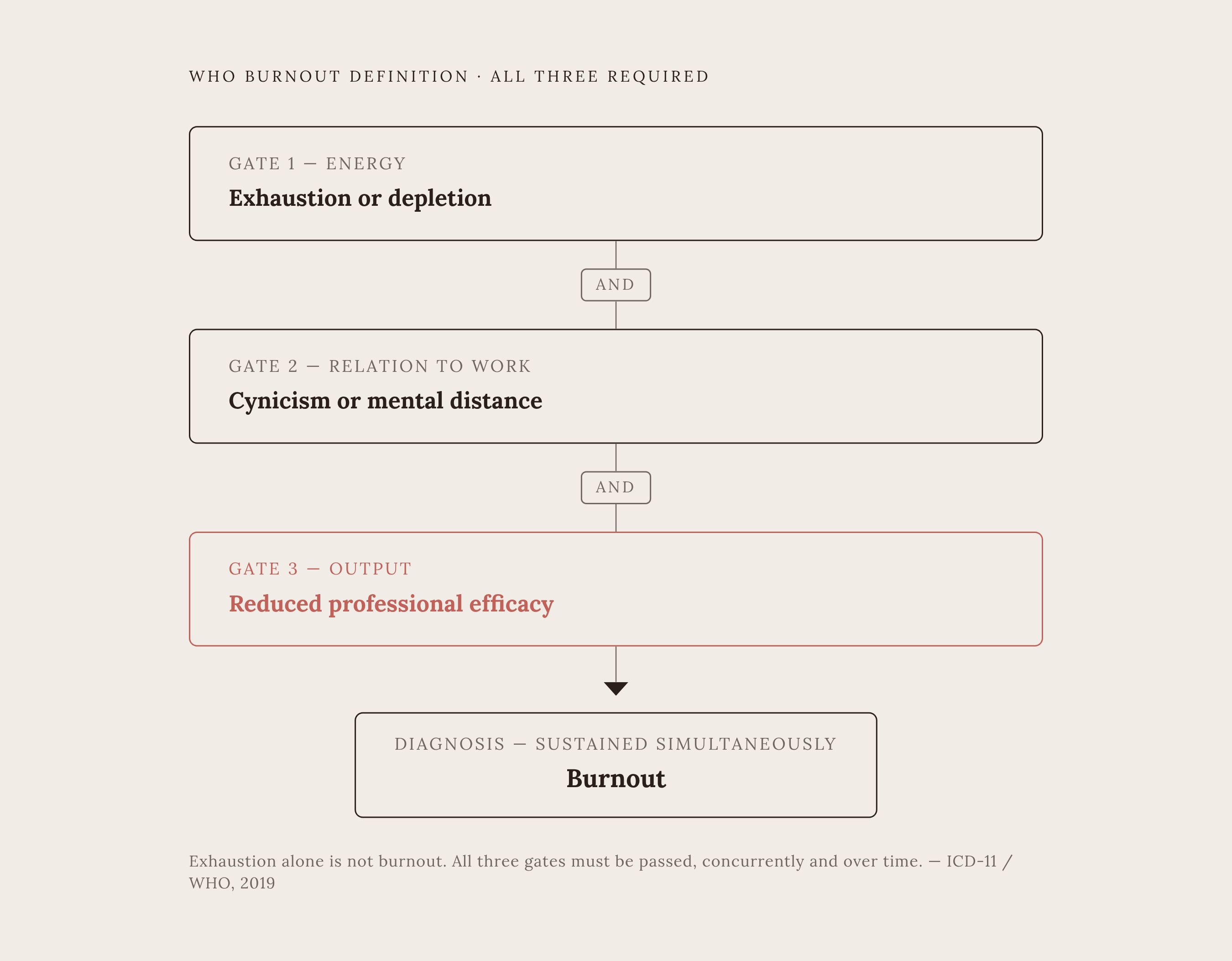
The WHO's own language breaks burnout into three components. First, feelings of energy depletion or exhaustion. Second, increased mental distance from one's job, or feelings of negativism and cynicism connected to that job. Third, reduced professional efficacy.
All three have to show up together. Exhaustion by itself does not clear the bar. That single requirement is probably the most under-discussed detail in the entire definition, because it means a genuinely tired person, even a chronically tired one, does not automatically qualify as burned out under this framework unless the cynicism and the reduced sense of competence are also present.
The lineage here matters too. The WHO's three-dimension model follows the framework psychologist Christina Maslach developed decades earlier, and the term "burnout" itself traces back to Herbert Freudenberger, who coined it in a 1974 Journal of Social Issues article after studying people worn down by excessive workplace demands. So this is a formal adoption of research language already in circulation. It is a formal adoption of research language that had already been circulating in occupational psychology for close to half a century.
A useful way to hold the three dimensions in mind: exhaustion is the energy system running low, cynicism is the relationship with the work souring, and reduced efficacy is the self-assessment of competence collapsing. A brutal week at the office might dent one of those. Burnout, under this definition, requires all three sagging at once, over time.
The Maslach Burnout Inventory (MBI) remains the most widely used tool for measuring these dimensions. The National Academies of Sciences, Engineering, and Medicine issued a caveat in May 2025: the MBI is built to measure burnout patterns within a given situation, not to serve as a diagnostic instrument for any one individual. That distinction between a discovery tool and a diagnostic one turns out to matter a great deal, and it sets up exactly where the scientific disagreements start to surface.
The scope restriction the definition makes explicit
Go back to the definition's closing sentence, because it is doing something most citations skip. "Burn-out refers specifically to phenomena in the occupational context and should not be applied to describe experiences in other areas of life." That is a deliberate distinction. It is a boundary drawn on purpose.
What falls outside that boundary? Exhaustion from caregiving, from raising kids, from grinding through a demanding creative project, none of that counts as burnout under this framework, however real or debilitating it might feel. Depression does not count either, at least not as a synonym. Depression is a mood disorder that extends across all of life, not anchored to work, and while its symptoms overlap with burnout's, burnout is job-related and situation-specific. Ordinary stress does not qualify. Ordinary stress is situational, and it eases once the demand passes. Burnout is workplace stress that has stopped being situational, turning into a permanent background hum instead.
Why insist on this boundary so precisely? Because it is not bureaucratic hairsplitting. Locating burnout specifically in the occupational context frames it as an environmental problem, something the workplace produces, rather than a personal failing or an individual pathology. Chris Warburton, a health and safety research officer at Prospect, flagged the risk of the previous "life management" framing individualising the issue, shifting blame onto the person rather than the conditions they work under. The ICD-11 architecture reverses that. Burnout is real enough to see a doctor about. The conditions it might trigger, depression, anxiety, cardiovascular strain, are the medical diagnoses. Burnout is the mechanism.
Where the scientific community disagrees with the WHO's framing
None of this settles the matter for researchers, and it would be misleading to pretend otherwise. A 2021 systematic review by Guseva Canu and colleagues counted as many as 88 distinct definitions of burnout floating around the scientific literature. The WHO's 2019 language narrowed that sprawl. It did not end it.
The sharpest fault line runs through the burnout-versus-depression question. Bianchi and colleagues, writing in 2024 and again in 2025, argue that burnout overlaps substantially with depression and may in fact be a subtype of depressive disorder rather than a separate phenomenon. De Beer and Schaufeli, also writing in 2025, push back, arguing burnout is a distinct construct rooted in occupational stress and ought to be kept separate from clinical depression. Both camps are working from serious data. Neither has closed the case.
Measurement compounds the disagreement. Different studies use different instruments, and the resulting numbers scatter wildly. A 2025 systematic review of burnout among orthopaedic surgeons found prevalence estimates ranging from 15% to 90% across 34 separate studies, with the MBI used in roughly three-quarters of them and a mix of other tools filling in the rest. A range that wide is not really measuring the same thing consistently, and that should give anyone pause before treating a single burnout statistic as gospel.
There are also active calls to push burnout further, into full disease classification. The European Trade Union Institute described the ICD-11 inclusion as "opening the door to having it classified in the WHO's International Classification of Diseases," a door that has not actually opened yet. Prospect points out that osteoporosis walked a comparable path, moving from a health-influencing factor into a recognized disease entity back in 1994. Whether burnout follows that same trajectory is an open question, not a settled one. Complicating matters further, a PMC-indexed review notes that because burnout is not classified as a medical condition, the epidemiological data needed to track it systematically over time is harder to accumulate, leaving a gap between how large the problem appears to be and how well the evidence base actually documents it.
None of this dismantles the WHO definition. It shows where the framework is still provisional, and where a reader should hold it with some humility rather than treating it as a closed argument.
The scale of burnout when the WHO's scope restriction is applied correctly
Before any numbers get thrown around, one caveat has to sit up front: because the WHO framework is occupational rather than diagnostic, every major prevalence figure in circulation is self-reported survey data, not a count of clinically diagnosed cases. That is a structural feature built into the definition itself. It is a direct consequence of how the definition itself is built.
With that caveat in place, the numbers still paint a sizable picture. A Gallup poll cited by HCA Healthcare Today found 23% of employees reporting they felt burned out at work very often or always, a figure that reflects a historical baseline from 2019 rather than a current snapshot. More recently, a DHR Global survey of roughly 1,500 white-collar knowledge workers across North America, Europe, and Asia found 83% reporting at least some degree of burnout, barely moved from 82% the year before, which suggests the trend line is flat rather than improving. Mental Health UK's Burnout Report found nine in ten UK adults experienced high or extreme pressure and stress over the past year.
Why bother with the scope restriction at all if the numbers are this large regardless? Because conflating burnout with every form of exhaustion inflates the figures further while making the actual, fixable cause, the workplace, disappear into the background noise. Apply the WHO definition properly, chronic workplace stress specifically, all three dimensions present, and the problem becomes something an organization can actually be held responsible for addressing. Healthcare work makes the point concretely. Burnout among U.S. healthcare workers ran around 30 to 31% before the pandemic, spiked during it, and has settled somewhat since, though it remains above pre-pandemic levels, a pattern that tracks directly with identifiable staffing and workload conditions rather than any flaw in the individuals doing the work Burnout in emergency medical and paramedical teams / European Psychiatry.
None of this is an argument for minimizing burnout. It is the opposite. Properly scoped, burnout carries documented links to insomnia, cardiovascular disease, and metabolic disruption, and getting the definition right is what makes the problem legible enough to actually act on, rather than a shrug dressed up as compassion.
Using the definition in practice as a personal reference point, not a self-diagnosis
So what is any of this actually for, if not to hand someone a checklist and a verdict? The WHO definition works best as a pattern-recognition tool. The relevant question is not "do I have burnout." It is whether the pattern, prolonged workplace stress, all three dimensions present, sustained over a real stretch of time, actually matches what is happening.
Three questions fall directly out of the definition itself. Is the source specifically tied to work, or has the exhaustion bled into everything, even the parts of life that used to feel restorative? If it is the latter, depression is a stronger fit, and that is a conversation for a clinician, not a framework. Are all three dimensions actually present, or is it really just exhaustion doing all the talking? Exhaustion on its own is not burnout, and cynicism on its own is not either. And is the stress chronic and unmanaged, or is it acute and tied to something with a visible end date? A brutal quarter with a known finish line is stress. The permanent sense of never recovering is what the definition is actually pointing at.
Burnout tends to creep rather than announce itself, which is part of why it is so easy to miss the moment recoverable stress tips into something chronic. Some form of regular reflection, whether written down or spoken aloud, tends to make that shift more visible before it compounds. Talking through a day, noting what drained the tank, what pushed distance between a person and their work, what started to feel pointless, maps almost exactly onto the WHO's three dimensions without requiring anyone to reach for clinical vocabulary. For anyone who thinks better out loud than on a page, a conversational voice journaling tool can serve that same function with considerably less friction than staring at a blank document.
None of that replaces professional support when symptoms are serious, and the WHO definition was never built as a self-diagnosis kit. It is a precise framework, nothing more dramatic than that, built to help someone ask sharper questions about their own working conditions and notice, earlier rather than later, when ordinary stress has quietly become something chronic.
Sources
- WHO expands definition of 'burnout' | HR Dive
- It's official! 'Burnout' defined and recognized as a medical diagnosis - HCA Healthcare Today
- Burn-out an "occupational phenomenon": International Classification of Diseases
- World Health Organisation widens definition of burnout | Prospect
- Burnout in emergency medical and paramedical teams
- WHO adds burnout to ICD-11. What it means for physicians. | American Medical Association
- ICD-11 Burnout for the psychiatrist: Meaning of the concept and prevalence of the condition
- Burnout Inclusion in ICD-11: Media Got It Wrong, WHO Says