Distinguishing Burnout From Depression
One specific question—whether distress follows you home—separates burnout from depression.
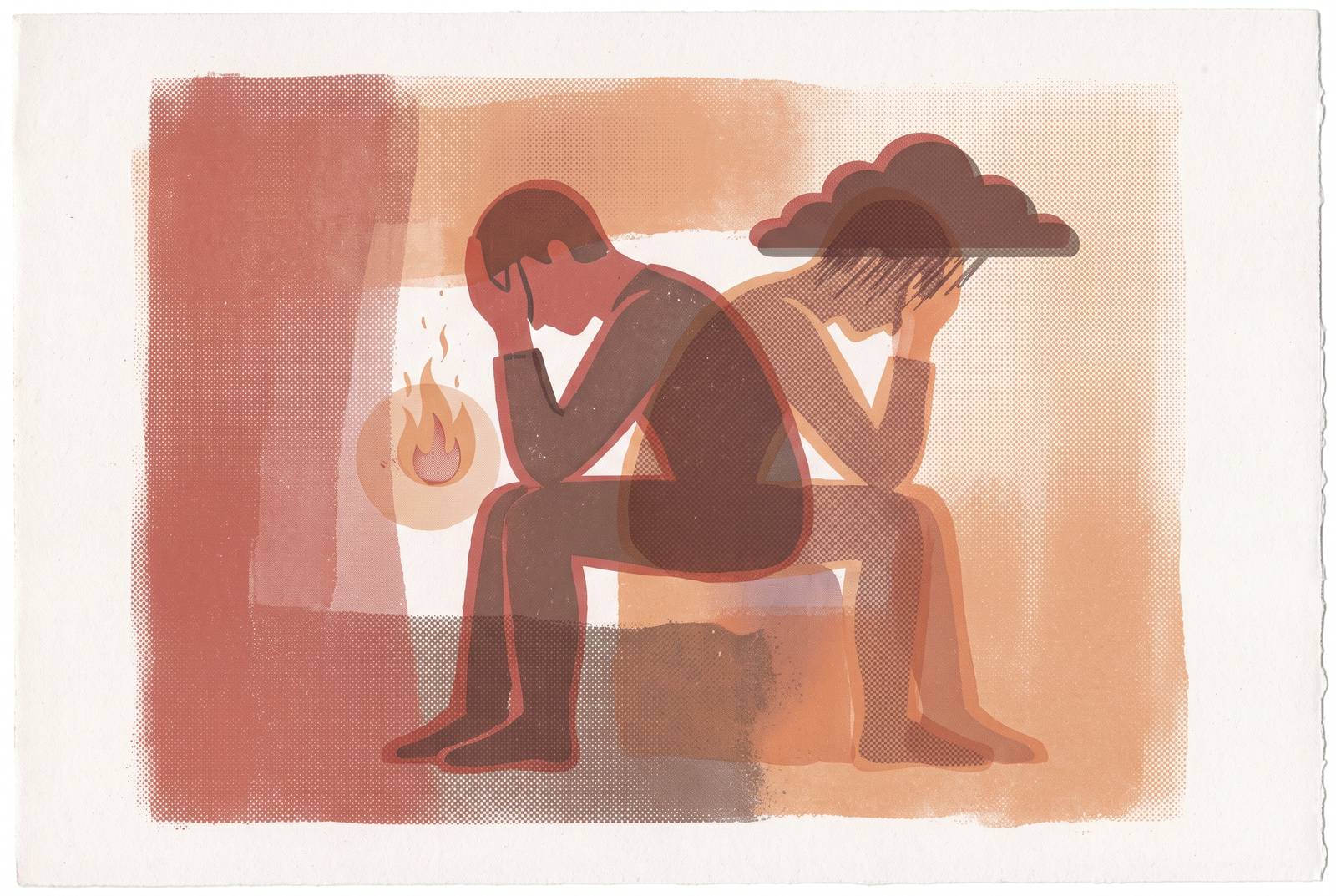
Burnout and depression share so much overlap on the surface that even trained clinicians sometimes hand out the wrong label. But they diverge on one decisive axis: whether the distress follows you home. That single question does more diagnostic work than the entire symptom checklist combined, and understanding it is the most practical tool a person has for figuring out what they're actually dealing with.
Here's why the checklist fails you. Exhaustion, brain fog, irritability, emotional flatness, a drop in motivation: burnout produces all of these, and so does depression. A 2023 study in the Journal of Affective Disorders (Tavella et al., comparing 622 people with burnout against 90 with depression) found that total scores on the Sydney Burnout Measure showed poor differentiation between the two groups. Read the symptom list alone, without any other context, and you often can't tell which condition you're looking at. Researchers suspect a shared biological substrate produces both, and that substrate is part of why the confusion isn't just a layperson problem.
That confusion has consequences. Get the label wrong and the treatment plan follows the wrong label too. Addressing a toxic workplace won't lift clinical depression, and antidepressants won't fix a manager who assigns triple the reasonable workload. So the goal here isn't self-diagnosis, and nobody should walk away from this piece thinking they've replaced a clinician. The goal is knowing which questions to ask, because one axis, examined carefully, does most of the sorting.
The one question that separates them: does it follow you everywhere?
Burnout attaches to a role. Depression attaches to you, regardless of where you are or what you're doing.
SimplyPsychology frames this as a practical diagnostic tool, and it holds up: if a week away from the demanding role lifts the exhaustion and you feel roughly like yourself again, burnout is the likelier explanation. If the exhaustion, the low self-worth, and the hopelessness travel with you to the beach, to your parents' house, to a hobby you used to love, depression fits the picture better. Someone burned out at work can still genuinely enjoy a Saturday hike. Someone depressed can be standing in the same beautiful spot and feel nothing shift at all, because depression doesn't care about scenery.
Gordon Parker, Scientia Professor of Psychiatry at UNSW Sydney, offers a clinical shorthand: depression is marked by helplessness, burnout by hopelessness. The distinction is subtle but real. Helplessness says "there's nothing I can do." Hopelessness says "nothing is going to get better even if I try," which sounds similar but sits differently in how a person relates to their own agency.
Here, "role" isn't limited to a paying job. Caregiving for an aging parent, raising a child with high needs, managing a chronic illness day after day, these all qualify as the kind of sustained, demanding context that can produce burnout. And to be clear, this is a triage question, not a diagnosis. It's a compass, not a verdict, and it works best as a starting point for a conversation with a professional rather than an endpoint on its own.
What burnout actually is, and what it is not
A leading international health body classifies burnout in the ICD-11 as an "occupational phenomenon," not a medical condition. That's a small phrase carrying a large institutional weight: burnout is officially a workplace problem before it's a psychiatric one, at least on paper.
Christina Maslach's research identified three dimensions that the ICD-11 definition formalizes. Emotional exhaustion comes first and hits hardest, manifesting as a pervasive fatigue that rest alone does not seem to resolve. Cynicism, or depersonalization, follows: the people involved in the role start feeling like obstacles rather than humans, a shift that's uncomfortable to notice in yourself. Reduced professional efficacy rounds it out, that creeping sense that effort no longer converts into results, that competence itself feels shaky.
Burnout doesn't arrive like a switch flipping. It's a slide. Early engagement gives way to mounting stress, then chronic stress, then a state where the symptoms stop being an event and start being the baseline. Timing varies: a short, brutal stretch of overwork (two weeks of an impossible deadline, say) can trigger a "burning out" phase, while full-blown burnout more often follows years of unrelenting pressure with no real recovery windows.
Perfectionism deserves a specific mention here. Parker's research at UNSW flags it as a significant risk factor, because perfectionism drives people toward overwork and links self-worth to performance outcomes, which is a recipe for exactly this slide. The texture of burnout gets described as "wired and tired": still caring, still wanting to hit the goal, but missing the physiological fuel to chase it. And under strict definitions, burnout requires a role or environment to burn out from. You can't burn out from life in general. You burn out from something specific, which is precisely what makes the first section's question so useful.
What depression actually is, and where it differs in kind
The DSM-5-TR defines depression as a cluster of symptoms present for at least two weeks, marking a real change from how someone previously functioned, and causing significant distress or impairment. That's a clinical bar, and it's a different bar than the one burnout clears.
Several core features of depression don't appear reliably in burnout at all. Anhedonia, the marked loss of interest or pleasure in things that used to feel good, is not the same as exhaustion-driven disengagement. A burned-out person might skip the concert because they're too drained to go; a depressed person might go and simply not feel anything once they're there. Self-worth shifts differently too: burnout tends to produce "I am failing at this job," while depression tends to produce "I am a failure," full stop, no qualifier attached. The future outlook diverges as well. Burnout says, "I want this to change but I don't have the energy to make it happen." Depression says, "I cannot picture a future where this feels different." And research comparing burnout and depression groups has found clinically meaningful differences in the severity of certain symptoms, differences that matter practically and aren't just semantic.
Two subtypes of depression matter for this comparison specifically. Melancholic depression appears to be genetic in origin, with episodes often striking with little external trigger, and it's managed primarily through antidepressant medication. Non-melancholic depression is environmentally triggered, frequently by life events that erode self-worth, and according to Tavella et al., this is the subtype that overlaps more with burnout's territory. Depression, overall, is multifactorial: genes, biology, and life events all feed into it, and it isn't anchored to one specific role. That's exactly why removing the stressor doesn't resolve it. Burnout symptoms tend to ease once the underlying pressure gets addressed. Depression can persist stubbornly even after the job changes, the caregiving ends, or the vacation happens. That behavioral difference, more than any symptom checklist, is probably the most useful thing a person can observe about their own experience in real time.
Where the biology diverges, and why that matters for self-understanding
Both conditions involve dysregulation of the HPA axis, the body's central stress-response system. But the dysregulation runs in opposite directions, and that's the clearest biological fork in the road between the two.
In depression, the HPA axis tends toward hyperactivity, producing elevated and persistent cortisol. Chronically excess cortisol is neurotoxic in a fairly specific way: it's linked to reduced hippocampal volume, which impairs both emotional regulation and memory. Burnout, on the other hand, has been associated in some research with a hypocortisolemic state. Research reviewing cortisol studies has found reduced cortisol awakening response to be a recurring pattern in burnout populations. So the same stress system, pushed in opposite directions, can still land a person in the same fog of exhaustion and forgetfulness. Identical symptoms can arise from mirror-image biology that produces them.
Brain imaging and EEG research in chronic burnout adds more texture. Studies have identified measurable neural signatures associated with burnout, including changes linked to cognitive drag, the kind of sluggish reasoning and slower complex decision-making a burned-out employee often notices weeks before they can name what's happening to them. A 2025 mechanistic review in Frontiers in Human Neuroscience pulled together 18 EEG studies covering 2,194 participants and identified resting-state and event-related neural signatures associated with burnout, evidence that burnout carries a measurable brain profile of its own.
The cortisol directionality point carries forward. It explains, at a mechanical level, why treating burnout as though it's depression (or the reverse) can backfire: you're pushing on a system that's already dysregulated in the opposite direction from what the treatment assumes.
How severe burnout can become depression if left unaddressed
Burnout is a clinically recognized risk factor for depression, anxiety disorders, cardiovascular disease, and immune dysfunction. None of that is speculative; it's the reason occupational health researchers treat burnout as more than a mood problem.
The pathway runs through withdrawal. Jennifer Kemp, MPsych, points to how burnout drives people away from meaningful activities and relationships, and that disconnection is itself one of the more direct routes into depression. It's a slow leak, not a dramatic break: fewer social plans, less energy for hobbies, a shrinking radius of things that still feel worth doing.
The Medscape 2024 Physician Burnout & Depression Report found that among physicians experiencing depression, 72% identified job burnout as a contributor. That's not a hypothetical risk sitting in a textbook; it's the reported experience of most depressed physicians in that survey. Nigel Girgrah, a gastroenterologist and chief wellness officer at Ochsner Health, put the mechanism plainly: burnout reduces the ability to address mental health challenges at an earlier stage. In other words, burnout doesn't just risk turning into depression, it degrades the exact capacity a person needs to notice depression creeping in and do something about it early.
Recovery timelines track the severity gradient closely: milder cases may resolve relatively quickly with meaningful intervention, while severe or chronic burnout that has tipped into secondary depression can require substantially longer support. The general pattern holds: catching the distinction early, while the symptoms are still contextual rather than pervasive, preserves a lot more room to recover quickly.
How prevalent these conditions actually are, and what that scale implies
The numbers here are large enough to stop treating this as a niche concern. Roughly 30% of the Australian workforce reports some level of burnout, and nearly 20% of Australians receive a depression diagnosis at some point in their lives, according to UNSW research.
The Medscape 2024 Physician Burnout & Depression Report surveyed 9,226 physicians across more than 29 specialties between July and October 2023, and the figures are stark. 49% of physicians reported burnout overall. Female physicians reported it at 56%, compared to 44% of male physicians. 42% of respondents said they'd been burned out for more than two years, which stops looking like a rough patch and starts looking like a chronic condition. 20% reported feeling depressed, and as noted above, 72% of that depressed group named job burnout as a contributor. Emergency medicine posted the highest burnout rate of any specialty surveyed, at 63%, which will surprise absolutely no one who has spent time in an ER.
Beyond medicine, a 2024 synthesis of public-health workforce surveys calculated a pooled burnout prevalence of 39%. A cross-sectional study of 4,338 salaried employees across Southeast Asian countries found that 62.9% met the cutoff for burnout on the Maslach Burnout Inventory. These figures swing widely depending on the population sampled and the measurement tool used, and that variability is itself a data point: burnout remains a contested, context-dependent thing to measure, even among people trying to measure it carefully.
The cost isn't abstract for the institutions footing the bill, either. A 2025 analysis estimated that disengagement and burnout cost employers in one country a multiple of the average annual health-insurance premium, and several times over annual training costs, per employee. Numbers like that tend to get an organization's attention faster than a wellness memo ever will.
Applying the contextual-vs.-pervasive lens to your own experience
None of this is about running a checklist and slapping a label on yourself. It's about honest observation, tracked across settings and across time, because a single symptom rarely tells you anything useful on its own. The pattern is where the information lives.
A few questions sit directly at the center of this. Do the symptoms track the role, easing on vacation or over a weekend when the demanding context disappears? Is the self-criticism tied to performance in one specific area, or has it generalized into something closer to "this is who I am"? Is there still real pleasure available somewhere outside the draining context, even in small amounts? And has the sense of the future narrowed to "I want this to change" or hardened into "I can't picture it changing"?
Management strategies split along the same line traced through this whole piece. Burnout responds to identifying and addressing the actual stressors: setting boundaries, taking real recovery time, pushing on the systemic factors (workload, autonomy, workplace culture) that created the slide in the first place. Depression usually needs more than that. Clinical intervention, whether CBT, medication, or structured psychotherapy, tends to be necessary, because removing the stressor alone often isn't sufficient when the biology has shifted the way Section 4 described.
Writing things out, or talking them through out loud, can help clarify which pattern is actually happening, since these patterns are often invisible from the inside and only become legible once they're on a page or in a recording. Research on expressive writing, going back to Pennebaker and continuing through later meta-analyses, has found that structured reflective writing reduces emotional exhaustion and improves psychological well-being, with effects measurable within three to four sessions and a sweet spot around 15 to 20 minutes each time. Guided prompts tend to outperform free-form venting for this specific purpose, because prompts that push toward perspective-taking or meaning-making engage actual cognitive processing rather than just recirculating the same distress on a loop. For someone who finds writing effortful while already depleted, thinking out loud can surface the same observations that a blank page tends to block.
There's a real limit to all of this self-observation, though, and it needs to be stated plainly rather than glossed over. If the symptoms are severe, persistent, and clearly spanning every domain of life, the right next move is a clinician, someone who can see the whole picture, rule out other physical causes like anemia or hypothyroidism, and confirm or revise whatever working theory this piece has helped build. The question of whether it follows you everywhere is a genuinely useful compass. It was never meant to replace the map.
Sources
- Burnout and depression: Points of convergence and divergence - ScienceDirect
- What’s the difference between burnout and depression?
- Burnout Vs. Depression: Understanding the Differences
- Physician burnout and depression, in 5 charts
- Distinguishing Burnout from Depression: A Clinical Guide
- ncbi.nlm.nih.gov
- frontiersin.org
- researchgate.net