Parentification and Its Long-Term Psychological Costs
When kids become emotional caretakers, the damage often stays invisible and lasts for decades.
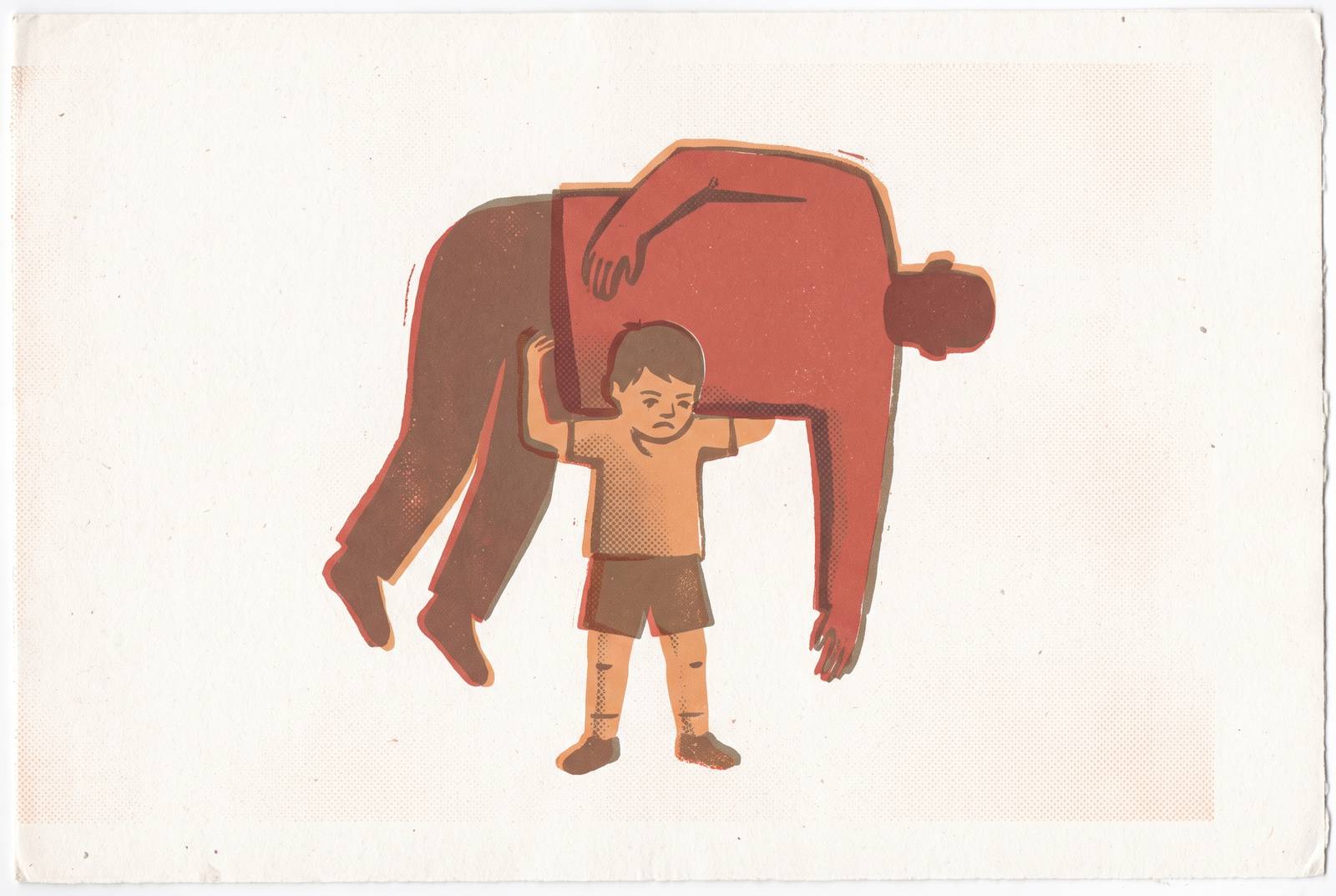
Parentification means a child ends up carrying out tasks and emotional labor that belong to an adult. Family systems theorists Boszormenyi-Nagy and Spark laid out the concept in 1973, and Minuchin's work around the same period described the same basic reversal: kid steps into the parent's job, both the practical parts and the emotional ones. Researchers have defined it as the process by which children get assigned adult responsibilities, both functional and emotional, that a parent would normally handle. That's the whole subject of this piece: what parentification is, how it splits into two distinct forms, and why the research keeps finding that its effects don't stay contained to childhood.
This isn't the same thing as a 10-year-old doing chores. Researchers draw that line explicitly, distinguishing parentification from the ordinary, supervised household responsibility that helps a kid build character and independence. Taking out the trash builds nothing bad. Being the only adult in the room at age nine is a different category of experience. A psychologist, in a book about the plight of the parentified child, split it further into adaptive and pathological versions. Adaptive parentification is short, driven by real necessity, and it ends. Pathological parentification is chronic, it spreads into every corner of family life, and nobody ever tells the kid they did a good job or that it wasn't supposed to be their burden.
The two types of parentification and why the emotional form causes more lasting harm
Split the concept into its two working parts and it gets easier to talk about precisely. Instrumental parentification covers the physical, task-based stuff: cooking dinner, cleaning the house, paying bills, watching younger siblings, or acting as the family's translator when a parent doesn't speak the local language well. Emotional parentification is quieter and harder to name. It's the child who becomes a parent's confidante, who manages a parent's moods, who mediates fights between two adults who should be handling their own conflict. Both types can point in two directions, either toward a parent (parent-focused) or toward siblings and other relatives, including grandparents (sibling-focused).
Emotional parentification tends to do more damage, and the reason has less to do with intensity than with visibility. A kid cooking dinner every night is a fact a teacher or neighbor can notice. A kid who has become their mother's therapist at age eleven leaves no dishes in the sink, no obvious sign anything is off. Nothing about it announces itself. That invisibility means the pattern usually just continues, unchallenged, for years, and the harm compounds quietly instead of getting interrupted. Kids in this position tend to learn two things early: bury your own feelings, and don't expect anyone to respect your boundaries, because you were never taught you had any to begin with.
None of this makes instrumental parentification harmless, to be clear. It's less consuming on average, and it appears less often in the severe end of the outcome research, but "less damaging" is a comparison, not a clean bill of health. A kid managing the family budget at thirteen because a parent can't is still losing something. The comparison here is relative. Neither version is free.
The family environments where parentification takes root
Parentification doesn't appear at random. It occurs reliably around a specific cluster of household conditions: a parent struggling with substance use, a parent dealing with untreated depression or other mental illness, ongoing marital conflict, divorce, a parent's physical illness or disability that requires daily hands-on care, and financial strain or low household income generally. None of these alone guarantees it. But stack two or three together and the odds shift hard.
Emotional parentification in particular tends to trace back to a parent's own unresolved attachment history, sometimes trauma that runs back another generation. The mechanism there is fairly direct: a parent who never had their emotional needs met as a child often doesn't know how to meet a child's needs as an adult, and instead looks to the child to meet theirs. The needs migrate downward. Instrumental parentification tends to have a more mechanical trigger: a parent with a physical illness who genuinely needs daily care, or a parent working two jobs who has no one else to hand the household logistics to. Other documented antecedents include poverty as a background condition that raises the odds across the board.
One detail from the research is almost counterintuitive: the kids most likely to get pulled into this role are the sensitive, empathic ones, the ones who read a room well and respond to distress quickly. That's a trait that should be an asset. Instead it becomes the exact quality that gets a kid recruited into managing an adult's emotional life. The parents in these households are frequently described in clinical literature not as absent, but as emotionally immature or emotionally limited, present at the dinner table but structurally unable to do the job of parenting.
For scale on just one of these risk factors: a global health organization estimated in 2024 that around 400 million people worldwide have an alcohol use disorder. That's not a parentification statistic, but it points to the size of the population of children growing up around at least one major, well-documented risk factor. A randomized trial, run by Michel and colleagues in 2026, examined young adults who grew up with a parent's substance misuse and found elevated risk of psychological difficulty in that population. The pattern isn't confined to one country or one substance.
How childhood role reversal disrupts attachment and identity formation
Secure attachment, in the standard developmental account, gets built through thousands of small repeated moments: a child gets scared or upset, an adult shows up, soothes them, and the child learns the world responds to distress with care. Parentification runs that process backward. The child is doing the soothing. The adult is on the receiving end. That inversion doesn't just fail to build secure attachment, it actively teaches the opposite lesson, and the result researchers describe is often a disorganized attachment style: the person wants closeness and also experiences closeness as dangerous, at the same time, with no clean way to resolve the contradiction. An ache for a parent's approval that never quite arrived tends to follow the person into every close relationship that comes after.
Emotion regulation suffers on a parallel track. A child learns to manage feelings by having a calm adult help name and process them repeatedly over years. Take that adult away, or worse, have the child act as the stand-in adult, and the child never gets the scaffolding. What develops instead is a habit of suppression: shove the feeling down, keep functioning, deal with it later, except later rarely comes.
Identity formation takes the same hit, and this one is subtler. A kid needs room to try things, fail safely, depend on someone without shame, and slowly work out preferences and desires that are actually their own. Parentified kids often skip that step entirely, because there's no time or safety to explore who they are when someone else's stability depends on them showing up a certain way. What's left, according to a common finding across clinical work with parentified adults, is a person who looks competent on the surface and genuinely doesn't know what they want, because wanting things was never treated as relevant.
The mental health costs that accumulate across development and persist into adulthood
The empirical picture, across cross-sectional, longitudinal, and intergenerational studies, points consistently toward depression, anxiety, personality disorders, addictive behavior, and PTSD symptoms. A 2026 study in BMC Psychology looked at 448 Turkish university students, average age just under 21, and found parent-focused parentification positively associated with both depression (r =.094, p =.046) and anxiety (r =.181). Those are modest correlations, statistically real but not large, and they describe a direction of association in one specific population, not a guarantee that any given parentified child ends up depressed. Mediation analyses in that study point to interpersonal processes as the actual pathway: the parentification itself doesn't cause depression directly so much as it shapes how a person handles relationships, and that shapes mood.
PTSD appears through more specific mechanisms, with boundary dissolution between parent and child among the pathways researchers have examined in the broader outcome literature. That's not two unrelated findings sitting side by side. The broader outcome literature describes multiple downstream symptoms that, while appearing unrelated on a chart, trace back to the same early relational disruption.
The chronic stress of parentification compounds rather than resolves on its own, Research consistently finds that relational patterns forged in parentification appear to be a significant part of what shapes depression later. The mechanism runs through relationships, again and again, in study after study. That theme sets up the entire next section.
Parentification in adult relationships, the workplace, and parenting
Romantic relationships tend to follow a predictable shape. The parentified adult defaults to caregiver mode almost automatically, and often ends up drawn to partners who need fixing, or who are themselves emotionally unavailable, which feels oddly familiar because it recreates the exact dynamic from childhood. Receiving care, meanwhile, feels foreign, sometimes uncomfortable in a way that's hard to explain to a partner who's just trying to be nice. The relationship often tilts one direction: constant giving, chronic difficulty naming a need out loud, real trouble accepting help even when it's offered without strings. Research has found both parent-focused and sibling-focused parentification associated with codependency in adult relationships, with the dynamic playing out across different relational contexts.
The workplace tells a stranger, more double-edged story. Skills that started as childhood survival tactics, crisis competence, a high tolerance for responsibility, sharp social perceptiveness, a habit of anticipating what's about to go wrong before it does, all read as leadership qualities to a manager doing a performance review. Nobody in that review knows those skills were forged at age nine managing a parent's crisis, not in a leadership seminar. Overachievement often functions as a coping strategy carried straight into adult life, where self-worth gets measured entirely by output and usefulness. That wiring also raises burnout risk substantially, since perfectionism rooted in a childhood where mistakes actually had serious consequences doesn't relax just because the stakes at a desk job are lower.
Parenting is where the pattern either gets interrupted or repeats, and the research describes two common outcomes. Some parentified adults overcompensate, doing everything for their own child to the point of exhaustion, determined that their kid will never carry what they carried. Others repeat the cycle more covertly, unconsciously looking to their own child for the emotional nurturing they never got. Play can be surprisingly hard for this group, and tolerating a young child's emotional demands can feel unfamiliar or even draining, since their own needs were never met at that age and meeting someone else's now taps a well that was never filled. Some avoid having kids altogether, worried about repeating what happened to them. Others go the opposite direction, determined to build the thing they never had. Both responses appear regularly in therapy rooms working with this population, alongside perennial themes of perfectionism, low self-esteem, and a kind of exhaustion that doesn't have an obvious external cause.
The role of cultural context and subjective appraisal in uneven outcomes
Here's a fair question to raise before going further: does any of this hold the same way in every culture, or is the whole framework built on a fairly narrow idea of what childhood is supposed to look like, one tied to a particular region's outlook? The research says the second option deserves real weight. Parentification gets described in the literature as a "culture-immersed phenomenon," meaning its causes, its outcomes, how people experience it, and even how researchers measure it shift depending on cultural setting.
One comparative finding makes the point cleanly: college students from one country reported higher rates of parentification than their peers from another country, but rated the experience more positively overall. Fairness perception, in other words, seems to matter as much as the raw fact of doing the caregiving. In cultures with strong filial piety traditions, common across collectivist societies in a particular part of the world, taking care of parents and siblings gets framed as dutiful, even honorable, not as a burden imposed unfairly. Individualistic cultural frameworks are more likely to code the same exact behavior as a loss, which raises the distress associated with it.
Language brokering is a useful test case here, and an unresolved one. Plenty of immigrant kids translate for parents at doctor's offices and government buildings starting young, and it's genuinely unclear from current research whether that specific role reliably harms youth mental health. The literature flags it as inconclusive, a priority for future study rather than a settled finding either way.
A qualitative study published in Contemporary Family Therapy in late 2025, using Reflexive Thematic Analysis on ten South Asian adults, surfaced four recurring themes: Lost Childhood, Cultural Conditioning, Self-Preservation Mechanisms, and Resilience. Cultural norms shaped how caregiving got normalized in the moment and also shaped, years later, how these adults made sense of it looking back, sometimes as loss, sometimes as strength, often both at once. Contrast that against Schorr and Goldner's 2023 study of Israeli women aged 30 to 68, which found mostly negative recollections: disconnection from a sense of self, fear, neglect, demands that never let up. So culture shapes the story a person tells about the experience, and it shapes how long it lasts and how visible it is to outsiders. It doesn't erase the underlying developmental risk. It modulates it.
The adaptive edge: competencies that sometimes emerge from childhood caregiving roles
Berkes and Piko, writing in the International Journal of Mental Health Promotion in 2025, called parentification a "double-edged sword," and that phrase earns its place here. Real mental health risk sits on one side. Genuine, non-uniform outcomes sit on the other, shaped by which type of parentification occurred, what culture it happened in, and how the kid personally made sense of it.
An integrated review by Masirah and colleagues, published in Children and Youth Services Review in January 2023 and pulling together 61 separate studies, found that instrumental parentification specifically can build real competence, a working sense of self-efficacy, and durable practical skills. One study inside that review followed adolescents helping care for an ill parent and found the role contributed to measurable personal growth rather than only harm.
So what actually separates the adaptive version from the damaging one? The literature points to a specific set of conditions: the child still has emotional support available somewhere, sibling and grandparent relationships stay warm, a parent openly hands over the role rather than letting it happen by default, the scope stays age-appropriate, the parent actually acknowledges what the kid is doing, and the kid's own read on the situation is more positive than resentful. Older adolescents in particular sometimes come out the other side with real gains in self-esteem and confidence when the responsibility fits those conditions.
The South Asian qualitative study's resilience theme fits here too, with an important nuance: resilience appeared as an ongoing, active process, built through self-reflection and reinterpreting the past, not a fixed trait some kids simply have and others don't. That distinction matters because it's easy to slide from "some parentified kids turn out resilient" into "parentification builds resilience," and that's not the same claim. Resilience is what a person does with what happened. It's not proof the harm never happened. The adaptive outcomes described here occur specifically when the caregiving was short, acknowledged, and supported, which is the exact opposite of the chronic, unsupported version that dominates the pathological end of the spectrum.
Generational transmission of these patterns and what interrupts them
The transmission mechanism is fairly well documented at this point: a parent's own history of being parentified as a child tends to distort their sense of parenting competence and skews their read on what their own kid actually needs versus what they assume the kid needs. Old wiring gets reused on a new child, often without either parent noticing it's happening.
Sibling-focused parentification may act as a partial protective factor against this transmission, according to some of the research, though this finding is newer and less settled than the parent-focused pattern. This is an open question rather than a conclusion.
The randomized waitlist-controlled trial from one country, run by Michel and colleagues in early 2026, offers the most concrete intervention data in this space. Young adults who grew up around a parent's substance misuse got either immediate access to psychological support or got placed on a waitlist first. The group with immediate access showed sizable improvements in psychological health in the short run, and those gains held three to four years later, even after the waitlist group eventually got the same support. The clear takeaway: timing matters just as much as whether the support exists. Waiting for help doesn't produce the same result as getting it right away.
On the therapy side, the literature converges on a few recurring elements. Culturally sensitive approaches matter given how much cultural conditioning shapes both the experience and how a person later interprets it. Simply naming the role, having actual language for what happened, is often the first real step in therapy, since many adults carrying this history never had a word for it before. And differentiation of self keeps functioning as the mediating factor that breaks codependent patterns loose, the slow work of building an identity that exists apart from the caregiver role a person got handed decades earlier.
Most of the research cited here is cross-sectional or retrospective, looking backward rather than tracking people forward over time, and some of the qualitative work, like the South Asian study, is built on small samples (ten participants, in that case). Longitudinal data on how well interventions work specifically for parentified individuals over the long run remains thin. What the existing evidence does support is a genuinely hopeful claim: the cycle isn't fixed or guaranteed. It requires specific conditions to keep running, and those conditions, unlike a lot of childhood, are things adults can actually interrupt.
Sources
- 29122010
- The positive and negative aspects of parentification: An integrated review - ScienceDirect
- arxiv.org
- PARENTIFICATION: THE LONG-TERM EFFECTS ON THE PARENTIFIED ADULT
- A Double-Edged Sword: A Scoping Review of the Mental Health Aspects of Parentification
- link.springer.com
- Navigating Parentification Dualities: A Qualitative Analysis of Cultural Influences and Growth among South Asian Adults | Contemporary Family Therapy | Springer Nature Link
- Parentification: Identifying Young Caregivers at Risk - ScienceDirect