The Gap Between Expected and Actual Early-Career Salaries
New graduates expect $80,000 but actually earn $56,000.
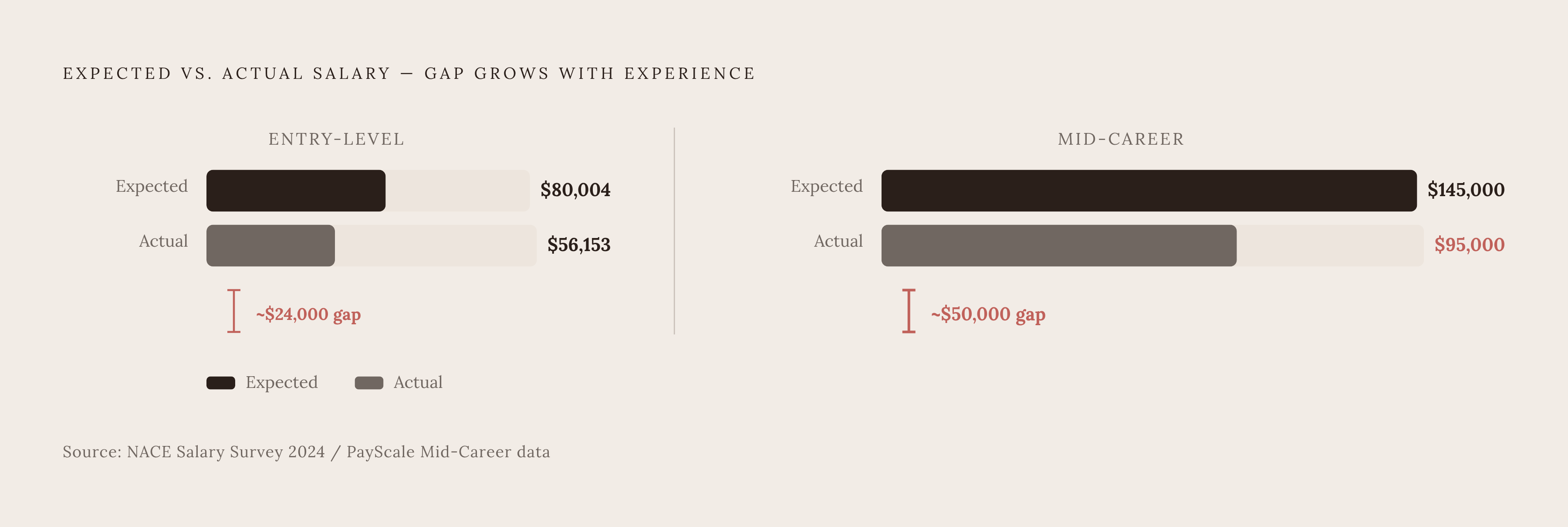
The Class of 2026 expects to earn $80,004 in the first year out of school. A survey conducted over two months in early 2026 put the actual number at $56,153. That gap runs about $24,000, and it isn't a one-year fluke: it appears survey after survey, year after year. Something structural is producing it rather than optimism striking each graduating class at random.
Last year confirms the pattern. The Class of 2025 expected $101,500 and landed closer to $68,400, a similar ratio at different dollar amounts. An older LendEDU study using PayScale data found the same shape years before that: a median expected salary of $60,000 against an actual $48,400. The gap doesn't close as people age into their careers, either. It widens. Mid-career workers project something like $145,000 in earnings; the real mid-career average sits closer to $95,000. Whatever distorts expectations at graduation doesn't correct with experience. It compounds.
Most explanations for this treat it as a mystery. It isn't a mystery: specific, traceable forces produce the gap, and the worst thing a graduate can do is treat the expected number as a starting point for negotiation rather than the fantasy it is. Specific, traceable forces produce the gap, and the worst thing a graduate can do is treat the expected number as a starting point for negotiation rather than the fantasy it is. What follows is an attempt to name those forces one at a time, so the number stops feeling like bad luck and starts looking like the predictable output of a system.
Starting points created by major choice
Start with NACE's Winter Salary Survey, built from 150 employer responses, because it shows how much of the gap gets baked in before anyone sits for an interview.
Computer science graduates average $81,535, up 6.9% from $76,251 the year before. Engineering averages $81,198, up 3.1%, with petroleum engineering at the very top at $100,750. Math and sciences is $74,184, business at $68,873. Education runs $42,000 to $48,000. Fine arts and performing arts average around $48,000. Sociology is $44,000 to $50,000. Social sciences is the only major category actually projected to shrink this cycle, down 1.7% from the prior year.
That's not a rounding difference between fields, and pretending otherwise does graduates no favors. STEM bachelor's graduates out-earn non-STEM graduates by roughly $20,000 to $35,000 in year one, wide enough to change what apartment someone can afford, not just what restaurant they can eat at. The spread inside a single discipline can be just as brutal: petroleum engineering at $100,750 against civil engineering at $64,500 is a $36,000 gap between two students who both, technically, majored in engineering. Most eighteen-year-olds pick a sub-field the way they pick a dorm roommate, based on vibes and scheduling, and that casual decision turns out to be worth more than most of them realize.
Most graduates don't land at the household-name employer anyway. Gusto's payroll data on small and medium-sized businesses puts the Class of 2026 average there at $65,734, up from $62,801 the year before, but still well under the eye-popping numbers that dominate salary discourse. Major sets the floor. Employer size adjusts it. Neither one fully explains why students across every field, not just the underpaid ones, tend to overshoot their own number. For that, the information environment itself needs a closer look.
The information environment that inflates salary expectations before graduation
Survivorship bias does a lot of quiet work here. The roommate with the $95,000 software offer becomes the mental anchor for an entire friend group, while the dozen classmates who landed ordinary offers simply don't come up at dinner. Nobody posts an unremarkable offer letter to a group chat with three fire emojis. Salary coverage in the press follows the same logic: outlets write about the impressive number, not the median one, and a student outside computer science absorbs a CS-level figure as though it applied to everyone.
Social media speeds up the distortion. ZipRecruiter career expert Sam DeMase said: "Social media definitely alters the perception of reality for a lot of these rising and recent grads." Clever's survey backs that up with a number showing 51% of college students believe they deserve an above-average salary because they're smarter than their peers, a statistically odd claim given that average is, by definition, the midpoint. Half a population cannot all be in the top half. Someone should probably mention that at orientation.
Credential inflation muddies the signal further. Employers now ask for a bachelor's degree for roles that, a generation ago, needed only a high school diploma or an associate degree. Wages for those roles haven't caught up to the new credential requirement, so students end up holding a pricier ticket to the same seat. When the degree becomes the goal instead of a byproduct of learning, the market signals that would otherwise correct expectations go quiet.
Geography does its own damage, and it's the one factor students seem to forget applies to them personally. The business average of $68,873 assumes something close to major-metro placement. A nursing degree that clears $110,000 in San Francisco might start around $58,000 in rural Mississippi, and most students building a mental salary model aren't modeling for where they'll actually live. They're modeling for wherever the number they heard came from.
Then there's the ghost of 2021 and 2022, when a tech hiring boom produced unusually generous entry-level offers. Those offers corrected sharply once the boom ended, but the numbers never left the room. They linger in graduation speeches, LinkedIn posts, and the family friend who keeps mentioning what his kid made three years ago. Fixing every one of these information failures still wouldn't close the whole gap, though. Something structural in the market itself is compressing outcomes no matter how carefully a student researched beforehand.
The job market conditions graduates are entering in 2026
The sharpest evidence sits in a single figure from the Federal Reserve Bank of New York: underemployment among recent college graduates hit 42.5% in the fourth quarter of 2025, the highest reading since the pandemic. Unemployment for the same group rose to 5.6%. Many graduates spend that first year doing something their diploma didn't specifically train them for.
ZipRecruiter's numbers sharpen the picture on pay. Among recent grads, large shares reported they couldn't get the salary they wanted and had been forced to lower their lifestyle expectations to match reality. Set against the overconfidence numbers from the last section, that's a rough picture: most students walk in expecting more and walk out with less, and the market doesn't much care which major they picked.
Employers aren't hiding their caution either. NACE's Job Outlook survey found 45% of employers, a plurality, rating the market for new grads as merely "fair," a notably guarded reading. Hiring conditions for the Class of 2026 remain constrained.
Underemployment isn't spread evenly across majors, and some of the names on the list are surprising. Underemployment rates are notably high across a range of majors, including some technical and STEM fields. Computer engineering sitting on that list should give pause. A technical degree was supposed to be the safe bet. Right now, it isn't functioning as one, and anyone still repeating "just major in something technical" as career advice hasn't looked at this list.
This isn't an ordinary cyclical dip, either. NACE's data holds a real paradox: salaries for the jobs that exist are rising even as the number of jobs shrinks. Fewer rungs on the ladder, each one paying a little more to whoever manages to grab it. One specific, traceable factor is accelerating that shrinkage, and it deserves its own section.
How AI is changing entry-level jobs and pay
A Stanford Digital Economy Lab working paper found a 16% relative decline in employment among workers aged 22 to 25 in occupations most exposed to generative AI, measured since the technology's spread. That's a specific age band, in specific job categories, showing a specific drop."
A separate working paper looked at hiring structure directly, analyzing large-scale worker and firm data. Entry-level hiring has contracted at companies adopting generative AI tools, while senior hiring has remained comparatively stable. Whatever AI displaces, it displaces disproportionately at the bottom of the org chart, not the top. So if the bottom rung is the one getting sawed off, what exactly is a new graduate supposed to climb onto?
That produces a split labor market. Roles in AI and machine learning are growing fast, while administrative and routine entry-level roles, the traditional first rung for a new grad, are contracting. Workers who can show actual AI skills are getting paid for the trouble: Research has documented a meaningful wage premium for workers with demonstrated AI skills over colleagues in the same role without them, and that premium has been rising quickly, a rare pace for wage data.
Almost half of new grads believe their own field will have fewer jobs because of AI, so the awareness exists. It just hasn't translated into updated salary expectations, which stay anchored to the older, more generous baseline described in the last two sections. Entry-level postings increasingly ask for judgment and stakeholder-management skills that used to belong to mid-career roles: the rung is still labeled "entry-level," but the bar for standing on it has moved up a few feet, which is a strange kind of promotion nobody applied for.
The causal story isn't fully settled. Some economists argue the entry-level slump started with post-pandemic hiring shifts and interest rate tightening, not AI specifically, and the two explanations are hard to cleanly separate in the data. Some firms are holding or even growing junior hiring, so the effect isn't uniform across every industry. But whichever cause carries more weight, the outcome is measurable: fewer entry-level postings, higher skill demands attached to the ones that remain, and pay compressed at the bottom of the ladder.
How the gap distributes unevenly across gender and race
Averages hide as much as they reveal, and the salary gap splits along lines that have nothing to do with major or graduation year. Entry-level data shows men earning more per year than women at the outset, a gap that appears before either group has had time to accumulate experience, promotions, or negotiating leverage.
The expectations side tells an odder story than it should. NACE found that female graduating seniors expect to earn 16% less than their male counterparts, and their actual outcomes track close to that lower expectation. It's an accurate read of an unfair baseline. It's an accurate read of an unfair baseline, which is a worse problem to have, since it means the women in this data aren't wrong about the market, only about what the market should be. Some of the gap traces back to field sorting: Bankrate research found that 78% of graduates in the twenty highest-paying bachelor's degree programs are men, so the pay gap is partly a pipeline problem showing up well before the first paycheck ever gets cut.
Race adds another layer. Hispanic women report the lowest median salary in the data at $43,880. Asian men and women report higher salary expectations than other groups. Census Bureau data shows Black households facing the widest income disparity relative to white non-Hispanic and Asian households. NACE's findings point past first-job placement, too: inequities in promotion and positioning compound the starting-salary gap over time, so the entry-level number is a floor, not the full account of where the disparity ends up.
What the gap costs early decisions
None of this stays abstract once the bills arrive. A student loan repayment plan built around an expected $80,004 salary doesn't bend gracefully to an actual $56,153. The math doesn't fail eventually. It fails on the first payment. Lifestyle choices, an apartment, a savings rate, a retirement contribution, get set against the expected number and then yanked downward under time pressure, which tends to produce worse outcomes than planning against the realistic number from day one. The mid-career gap, roughly $145,000 expected against something closer to $95,000 actual, suggests this correction doesn't happen on its own. Graduates who don't update the mental model early seem to carry the distortion forward for years, sometimes decades.
Knowing the real number changes what's possible in a few concrete ways. Budgeting against $56,153 in a specific city, rather than against a number pulled from a friend's LinkedIn post, means fewer surprises about what rent actually eats. Negotiating from an accurate range for the actual major and actual region beats anchoring to an inflated figure a recruiter was never going to match; a negotiation built on the wrong baseline just wastes everyone's time and makes the candidate look like they skipped the homework. Choosing a sub-specialty with the $36,000 gap between petroleum and civil engineering in mind, or weighing a large employer against a small business's $65,734 average, are decisions that compound for a decade, not a single paycheck. And the AI wage premium, documented at 56% for workers with demonstrated skills, offers about as clear a countermove as the current data supports: a specific, quantified path through a market that's otherwise stacking the deck against entry-level workers.
None of this traces back to overconfidence as some kind of personality flaw. The gap comes from survivorship bias, media amplification, an anchoring effect left over from the 2021 tech boom, credential inflation that isn't matched by wage growth, a geographic blind spot in how students picture their own future paycheck, and a labor market genuinely reshaping itself under AI adoption. Each force has a fairly specific countermove, and the countermove starts with the actual number, not the number someone expected to see.
Some of the recalibration is just administrative: check the NACE figures for the actual major, adjust for the actual city, budget against the actual offer instead of the offer imagined months earlier. But some of it sits closer to a private reckoning between what the plan was supposed to look like and what actually happened, and no spreadsheet fully holds that. Talking through the gap out loud, on a regular basis, tends to reveal where assumptions went stale faster than staring at a budgeting app ever does. None of this fixes the labor market. It's a way of noticing, early, when the plan and the paycheck have quietly stopped agreeing with each other.
Sources
- Salaries Expected to Climb for Class of 2026 Grads Despite Flat Hiring
- Expectations vs. Reality: Early Career Salaries
- College Students Overestimate Starting Salaries by Nearly $25,000 | Clever Real Estate
- Class of 2026 Starting Salaries: What the Data Shows
- cnbc.com
- en.koreadaily.com
- Average Starting Salary by College Major 2026 (NACE ~$68.5K)
- businesswire.com