Why the Five Stages of Grief Model Is Misleading
Longitudinal research shows grief doesn't follow the five predicted stages.
The five stages of grief model is misleading because it was developed without evidence about bereaved people. Its original subject was dying, and subsequent research has not established its promised sequence in bereavement. Understanding that mismatch offers a practical release from a false standard. People whose grief does not follow the stages are not failing a test.
Where the five stages model actually came from
A corporate “change curve” slide is a useful measure of how far the model has travelled. A framework now used to explain organisational change began with terminally ill patients confronting their own deaths. Elisabeth Kübler-Ross introduced it in her 1969 book On Death and Dying, drawing on interviews with those patients. The five stages, namely denial, anger, bargaining, depression and acceptance, were observations made without testing a hypothesis against a bereaved sample.
That distinction matters because facing death and mourning someone who has died are not interchangeable research populations. Avis, Stroebe and Schut (2021) note that Kübler-Ross extended the stages to anticipatorily bereaved family members in one chapter, but that extension was not independently tested. Kübler-Ross and Kessler turned explicit attention to bereavement in their 2005 book On Grief and Grieving, more than three decades later. Kessler subsequently added a sixth stage, meaning, in a book of his own.
How the model spread far beyond what its evidence could support
The model acquired authority through repetition across institutions. It became a backbone of grief counselling curricula, palliative care training and corporate change-management frameworks, with each domain treating it as established science. Repeated exposure made the stages familiar, while their institutional setting made them appear validated. A memorable diagram can travel much faster than the qualifications attached to it.
Online resources brought the model to people seeking help in acute grief. Avis, Stroebe and Schut (2021) found that definitive, uncritical presentations online could leave readers with the impression that the stages were the only way to grieve. Joseph and Monkman (2025) found it still being applied in healthcare technology implementation and design, recast as non-linear heuristics. That reframing preserves the vocabulary while dropping the sequence that made it a stage model. It helps explain institutional persistence, but it is not new evidence for the original claim.
What the lay public believes the model predicts, versus what researchers actually think
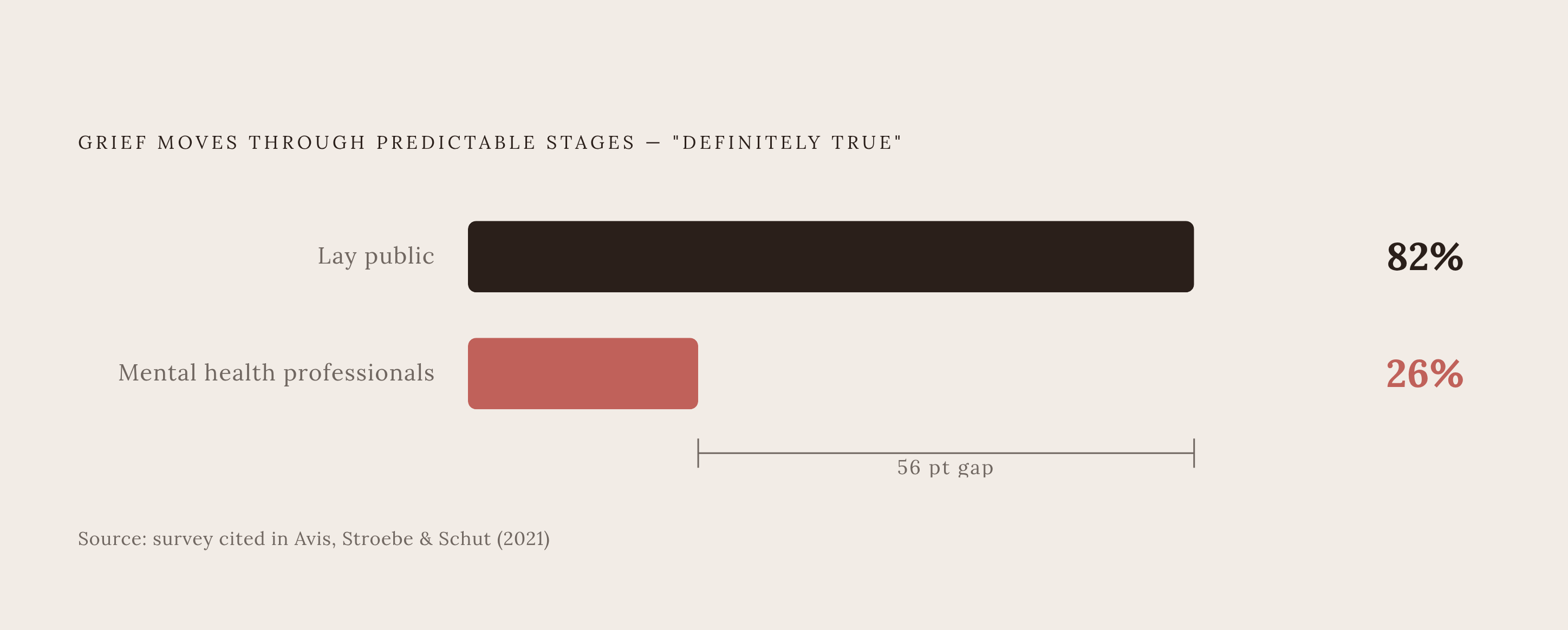
A survey cited by Avis, Stroebe and Schut (2021) asked whether grief could be expected to move through predictable stages, beginning with denial and ending with acceptance. A substantial share of the public regarded that claim as definitely true, compared with a much smaller share of mental health professionals. The gap suggests that professional qualifications have not displaced the popular script.
That script matters because people may use it to interpret their own distress. Describing the model more loosely as a set of common emotions does not establish that readers understand it that way. Nor does it answer the central empirical question, which is whether grief responses actually unfold in the proposed order. To answer that, researchers need to follow bereaved people over time rather than infer a sequence from a collection of emotional descriptions.
What longitudinal research found when it tested the stage sequence directly
A longitudinal study published in a medical journal followed bereaved individuals from a community sample in Connecticut over 24 months after loss. It measured disbelief, yearning, anger, depression and acceptance at multiple points. Acceptance was present and endorsed early in bereavement.
That finding undercuts the idea that acceptance is a final emotional achievement reached after the other responses have run their course. Acceptance can be part of grief while grief is still taking place. Calling it a terminal stage therefore misrepresents the timing of the experience it names. The study’s measured responses also did not simply reproduce the original five labels, an important limit when treating it as a direct test of the whole model.
Critics also question why the model puts grief in a fixed order, claims to fit everyone and gives so little weight to culture. Those objections matter, but the early presence of acceptance is the clearest contradiction here.
How the model's misapplication has caused documented harm
Avis, Stroebe and Schut (2021) warn that inaccurate portrayals can make bereaved people feel they are grieving incorrectly and can lead to ineffectual support from loved ones and healthcare professionals. Their analysis of online portrayals also identifies the risk of alienating people who do not recognise themselves in the stages. A prescribed pattern makes other patterns look wrong.
Clinical psychologist Lisa Burke describes the consequence of treating the stages as a road map. People feel distressed when their grief does not follow the route they have been told to expect. Burke reports that acceptance is especially troublesome when clients understand it as a “state of higher being” they have failed to reach. A person who feels accepting early, or does not feel angry on schedule, can then interpret that difference as evidence of a problem. The framework generates this false standard even when those offering it intend to help.
What bereavement research actually shows about grief trajectories
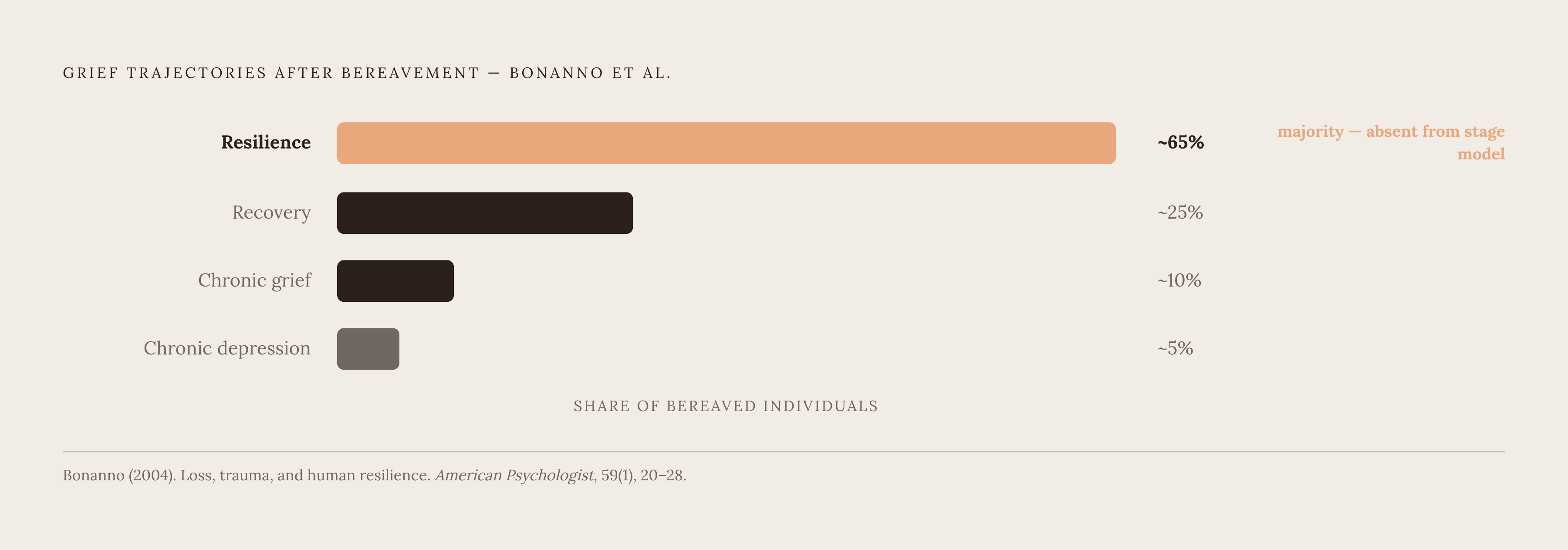
Columbia University psychologist George Bonanno’s longitudinal research found across multiple studies that resilience was the most common grief trajectory. Characterised by minimal functional disruption, it appeared in the majority of bereaved individuals. This is more than an exception to a rule about emotional upheaval. It means the most common pattern is one the stage model does not adequately represent.
Bonanno identified four primary trajectories, which are resilience, recovery, chronic grief and chronic depression. Chronic grief involved prolonged and severe disruption, but affected only a minority.
Resilient grievers can process grief without becoming incapacitated. The trajectory research gives no grounds for assuming that people who keep functioning are hiding distress. The positive alternative is not to deny suffering, but to recognise that suffering and functional collapse are not the same thing.
Two frameworks that fit the evidence the stage model ignores
Trajectory research describes how people fare over time, while process models address how they live with loss. Stroebe and Schut’s Dual Process Model (1999) proposes oscillation between loss-oriented and restoration-oriented coping. Loss-oriented coping deals with the death and the feelings it brings, while restoration-oriented coping deals with the changes people must make in daily life. Movement between the two is part of healthy grieving. Fixation on the loss, or persistent avoidance of emotional work, can increase the risk of Prolonged Grief Disorder.
Lisa Burke introduces this model to clients because it presents grief as an active process in which they participate. Continuing Bonds Theory, developed by Klass, Silverman and Nickman (1996), addresses another part of that process. It challenges the assumption that healthy grieving requires “letting go” of the deceased. Emotional or symbolic connections through rituals, dreams, visiting graves and internal dialogue can instead be adaptive. Chris Hall of Grief Australia describes practitioners moving towards this understanding as a shift from a relationship of physical presence to a relationship of memory.
What neuroscience shows about what grief is actually doing in the brain
Structural MRI studies have reported reductions in hippocampal, amygdala and supramarginal gyrus volumes in grieving individuals, together with disruptions in networks involved in emotion regulation, reward processing and cognitive control. These findings describe changes across interacting systems. They do not establish five discrete emotional phases or a neural sequence leading from denial to acceptance.
Research on Prolonged Grief Disorder shows more clearly how attachment and reward are linked. Its neurobiology is distinguished from depression and PTSD by disturbances in appetitive processes and regions involved in reward processing alongside fear circuitry. In this context, appetitive processes concern seeking and wanting, which helps explain why the disruption of a bond matters to the account. The biological picture is therefore more consistent with disrupted attachment and reward than with a fixed procession of emotions. That supports the relevance of continuing bonds without turning a brain finding into proof of an entire psychological theory. It also keeps the claim proportionate, since the neural mechanisms of grief remain incompletely understood.
Why the stage model's universalism fails across cultures, and why newer diagnostics risk the same error
The first interviews were held in mid-20th-century American hospitals. Their emotional vocabulary and clinical conventions belonged to that setting, but the model came to present them as a universal human script. Chris Hall notes that the five stages do not account for cultural and social differences in grieving. Beyond the order of the stages, the model assumes that one population can supply the standard for everyone.
Newer ways of diagnosing grief risk making the same mistake even without stages. Prolonged Grief Disorder was added to the DSM-5-TR in 2022, with a duration threshold of more than a year in its framing of pathological grief. Moore, da Silva, and Farias (2025) identified three cultural challenges to the diagnosis, namely duration of mourning, intensity of emotions and anomalous cognitions. They called for culturally sensitive approaches because these dimensions do not have the same meaning everywhere. Mourning rituals may extend well beyond a year, while communing with ancestors may be a normal form of cognition.
Duration alone cannot resolve those differences. A universal timeline risks classifying culturally ordinary mourning as pathological when the practice differs from the diagnostic framework’s source population.
The strongest defence of the model and why it does not rehabilitate it
The strongest defence is that the model gave people words for experiences that were difficult to discuss. Avis, Stroebe and Schut (2021) acknowledge that proponents and opponents alike credit Kübler-Ross with bringing death and dying into the open. Chris Hall describes her public conversations with dying people as something that “was kind of unheard of”. That historical contribution deserves recognition.
Being able to name anger can help, but that does not prove it must come between denial and bargaining. Being grateful for the original work is no reason to prescribe its sequence to people grieving today. Avis, Stroebe and Schut (2021) recommend presenting the model for its historical significance, with critical appraisal and contemporary alternatives that better represent grief processes.
What grieving people can take from this instead
The practical conclusion is that there is no correct stage to occupy and no deadline by which acceptance must arrive. A day spent managing practical life need not be denial, just as a day dominated by loss need not be regression. The Dual Process Model allows for that movement without judging each change as a sign of how well someone is doing.
Continuing bonds also allows people to keep a relationship through memory, rituals or internal dialogue. Bonanno’s resilience research also makes clear that grief need not become incapacitating to be genuine. People who remain able to function do not need to become more upset to make their loss count. Grief models are best treated as guides rather than checklists, taking what fits and leaving what does not. When a person’s grief refuses to follow the five-stage prescription, the failure belongs to the framework.