Quarter-Life Crisis as a Clinical Construct
Research links the quarter-life crisis to measurable clinical distress and developmental stages.

The quarter-life crisis has no entry in the DSM-5-TR. It also, according to a growing body of developmental psychology research, has a measurable prevalence, a describable structure, and a strong statistical link to clinical anxiety and depression. Clinical psychologist Alex Fowke defines it plainly, as "a period of insecurity, doubt and disappointment surrounding your career, relationships and financial situation," and that gap between diagnostic absence and empirical weight is the whole story here. This piece walks through how the concept got built, what it actually looks like from the inside, and why the timing of a crisis in your mid-twenties to mid-thirties is not some cultural accident but is produced by real developmental scaffolding, as the pattern itself demonstrates.
How the concept arrived in psychology: from Erikson's eight dilemmas to a standalone developmental stage
Erik Erikson never used the phrase "quarter-life crisis." What he did, in 1968, was map out eight stages of psychosocial development, and two of them sit right where this story starts. Stage 5, "Identity vs. Role Confusion," covers adolescence and the scramble to figure out who you are. Stage 6, "Intimacy vs. Isolation," takes over from there and stretches across young adulthood, roughly ages 18 to 40, which is a wide enough net that it can catch almost anything and therefore explains almost nothing specific.
Erikson's real insight, though, holds up: people who'd spent their whole lives inside structured systems (school, semesters, grades, clear finish lines) suddenly found themselves unmoored once that structure disappeared. No more syllabus for your life. That observation is the seed of everything that follows, even though Erikson himself never drew a box around the twenties specifically.
Alexandra Robbins and Abby Wilner picked up that thread in 2001 with Quarterlife Crisis: The Unique Challenges of Life in Your Twenties, drawing on interviews with young adults. Their framing mattered as much as their data: this wasn't personal failure, it was a normative response to economic pressure and shifting social scripts, modeled explicitly after the "midlife crisis," a term psychoanalyst Elliott Jaques coined back in 1965. If forty-somethings could have a socially sanctioned crisis, why not twenty-somethings?
Jeffrey Arnett then supplied the theoretical container: "emerging adulthood," a distinct developmental stage between eighteen and twenty-five defined by identity exploration before the concrete commitments of adult life set in. Arnett went further and pointed to the brain itself, noting that prefrontal cortex development extending into the late twenties gave this instability a biological basis, not just a sociological one. Erikson's model left a hole in the middle of early adulthood. It took decades, and one researcher in particular, to fill it with actual data.
Oliver Robinson's four-phase model: what a quarter-life crisis actually looks like from the inside
Oliver Robinson, at Regent's University London, made the case that Erikson's scheme needed an update: a normative crisis becomes visible in the middle of early adulthood, somewhere around ages 25 to 35, and the original eight-stage model simply had no slot for it. Robinson's proposed fix swaps out Erikson's intimacy-versus-isolation tension for something more specific to this life stage: commitment versus independence.
Two flavors of crisis emerge from that tension. There's the "locked-out" version, where someone feels shut out of the adult roles they actually want, meaningful work, a stable relationship, financial independence. Then there's "locked-in," which is almost the mirror image: you got the job, the relationship, the apartment, and now you're trapped inside a life you no longer want but already built.
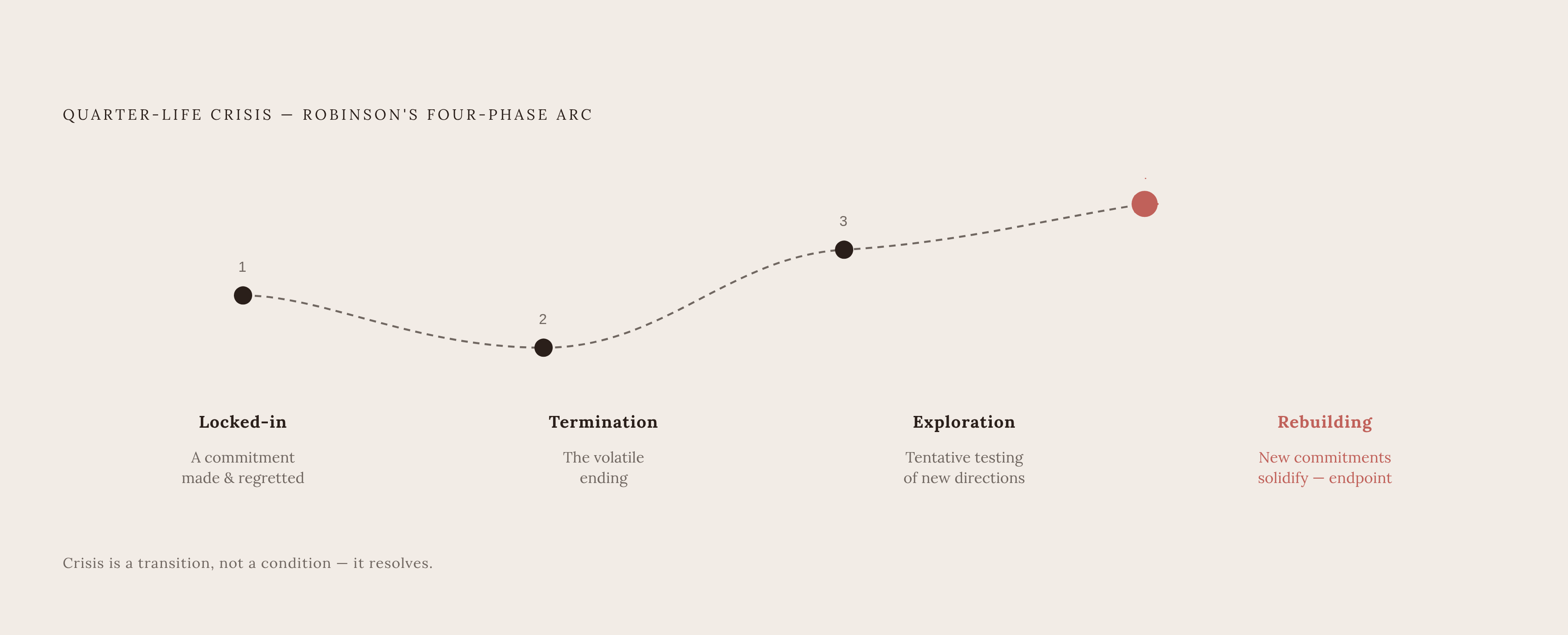
Drawing on 50 interviews with people aged 25 to 35, Robinson built a four-phase model that plays out however the crisis started. Phase one is that locked-in moment, a commitment made and now regretted. The next phase is the messy, emotionally volatile stretch where that commitment actually gets terminated (quitting the job, ending the relationship, whatever form it takes). From there comes a period of exploration, tentative and often clumsy, testing out new directions without full commitment to any of them yet. The final phase is rebuilding, where a coherent identity and a new set of commitments start to solidify.
Each of those four phases, per Robinson, operates across four separate levels at once: how someone relates to their environment, how they understand their identity, what motivates them, and how they process emotion and cognition. That's a lot of moving parts. But the clinical payoff is simple: the crisis has an arc. It is not a permanent condition or a personality flaw, it's a transition with a recognizable shape, which means it can be navigated rather than just endured.
What recent measurement studies say about how real and how common this is
Numbers help settle the "is this even real" question, and recent studies have started supplying them. A 2026 study published in Discover Psychology (Springer Nature) found a strong association between quarter-life crisis features and the PHQ-4, a standard screening tool for depression and anxiety, with a correlation of.673. People with elevated crisis features were 5.7 times more likely to also screen positive for depression and anxiety. Of the study's participants, 45.6% exceeded the pre-set cutoff on the QLCI-5 measurement scale, and the single most common symptom, reported by 68.9% of respondents, was the felt pressure to choose the "right" direction in life. The authors were direct about what this means: the finding, they wrote, "contrasts with views that have framed QLC as a fashionable label without clinical relevance."
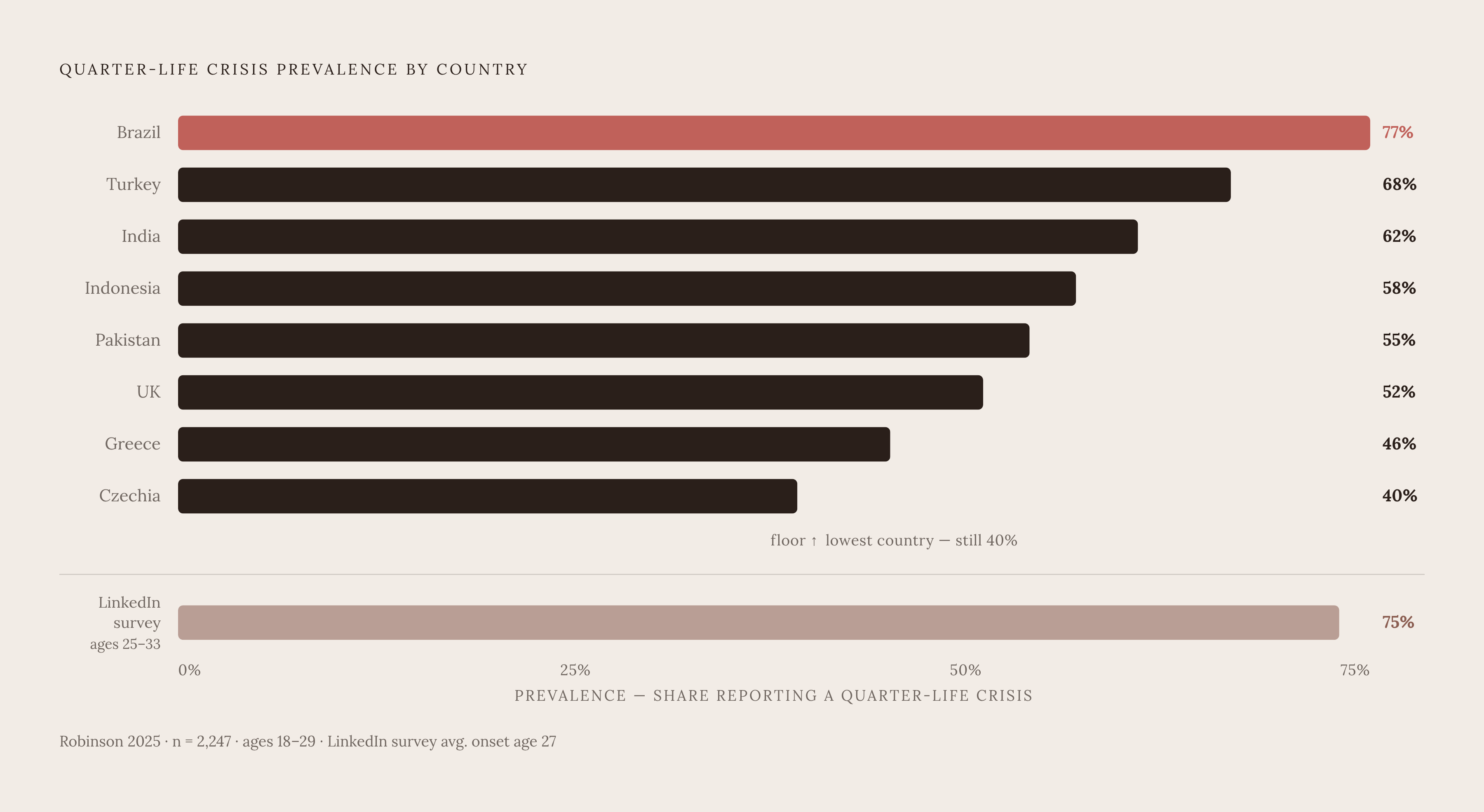
A separate 2025 cross-cultural study led by Robinson and published in Emerging Adulthood surveyed 2,247 participants aged 18 to 29 across eight countries: the UK, Greece, Czechia, Turkey, India, Pakistan, Indonesia, and Brazil. Prevalence ranged from 40% to 77% depending on the country, which is a wide spread, sure, but notice what doesn't happen anywhere in that range: the crisis never drops to "rare." A widely cited LinkedIn survey backs this up from another angle, with 75% of participants aged 25 to 33 across multiple countries reporting they'd experienced a quarter-life crisis, with an average onset age of 27.
Put those together and a pattern holds across very different economies, cultures, and survey designs: this is not a lifestyle complaint invented by bored people in wealthy countries with too much time spent connected online. It's a measurable phenomenon, closely coupled to clinically significant distress, that appears wherever researchers have thought to look for it.
The brain during emerging adulthood: why the timing of this crisis is not arbitrary
Why does this cluster of crises land specifically in the mid-twenties to mid-thirties, rather than, say, at 19 or at 45? Part of the answer is neurological, not psychological. The prefrontal cortex, the region handling decision-making and long-term planning, doesn't finish maturing until somewhere in the mid-to-late twenties, according to NIMH's public health communications and longitudinal research from scientists including Jay Giedd.
Giedd's work tracked significant prefrontal changes continuing well into a person's twenties, which creates an awkward sequencing problem. Careers get chosen, partners get committed to, cities get moved to, all while the brain hardware best suited for weighing complex, long-term tradeoffs is still under construction. So it's not exactly surprising that people arrive at 28 or 30, brain development largely complete, and look back at decisions made at 22 with a kind of dissonance. That's Robinson's "locked-in" pattern again, appearing right where the neuroscience would predict it.
There's a feedback loop layered on top of this, too. The overlap between anxiety and decision-making creates a feedback loop of its own: worry about big choices can itself make those choices harder to think through clearly. Worry about choosing wrong makes choosing correctly harder, which produces more worry. None of this pathologizes the crisis. It just means the twenties ask people to make some of life's biggest bets before the machinery for making bets is fully online.
What actually drives the crisis: the internal factors that get less attention than the external ones
Money and job security get most of the blame in casual conversation about the quarter-life crisis, and they're not wrong to. But a 2024 systematic review in Psychology Research and Behaviour Management, led by Hasyim, Setyowibowo, and Purba at Universitas Padjadjaran, pulled together 14 peer-reviewed studies across multiple countries and found the internal drivers matter just as much, if not more.
External pressures appeared exactly where you'd expect: financial strain, weak social support, relationship trouble, and the pressure to hit culturally prescribed milestones on schedule. That pressure runs hotter in collectivist cultures, where family expectations and social scrutiny intensify the whole experience. But the review also identified internal factors carrying equal weight. A sense of being constrained by obligations and life tasks was one. A search for meaning and spirituality was another, with meaning-making and spirituality appearing as relevant moderating factors. Anxiety about the future also emerged as a significant internal driver of crisis severity.
Writing in Psychology Today in April 2026, clinical observer Mark Shelvock noted that people in the grip of this crisis rarely walk in and announce "I have a meaning problem." Instead they describe a restless unease, a sense of "living someone else's life," which is really the surface expression of a deeper question: is this actually one's own life, and has it been lived on purpose? Identity confusion, in other words, isn't just a symptom of hard circumstances. It's its own animal, and it tends to intensify precisely when external pressure leaves no room for the self-examination that might resolve it.
There's a buffering effect too. A study of 352 emerging adults in Karawang found that self-efficacy and resilience together accounted for 26% of the variance in crisis severity, with self-efficacy alone responsible for 23.89% of that and resilience contributing another 2.52%. That's a meaningful chunk of the picture explained by internal traits rather than external circumstance. And it points toward something practical: circumstances (a bad job, a broke bank account) can improve on their own or with direct action. Identity confusion asks for a different kind of work entirely, the kind that involves slowing down and getting honest, not just getting a raise.
How macroeconomic conditions in the 2020s have amplified the crisis beyond what earlier cohorts faced
Something structural shifted in the 2020s, and it shows up clearly in a 2025 NBER working paper from one economist (Dartmouth and University of Glasgow) and a co-author at UCL. For decades, despair followed a hump shape across the lifespan, low in youth, peaking in midlife, easing again in old age. That pattern has reversed. Young people now report more despair than midlife or older cohorts, and Blanchflower and Bryson describe this as the "disappearance" of the traditional midlife crisis, with the quarter-life crisis effectively taking over as the dominant despair cohort.
What's driving it isn't falling wages, oddly enough. Wage levels alone do not tell the whole story. The pressure instead comes from the rising relative cost of housing, healthcare, and student debt, compounded by worsening physical health, more social isolation, and rising obesity rates among younger cohorts. Add to that a 2025 labor market that's been described as "low-hire, low-fire": companies aren't laying off in droves, but they've also mostly stopped hiring, with entry-level job postings down 29% since January 2024. That LinkedIn survey mentioned earlier found 61% of respondents named finding a job or career they're passionate about as their primary source of anxiety, which makes sense in a market where even finding a job, passion aside, has gotten harder.
The stakes here extend well past someone's twenties, too. Separate NBER research on "recession scarring" found that people who enter the labor market during a downturn carry the damage for decades: lower lifetime earnings, higher disability rates, fewer marriages, and higher mortality risk in midlife. So a rough start at 24 isn't just a rough year, it's a data point that can echo for thirty more years.
The mental health numbers track right alongside the economic ones. Johns Hopkins' CLIMB study, published in Health Affairs Scholar in September 2025, found young adults aged 18 to 29 reported crisis prevalence of 15.1%, compared to just 2.6% among adults over 60. And a federal agency's 2024 survey on substance use and mental health, released in July 2025, found 15.9% of 18-to-25-year-olds had experienced a major depressive episode in the past year, nearly double the rate for adults overall.
How social media turns the developmental pressure of the twenties into a continuous comparison loop
Every generation compares its actual life against its own hopes for that life. Ambition has always worked this way, indifferent rather than cruel. What's new for the current cohort is a second axis of comparison layered on top: a curated, always-on feed of what everyone else's twenties supposedly look like. Earlier generations measured themselves against an internal yardstick. This one measures against a highlight reel, refreshed continuously, that never shows the boring Tuesday afternoons.
A 2020 study by Agarwal and colleagues, published in Frontiers in Psychology, analyzed the actual language people use online when posting about a quarter-life crisis, and found it clusters around the future, mixed emotions, feeling stuck, wanting change, and specific anchors like career, illness, school, and family. That's not vague malaise, it's a fairly consistent linguistic fingerprint appearing across a lot of different posts.
There's also a particular flavor of anxiety about missing out tangled up with age itself for this generation: social media has helped cement the idea that getting older forecloses possibility, rather than simply changing its shape. That turns the twenties into a narrowing window instead of an open field, which is a strange thing to do to what's supposed to be the most exploratory decade of adult life. And the sheer volume of exposure has no real historical precedent. A May 2025 PartnerCentric survey of 994 Americans found Gen Z spending an average of three hours a day on TikTok and over two hours on Instagram, a level of daily comparison input no prior cohort had access to at this age.
There are early signs of pushback, though, before this section turns into a doom loop of its own. A 2025 Deloitte consumer trends survey of more than 4,000 people in the UK found nearly a third of Gen Z respondents had deleted a social media app in the previous twelve months. That's not nothing. It suggests a generation starting to actively manage its own exposure rather than simply absorbing it as background radiation.
What "not a diagnosis" actually means for someone who recognizes themselves in this research
So where does all of this leave someone who reads through Robinson's phases, or the LinkedIn numbers, or Shelvock's description of "living someone else's life," and recognizes something of themselves in it? The absence of a DSM code doesn't mean the experience is imaginary, or self-indulgent, or too minor to take seriously. An odds ratio of 5.7 for co-occurring depression and anxiety, as the 2026 Discover Psychology data showed, makes that dismissal hard to defend with a straight face.
What the research actually offers instead is something more useful than a diagnostic label: a recognizable pattern with a known shape (Robinson's four phases), a set of identified drivers that go well beyond just economics (identity confusion, the search for meaning, future-oriented anxiety), and evidence that this thing resolves. It has an arc. People move through it into something more stable on the other side, more often than not.
One might argue the most practical distinction in all of this is between circumstance and identity. Circumstances change on their own, or respond to direct action: a new job offer arrives, a lease ends, a relationship gets renegotiated or ends. Identity confusion doesn't respond to that kind of leverage. It asks for something slower: honest self-examination, and permission to not have the answer yet. The 2024 systematic review found that people with a coherent framework for what matters to them navigate this period with noticeably more stability, not because their circumstances happened to be easier, but because they had something internal to hold onto while the circumstances sorted themselves out.
Journaling appears in the research as one of the more accessible tools for doing that internal work, specifically the practice of speaking or writing through the questions the crisis tends to raise: who a person is outside the roles they've been handed, and what they actually want, apart from what they're supposed to want. Getting those questions out of your head and onto a page, or into a voice memo, externalizes them just enough that they become something to examine rather than something to just keep circling in the dark. Voice journaling in particular fits how this age group actually operates, low-friction, on the go, squeezed in between everything else. None of it treats the quarter-life crisis as a problem to cure. It treats it as a signal, one that tends to resolve into real clarity when someone actually stops to listen to it instead of scrolling past.
Sources
- Factors Contributing to Quarter Life Crisis on Early Adulthood: A Systematic Literature Review - PubMed
- Predicting Quarter-Life Crisis in Emerging Adulthood through Self-Efficacy and Resilience | Philanthropy: Journal of Psychology
- Quarter-life Crisis Episodes in Emerging Adulthood: A Mixed-Methods Analysis of Data From Eight Countries - Oliver C. Robinson, Nikolay Petrov, Georgios Vleioras, Figen Çok, H. Kübra Özdoğan, Zehra Yeler, Kübra Berber, Katarina Millova, Saba Sajjad, Luciana Dutra-Thomé, Maria Nugraheni Mardi Rahayu, Afinnisa Rasyida, Nindya Putri Aprodita, Shefali Mishra, Payal Sharma, Akancha Srivastava, Irini Dermitzaki, Anastasia Spyrou, Emmanouela Mante, Ume Laila, Amy Fisher, 2025
- Prevalence, predictors, and psychosocial correlates of the quarter-life crisis in early adulthood | Discover Psychology | Springer Nature Link
- academia.edu
- tandfonline.com
- academia.edu
- A Longitudinal Mixed-Methods Case Study of Quarter-Life Crisis During the Post-university Transition: Locked-Out and Locked-In Forms in Combination - Oliver C. Robinson, 2019